Wrong piping choices lead to corrosion-driven contamination, pressure drops across long runs, expensive retrofits, and in some cases, OSHA violations. PVC in compressed air lines isn't just a bad idea — it's prohibited.
This guide breaks down the five main compressed air piping materials, the factors that separate a smart choice from a costly one, and how to match material selection to your pressure requirements, air quality standards, and facility layout.
Key Takeaways
- Piping material directly determines air quality, pressure consistency, and system longevity — not just installation cost
- Common options include black iron, galvanized steel, stainless steel, copper, aluminum, and select approved plastics (ABS, HDPE)
- PVC and CPVC are OSHA-prohibited for compressed air — no exceptions
- Aluminum is the leading choice for new industrial installations; stainless steel suits oil-free and regulated environments
- Factor in total cost of ownership: leaks, corrosion, and pressure losses can far exceed upfront savings
What Is a Compressed Air Piping System?
A compressed air piping system is the network of pipes, fittings, valves, and connectors that transports compressed air from the compressor — through treatment equipment like dryers and filters — to every downstream point of use across a facility. Everything downstream depends on it performing reliably.
Three Baseline Performance Requirements
Every system must meet these operational standards:
- Minimize pressure drop — According to the DOE/Compressed Air Challenge Sourcebook, main distribution lines should be sized for no more than 1% to 2% maximum pressure drop, with total system loss well under 10% from compressor discharge to point of use
- Eliminate leakage — Leaks typically waste 20% to 30% of compressor output; proactive programs can reduce this below 5–10%
- Manage condensate — Without proper drainage or a functioning dryer, condensate accelerates internal corrosion and contaminates downstream equipment
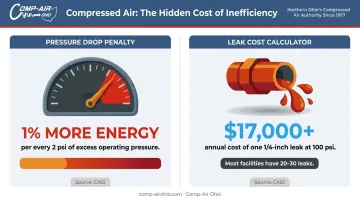
These aren't aspirational targets. According to CAGI, every 2 psi of excess operating pressure increases compressor power consumption by approximately 1%. A single quarter-inch leak at 100 psi costs over $17,000 per year in wasted energy at $0.10/kWh. Compensating for poor piping by simply cranking up pressure only compounds those costs.
The pipe material you choose directly determines whether your system meets — or misses — these benchmarks.
Types of Compressed Air Pipe Materials Explained
Today's facilities have five principal material categories to evaluate. Each fits different performance needs, budgets, and regulatory environments.
Black Iron and Galvanized Steel Pipe
Black iron was the standard for decades. It's strong, widely understood by technicians, and available with standard fittings everywhere. The problem is what happens inside the pipe over time.
When condensate is present (and it always is without proper treatment) black iron corrodes from the inside out. Rust particulates enter the air stream, damage pneumatic equipment, and progressively restrict flow. A 30-foot rusted steel drop of 1-inch diameter can create 2.4 to 5 psi of pressure drop compared to just 1.02 psi for aluminum.
Galvanized steel was supposed to fix the corrosion problem. It doesn't fully deliver. The zinc coating degrades, producing flakes that contaminate the air stream and clog downstream equipment. Many pipes are only galvanized on the exterior, leaving the interior still vulnerable to moisture attack.
Both materials also require skilled pipefitters for cutting, threading, and welding, making future modifications slow and expensive.
Stainless Steel Pipe
Stainless steel (typically SS304L or SS316L) eliminates corrosion risk on both interior and exterior surfaces. It's the top recommendation for:
- Oil-free compressor installations
- Pharmaceutical and laboratory environments
- Healthcare facilities and cleanrooms
- Any application where ISO 8573-1 air purity classes are strictly enforced
Historically, stainless required welding, which made installation expensive. Modern pressed and Victaulic-style systems have changed that significantly — Victaulic Vic-Press fittings for Schedule 10S stainless are rated from full vacuum to 500 psi and cover a -30°F to +300°F operating range, making installation faster and more accessible than it used to be.
For healthcare applications, NFPA 99 specifically permits ASTM A269 TP304L and TP316L stainless steel tube for field-installed medical-surgical vacuum piping systems.
Copper Pipe
Copper has a long track record in both plumbing and compressed air. It's corrosion-free, lightweight, and carries a natural antimicrobial property. Copper alloys registered with the EPA kill over 99.9% of certain bacteria within two hours of contact, which explains its preferred status in medical and dental compressed air systems.
NFPA 99 requires hard-drawn seamless copper tube (ASTM B819) for positive-pressure medical gas systems. Type K hard copper handles impressive pressures — up to 585 psi at 100°F for 1-inch diameter pipe.
The practical limitations: copper prices have risen considerably, soldering and brazing require skilled labor, and its higher thermal expansion coefficient means larger installations need expansion joints or offset bends to accommodate movement.
Copper makes the most sense at smaller diameters and in specialized medical or dental applications rather than large-scale industrial distribution.
Aluminum Pipe
Aluminum has become the preferred material for new and upgraded industrial compressed air installations.
Key advantages over steel alternatives:
- Approximately three times lighter than iron — faster to handle and install
- Fully corrosion-resistant — no rust, no scale, no contamination from the pipe itself
- Smooth interior surface — lower friction-generated pressure loss compared to corroded steel
- No welding, threading, or hot work permits required for modular systems
- Modifiable in-house — expand or reconfigure the layout without shutting down operations or calling in subcontractors
Plant Engineering notes aluminum piping can deliver labor savings of up to 50% because it arrives ready to install without threading or soldering.
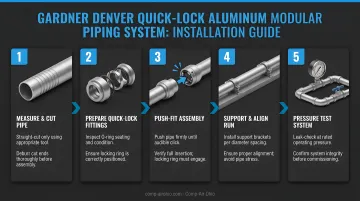
Comp-Air Ohio carries both the Gardner Denver Quick-Lock and Big-Lock aluminum piping systems for Northern Ohio customers. The Quick-Lock system covers ½" to 2½" (14–63 mm) with push-to-connect fittings; the Big-Lock handles larger applications from 2½" to 10" (70–273 mm) with clamp-to-connect fittings. Both are rated at 300 PSI and 300°F across all fittings, are manufactured from marine-grade aluminum, and carry a lifetime warranty on all piping and fittings.
Plastic Pipe: What's Allowed and What Isn't
PVC and CPVC are prohibited for compressed air applications. This is not a gray area.
OSHA's 1991 interpretation explicitly states that PVC pipe used above ground for compressed air violates the General Duty Clause. A 2018 OSHA citation directly names both PVC and CPVC as prohibited due to the struck-by hazard from flying fragments. The injury history behind this prohibition is serious — documented incidents include pipe explosions throwing fragments 60 feet and causing facial fractures.
PVC fails in compressed air applications because it can't handle high pressure, degrades on contact with compressor oils, and shatters catastrophically rather than deflating gradually.
OSHA-approved plastic options include ABS, PE, and HDPE. IPEX Duraplus ABS is rated at 185 psi at 73°F; PE/AL/PE thermoplastic systems reach 200 psi at 73°F with derating at higher temperatures. These materials work well for small workshop tool distribution but carry temperature limitations (typically up to 140°F) that make them unsuitable near compressor discharge points.
Key Factors for Choosing the Right Compressed Air Pipe
The right material is never determined by price alone. Selection requires connecting technical specifications to operational priorities, regulatory obligations, and total lifecycle cost.
Operating Pressure and Temperature
Every piping material has rated limits for both pressure and temperature — and your system must handle worst-case scenarios, not just normal operating conditions.
Consider: oil-injected rotary screw compressors can produce discharge air around 200°F; oil-free rotary screw units can reach 350°F. Aftercoolers bring temperatures down to within 5–20°F of ambient, but if an aftercooler fails, that hot air hits your distribution piping. Thermoplastics rated to 140°F won't survive that scenario anywhere near the discharge point.
| Material | Pressure Rating | Temperature Range |
|---|---|---|
| Aluminum (Gardner Denver) | 300 psi | -4°F to 300°F |
| Stainless (Victaulic Vic-Press) | Up to 500 psi | -30°F to 300°F |
| Copper Type K hard (1") | 585 psi at 100°F | Degrades above 200°F |
| ABS (IPEX Duraplus) | 185 psi at 73°F | Limited to ~73°F rating |
| PE/AL/PE (IPEX Duratec) | 200 psi at 73°F / 160 psi at 140°F | Min -40°F |
Corrosion Resistance and Air Quality Requirements
Compressed air condensate forms an abrasive, often acidic sludge that corrodes pipework without proper air treatment. The material you choose determines how aggressively that condensate attacks your distribution system from the inside.
Industries with strict air purity requirements — food and beverage, pharmaceutical, medical device manufacturing, semiconductor production — cannot tolerate rust, scale, or coating flakes in the air stream. ISO 8573-1:2010 classifies compressed air quality by particles, water content, and oil content. Your piping material must be compatible with achieving and maintaining your required purity class.
For these regulated applications, aluminum or stainless steel are the only practical choices. Black iron and galvanized steel cannot reliably deliver ISO 8573-1 compliance over time.
Ease of Installation and Future Modifications
Installation complexity affects both upfront labor cost and long-term operational flexibility.
- Black iron/galvanized: Requires skilled pipefitters, welders, threading equipment, and hot work permits. Future modifications are disruptive and expensive.
- Copper: Requires skilled brazers/solderers. More practical at small diameters.
- Modular aluminum: No hot work permits, no specialized tools, modifiable in-house. Facilities with frequently changing production layouts — automotive support, packaging, machine tool operations — gain significant flexibility.
When production layouts shift, the avoided downtime and rework costs typically recover the material premium within the first modification cycle.
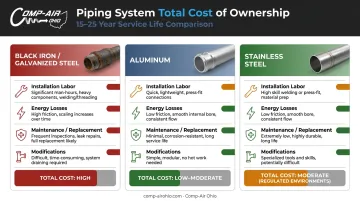
Total Cost of Ownership
Initial material cost is one line item. The true cost of a piping system spans:
- Installation labor and permitting
- System modifications over its service life
- Energy losses from pressure drop and leaks
- Replacement costs from corrosion failure
Threaded steel connections are estimated to leak 8% to 10% of total compressed air — before any corrosion even develops. Add progressive internal diameter restriction from rust buildup, and you're compensating with higher compressor pressure, paying the 1% energy penalty per 2 psi across the system's entire lifespan.
Aluminum and stainless steel maintain smooth interior surfaces, resist contamination buildup, and need minimal upkeep. The Gardner Denver aluminum piping systems Comp-Air Ohio installs carry a lifetime warranty on fittings and pipe. That cost picture looks very different over a 15–25 year service life compared to black iron.
Industry and Regulatory Requirements
Some industries have no discretion here — specific piping standards are mandatory:
- Healthcare: NFPA 99 requires hard-drawn seamless copper (ASTM B819) for positive-pressure medical gas; stainless steel (ASTM A269 TP304L/316L) for medical-surgical vacuum
- Food and beverage: 21 CFR 117.40 requires compressed air contacting food or food-contact surfaces be treated to prevent contamination; 3-A Sanitary Standard 604-05 covers air under pressure in product contact
- Pharmaceutical: 21 CFR 211.65 requires equipment surfaces to be non-reactive and non-additive; 21 CFR 211.46 requires appropriate air controls in production areas
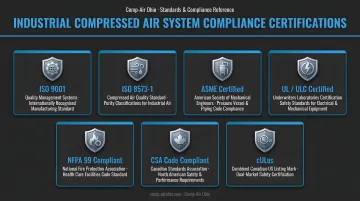
Comp-Air Ohio holds NFPA 99 compliance certification and ISO 8573-1 Air Quality Standard compliance — credentials that matter when designing systems for healthcare or regulated manufacturing facilities in Northern Ohio.
System Layout: Ring Main vs. Dead-End
Routing strategy has the same energy and pressure impact as material selection — choose the wrong layout and you'll compensate with compressor pressure indefinitely.
A ring main (closed-loop) layout delivers air to each consumption point from two directions, keeping pressure uniform across the network. This design prevents the progressive pressure drop that plagues dead-end layouts and is the standard recommendation for most industrial facilities.
A dead-end (branch) layout causes pressure to fall toward the furthest points, forcing operators to raise compressor pressure to compensate — triggering that 1% energy penalty per 2 psi, multiplied by every operating hour.
Pipe diameter must be sized based on required flow (CFM), total run length, number of bends, and acceptable pressure loss per section. Installing slightly oversized pipe during the initial build is far less expensive than rebuilding the system when demand grows.
How Comp-Air Ohio Helps You Choose the Right Piping System
Choosing the right piping material is only part of the equation — it has to work within your full system. Comp-Air Ohio has served Northern Ohio since 1977 as an authorized Gardner Denver distributor, supplying, designing, installing, and servicing complete compressed air systems for industrial and commercial facilities.
Piping decisions interact directly with compressor performance, air treatment equipment, and downstream air quality requirements. Comp-Air Ohio evaluates the full system — piping material, layout, sizing, connection to dryers and filtration, and long-term operational goals.
Their compressed air audit service identifies existing inefficiencies, including piping-related pressure losses, before they grow into larger energy and operational costs.
Capabilities and credentials relevant to piping system projects include:
- ISO 9001 quality certification and ASME certification
- ISO 8573-1 Air Quality Standard compliance
- NFPA 99 compliance for healthcare compressed air applications
- Aluminum piping systems: Gardner Denver Quick-Lock/Big-Lock and AIGNEP INFINITY
- Turnkey system design and installation, including dryers, filters, and compressors
- Factory-trained technical support for manufacturing, medical, pharmaceutical, food and beverage, automotive, and aerospace facilities
- 24/7 emergency service for contract customers
Conclusion
The right compressed air piping is about matching material performance to your system's pressure and temperature demands, your facility's air quality standards, your industry's regulatory requirements, and the operational reality of how often your layout might change.
Those decisions aren't one-time events. As your facility expands, adds production lines, or upgrades compressors, your distribution system needs re-evaluation to ensure it stays appropriately sized, leak-free, and compliant.
Common triggers for a piping review include:
- Adding a new compressor or increasing system pressure
- Expanding the facility footprint or production floor
- Experiencing unexplained pressure drops or rising energy bills
- Shifting to a process with stricter air quality requirements
Comp-Air Ohio has served Northern Ohio industrial facilities since 1977, with factory-trained technicians who can assess your current distribution system, identify losses, and recommend piping that keeps pace with your operation — before small inefficiencies become costly ones.
Frequently Asked Questions
What kind of pipe do you use for compressed air?
The most common options are aluminum, stainless steel, copper, black iron/galvanized steel, and OSHA-approved plastics like ABS and HDPE. For new industrial installations, aluminum has become the leading choice due to its corrosion resistance, smooth interior, and no-weld modular installation.
What is a compressed air piping system?
It's the network of pipes, fittings, valves, and connectors that transports compressed air from the compressor through treatment equipment to every downstream point of use. Its design directly determines pressure consistency, air quality, and system efficiency across the facility.
Is PVC pipe safe to use for compressed air?
No. OSHA prohibits PVC and CPVC for compressed air applications because they cannot withstand high-pressure conditions, degrade when exposed to compressor oils, and can shatter into dangerous projectiles without warning. If plastic is required, consult OSHA guidelines for approved alternatives such as ABS or HDPE.
What is the best piping material for a compressed air system?
Aluminum is the best all-around choice for most modern industrial systems — lightweight, corrosion-resistant, and easy to modify without welding. Stainless steel is the better choice for oil-free compressor installations and regulated environments like healthcare or pharmaceutical facilities.
How do I know if my compressed air piping needs to be replaced?
Watch for these warning signs:
- Compressor discharge pressure significantly higher than point-of-use pressure
- Filters requiring unusually frequent replacement
- Visible rust or scale in the air stream
- Recurring leaks at joints or mismatched materials across sections
Does pipe size matter in a compressed air system?
Undersized pipe creates pressure drop that can't be recovered downstream. Correct diameter must be sized based on flow rate (CFM), total pipe run length, number of bends, and acceptable pressure loss — and sizing up slightly at installation is far cheaper than rebuilding later.