
This guide is written for oil field operators, petroleum engineers, and facilities managers working in the upstream sector. If you're evaluating whether nitrogen pressurization makes sense for an aging well, planning a generator deployment, or trying to understand what separates a well-designed system from a costly one, you're in the right place.
We'll cover how the process works, why nitrogen is the preferred injection gas, where it fits across the well lifecycle, what determines its effectiveness, and when it's the wrong tool for the job.
Key Takeaways
- Nitrogen is safe for hydrocarbon environments because it's inert, non-corrosive, and non-flammable
- On-site PSA or membrane generators deliver a continuous, cost-controlled supply without relying on delivered liquid nitrogen
- Pressurization works best in aging wells with declining drive pressure but recoverable oil remaining
- Feed air quality directly determines nitrogen purity; contaminated inlet air degrades both safety and equipment life
- Reservoir suitability must be assessed before deployment — not every declining well is a candidate
What Nitrogen Well Pressurization Is and Why It's Used
Nitrogen well pressurization — also called nitrogen injection or nitrogen-assisted enhanced oil recovery (EOR) — works by injecting high-purity gaseous nitrogen into a well or reservoir to artificially restore the pressure gradient that drives oil toward the production wellbore.
Two related processes often get conflated with this:
- Gas lift injects nitrogen into production tubing to reduce the hydrostatic weight of the fluid column, helping lift fluids to surface. It addresses a different problem — wellbore hydraulics, not reservoir pressure.
- Nitrogen purging uses nitrogen to inert pipelines and equipment during maintenance. It's a safety procedure, not a production technique.
The Recovery Gap Nitrogen Pressurization Targets
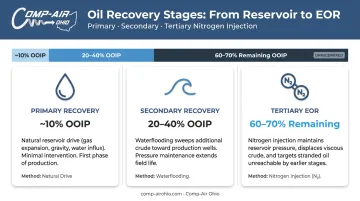
According to DOE/NETL, primary recovery typically extracts around 10% of original oil-in-place (OOIP). Secondary recovery — primarily waterflooding — adds another 20–40%. That means 60–70% of the original oil typically remains in the reservoir after conventional recovery methods are exhausted.
Tertiary EOR methods, including gas injection, are designed to address that gap.
Why Nitrogen Specifically
Air Products documents nitrogen's key properties for this application:
- Inert — won't react with hydrocarbons or wellbore equipment
- Non-corrosive — safe in both freshwater and saltwater injection environments
- Non-flammable — critical in explosive hydrocarbon atmospheres
- Non-toxic — no direct chemical hazard to personnel or formation fluids
Note that nitrogen displaces oxygen and creates an asphyxiation hazard in confined spaces — site safety protocols must account for this before any injection work begins.
When reservoir pressure drops below economical production thresholds, operators risk premature well abandonment even with significant oil still in place. The natural drive energy is simply exhausted. Nitrogen pressurization is one of the few tertiary methods that restores that energy without introducing reactive or corrosive gases.
How Nitrogen Well Pressurization Works
The process moves through three distinct stages: compressed air production and treatment, nitrogen separation, and controlled well injection. Each stage depends on the one before it — failures upstream cascade downstream.
Step 1: Compressed Air Production and Treatment
Ambient air is drawn into an industrial compressor and pressurized to the system's operating pressure. Before the air reaches the nitrogen generator, it passes through dryers and filters to remove:
- Moisture and water vapor
- Oil mist and aerosols
- Particulates
This pre-treatment step is not optional. Moisture causes irreversible damage to molecular sieve beds in PSA systems. Oil vapor coats membrane fibers and renders them ineffective. Particulates clog both. The performance of the entire nitrogen generation system depends on the quality of air entering it.
Gardner Denver's EnviroAire and PureAir series compressors — available through Comp-Air Ohio — carry ISO 8573-1 CLASS 0 certification, meaning zero oil contamination risk at the compressor outlet. For nitrogen generation applications where feed air contamination is a primary concern, CLASS 0 oil-free compressors are the right starting point.
On the treatment side, ZEKS Eclipse desiccant dryers achieve pressure dew points down to -100°F, paired with Gardner Denver's HE-grade filtration to reach ISO Class 1 for both oil content and particulates.
Step 2: Nitrogen Separation and Purity Control
Cleaned compressed air enters the nitrogen generator, where one of two separation technologies does the work:
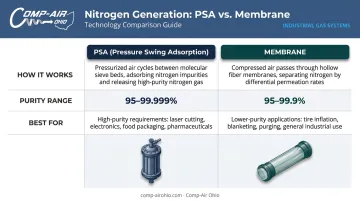
| Technology | How It Works | Purity Range | Best For |
|---|---|---|---|
| PSA (Pressure Swing Adsorption) | Cycles air through molecular sieve vessels; oxygen and other gases are adsorbed and vented | 95–99.999% | High-purity injection requirements, sensitive formations |
| Membrane | Passes air through hollow fiber membranes; oxygen permeates out, nitrogen flows through | 95–99.9% | Moderate-purity applications, compact/mobile deployments |
The nitrogen stream is measured for purity before entering a buffer storage vessel. Purity requirements are project-specific , driven by reservoir characteristics, wellbore metallurgy, oxygen tolerance of the formation, and injection pressure. No single universal threshold applies across all applications — equipment vendor and reservoir engineer specifications should drive the selection.
For operations that need flexibility across both approaches, Comp-Air Ohio's nitrogen generator line spans membrane systems from 1–153 CFM and PSA systems from 15–2,353 CFM, with purity from 95% to 99.999%.
Step 3: Injection into the Well
Nitrogen flows from the buffer vessel through flow control equipment to the injection wellhead. In a multi-well configuration, nitrogen enters injection wells surrounding the production well. The resulting pressure front pushes residual oil through the reservoir toward the producing wellbore.
The process is monitored in real time based on:
- Wellhead pressure readings
- Production response at producing wells
- Nitrogen consumption rates
- Nitrogen breakthrough detection at production wells
Injection pressure must exceed reservoir pressure at the target depth without fracturing the formation. Undersized generators or insufficient buffer storage cause pressure drops that stall the displacement front, stopping oil movement entirely.
Where Nitrogen Pressurization Is Applied
Nitrogen pressurization applies across multiple stages of well life — from initial drilling through late-stage recovery. Each application has distinct pressure requirements, flow rates, and equipment implications.
Enhanced Oil Recovery (EOR)
EOR is the primary application. When primary and secondary recovery are no longer economical, nitrogen injection can extend productive well life by restoring reservoir pressure. Mexico's Cantarell Complex is one of the most documented examples — nitrogen injection began in 2000 and reached approximately 1.2 Bcf/d for reservoir pressure maintenance.
Well Workover and Underbalanced Drilling
Workover operations use nitrogen to restore pressure before re-completion, allowing safe re-entry without relying on natural reservoir energy.
Underbalanced drilling (UBD) keeps wellbore pressure below formation pore pressure. Benefits include:
- Reduced formation damage during drilling
- Higher drill rates and extended bit life
- Real-time reservoir data acquisition while drilling
Offshore Platform Operations
Liquid nitrogen delivery to offshore platforms requires vacuum-insulated tanks, supply-boat transport, and crane handling. On-site membrane converters can reduce these logistical costs by up to 70%, which is why on-site generation is the standard for most offshore deployments.
Process duration varies significantly by application:
- EOR injection — continuous, sustained over months or years
- Workover/intervention — event-based, typically days to weeks
- Pipeline inerting — event-triggered at shutdown or maintenance windows
Key Factors That Affect Nitrogen Pressurization Performance
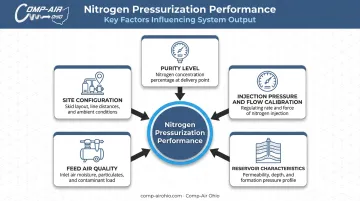
Consistent nitrogen pressurization depends on matching system design to reservoir conditions, feed air quality, and site constraints. Most deployment failures trace back to one of the five variables below.
- Purity level: Reservoir oxygen tolerance, wellbore metallurgy, and injection depth all drive purity requirements. Define these with a reservoir engineer for each project — don't carry over assumptions from comparable wells.
- Injection pressure and flow calibration: Injection pressure must exceed reservoir pressure at target depth without fracturing the formation. Size the buffer storage for peak demand, not average flow — undersized storage causes pressure drops that stall the displacement front (the advancing boundary between nitrogen and reservoir fluid).
- Reservoir characteristics: Formation permeability, heterogeneity (uneven rock properties), and natural fracture density determine how evenly the nitrogen front advances. In highly fractured carbonates, nitrogen can channel through fractures and bypass oil entirely — a behavior documented in peer-reviewed research on naturally fractured carbonate reservoirs.
- Feed air quality: Moisture, oil aerosols, or particulates in feed air degrade purity and accelerate component wear. ISO 8573-1 class selection for the feed air system should follow the nitrogen generator manufacturer's specifications — oil-free compressors eliminate contamination at the source.
- Site configuration: Remote and offshore deployments benefit from skid-mounted, modular systems. Factor in flow rate requirements (Nm³/h or CFM) and redundancy needs for continuous injection before finalizing system design.
When Nitrogen Pressurization Is Not the Right Answer
Nitrogen pressurization has a strong track record, but it gets misapplied more often than it should.
Common Misconceptions
"It will restore original production rates." Nitrogen pressurization extends economic life by improving recovery of remaining oil — it doesn't replace depleted hydrocarbons. Operators benchmarking against initial production rates will be disappointed.
"Any inert gas will do." CO₂ and methane are used in gas injection EOR, but they behave differently. CO₂ offers miscibility advantages for certain crude types yet introduces corrosion risks and different cost structures. Substituting gases without a reservoir-specific evaluation can produce worse results at higher cost.
"Membrane generators are always sufficient." Membrane systems suit moderate-purity applications. For high-pressure injection or purity-critical environments, PSA systems are the right choice.
Conditions Where Nitrogen Pressurization Yields Poor Results
- Remaining oil saturation is below economically recoverable levels, making pressure application futile
- Reservoir fracturing is severe enough that gas will channel directly to production wells without displacing hydrocarbon
- No monitoring infrastructure exists — unmonitored high-pressure injection risks formation damage and uncontrolled pressure buildup
The Default Deployment Problem
If a nitrogen pressurization program was deployed because "it worked on a similar well nearby," without a site-specific reservoir assessment, the foundation is already weak. When production response isn't tracked against nitrogen breakthrough at producing wells, the process runs without the diagnostic feedback needed to optimize it or confirm its viability.
Nitrogen pressurization works when it's matched to the reservoir, sized correctly, and monitored continuously. Miss any of those three conditions and operators are spending real capital with no reliable signal that it's working.
Frequently Asked Questions
What purity of nitrogen is required for oil well pressurization?
Purity requirements are project-specific, depending on formation oxygen tolerance, wellbore metallurgy, and injection pressure. Reservoir engineers define the specification per deployment: PSA systems can deliver up to 99.999% where required, while membrane systems cover the 95–99.9% range for moderate-purity applications.
What is the difference between PSA and membrane nitrogen generators for oilfield use?
PSA systems use molecular sieves to achieve higher purity (up to 99.999%) and are preferred for demanding pressurization or purity-sensitive applications. Membrane systems are simpler, lower-maintenance, and cost-effective for moderate-purity needs such as underbalanced drilling or pipeline inerting, with offshore-rated versions reaching up to 5,000 psig discharge pressure.
How does nitrogen well pressurization differ from gas lift?
Gas lift injects nitrogen into production tubing to reduce the hydrostatic pressure of the fluid column and help lift fluids to surface. Well pressurization injects nitrogen into the reservoir formation itself to push residual oil toward the producing wellbore. They address different production problems and are sometimes used together.
Can nitrogen well pressurization be used on any oil well?
No. It's most effective in aging conventional reservoirs with declining drive pressure but recoverable oil remaining. It generally performs poorly in fully depleted formations, highly fractured reservoirs prone to gas channeling, or wells without the infrastructure to safely manage high-pressure injection.
Is on-site nitrogen generation better than delivered liquid nitrogen for oilfield operations?
For continuous EOR injection or remote/offshore sites, on-site generation is typically superior. It eliminates supply chain dependency and reduces per-unit cost significantly over time — offshore installations can cut logistics costs by up to 70%. Delivered nitrogen makes more sense for short-duration operations where capital investment in a generator isn't justified.
What compressed air quality is needed for oilfield nitrogen generation systems?
Feed air must be clean, dry, and oil-free. Contaminants degrade molecular sieve beds and membrane fibers, reducing purity and shortening generator service life. ISO 8573-1 CLASS 0 certified compressors, paired with desiccant dryers and high-efficiency filtration, deliver the feed air quality required for reliable oilfield nitrogen generation.