Automation controls come up constantly as the answer to compressed air waste — but the conversation rarely gets past feature lists. What does a system controller actually change on the plant floor? What does a maintenance technician experience differently? Where do the savings show up on the utility bill?
This article focuses on those operational outcomes: reduced energy spend, faster fault response, and maintenance that prevents failures rather than reacting to them.
Key Takeaways
- Automation controls match compressed air output to real demand, eliminating unloaded running and pressure overshoot
- VSD controls and system-level sequencing can deliver 20–50%+ energy savings on compressed air costs
- Centralized monitoring gives technicians pre-diagnosed fault data before they leave the office
- Predictive maintenance cuts unplanned breakdowns by up to 70–75% compared to reactive approaches
- Energy savings, lower maintenance costs, and longer equipment life stack together — making automation upgrades pay for themselves faster than most facilities expect
What Are Air Compressor Automation Controls?
Automation controls are the electronic systems that manage how compressors start, stop, load, unload, and sequence — without manual intervention. They operate at two levels:
- Machine-level controls manage an individual compressor's output, adjusting motor speed or load/unload cycles to maintain a target pressure
- System-level controllers coordinate multiple compressors across a facility, selecting which machines run and at what capacity to meet plant-wide demand efficiently
The core objective is matching air supply precisely to demand. That precision is where energy savings, reliability, and operational control come from.
Gardner Denver equipment, available through Comp-Air Ohio, shows what this looks like in practice:
- Governor™ touchscreen controller — provides real-time machine status, advanced diagnostics, data logging, and iConn remote monitoring connectivity
- Air Command platform — extends control to system-level management, delivering 24/7 visibility into compressor health, real-time KPIs, and historical trend data accessible from anywhere
Key Advantages of Air Compressor Automation Controls
Advantage 1: Reduced Energy Consumption Through Demand-Matched Output
Fixed-speed compressors don't stop when demand drops — they run unloaded. According to Compressed Air Best Practices, an unloaded rotary screw compressor consumes 15–35% of full-load horsepower while producing zero usable air. The DOE's compressed air sourcebook puts fully unloaded operation at roughly 30% of full-load electricity. That's significant waste running continuously in facilities with variable demand.
Automation controls eliminate this two ways:
- VSD (variable speed drive) controls adjust motor speed continuously so the compressor produces only what the system needs — no more, no less
- System-level sequencing determines which combination of compressors covers current demand most efficiently, bringing units online as demand rises and taking them offline as it falls
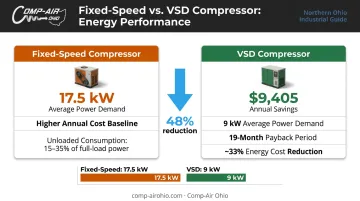
The energy impact is well-documented. A CAGI case study tracked an aerospace manufacturer that replaced a 50-hp fixed-speed unit with a properly sized VSD compressor. Average power dropped from 17.5 kW to 9 kW, annual energy cost fell by $9,405, and the projected payback period was 19 months. CAGI's broader VSD analysis indicates that properly sized variable speed compressors can reduce compressed air costs by roughly one-third.
For multi-compressor systems, the gains can be larger. A DOE case documented inconsistent sequencing consuming about 30% more energy than required — waste that a system controller eliminates by coordinating machines rather than letting each respond independently.
KPIs this improves:
- Energy cost per unit of compressed air
- Compressor unloaded run time
- Pressure band deviation
- Compressed air energy as a percentage of facility electricity spend
When it matters most: Plants running multiple compressors across multiple shifts, facilities with variable demand throughout the day, and operations where electricity is a significant overhead cost.
Gardner Denver's LRS Series VSD compressors — available through Comp-Air Ohio in 10–400 HP configurations — use direct-drive variable speed technology to deliver 30–50% energy savings where demand patterns support it. The GD Connect 12 system controller can coordinate up to 12 fixed or variable speed compressors, maintaining the tightest possible pressure band across the system.
Advantage 2: Centralized Visibility and Faster Fault Response
Without a system controller, key compressor data exists only at the machine. A technician who needs to assess system status, respond to a fault, or verify that pressure is stable across the facility must physically visit each unit. In a plant with six compressors spread across multiple buildings, that's a slow and labor-intensive process before repair even begins.
Automation controls centralize that information:
- A system controller aggregates pressure, load state, fault codes, and run hours from every compressor to a single interface
- When a fault occurs, the controller identifies the specific unit and fault type — before a technician leaves the desk
- That technician arrives with the right diagnostic information, the right parts, and a clear repair path
McKinsey's industrial condition monitoring research found that pre-diagnosed fault data reduced mean time to repair (MTTR) from 6.5 hours to approximately 3 hours in an industrial setting. Arriving with a diagnosis cuts the troubleshooting phase nearly in half.
Remote monitoring extends this further. Gardner Denver's iConn platform — integrated with the Governor™ controller — provides 24/7 access to real-time KPIs, system trends, and alert notifications from any connected device. An aerospace manufacturer case documented by Compressed Air Best Practices showed that automated control and remote monitoring reduced non-productive energy from 37% to 23% and improved system efficiency from 25.8 to 20.1 kW/100 cfm, producing expected annual savings of $35,050.
KPIs this improves:
- Mean time to repair (MTTR)
- Unplanned downtime hours
- Technician labor per maintenance event
- Service visits per fault
When it matters most: Multi-shift operations without a dedicated overnight technician; facilities with compressors spread across a large footprint; pharmaceutical, food and beverage, and medical manufacturing where a compressed air failure carries production or compliance consequences — all sectors Comp-Air Ohio serves across Northern Ohio.
Advantage 3: Predictive Maintenance and Extended Equipment Life
Traditional maintenance runs on two tracks: time-based (service every X hours regardless of condition) or reactive (fix it when it breaks). Both carry real costs.
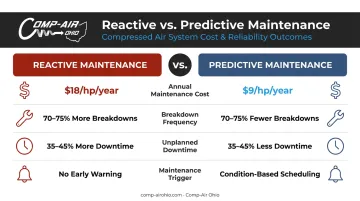
Reactive maintenance is the most expensive. The DOE/FEMP Operations & Maintenance Best Practices Guide benchmarks it at $18/hp/year, compared to $9/hp/year for predictive maintenance. The same guide reports that condition-based maintenance delivers 25–30% lower maintenance costs, 70–75% fewer breakdowns, and 35–45% less downtime.
Automation controls enable condition-based maintenance by continuously monitoring operating temperatures, pressures, run hours, load cycles, and performance trends. When parameters drift outside normal ranges, the system flags the deviation — often weeks before it would cause a failure. Maintenance teams can schedule the repair during planned downtime rather than responding to an unexpected shutdown.
The secondary benefit is preventing cascade damage. Left unaddressed, a bearing running hot, a degrading oil separator, or a fouling heat exchanger rarely stops at itself — it triggers secondary failures that are far more expensive to repair. Automation controls close that window by catching the deviation early.
Comp-Air Ohio's Air Command platform retains comprehensive performance history through the Air Command portal, with trend analysis and detailed system records that make it easier to identify patterns and schedule maintenance by actual equipment condition rather than arbitrary intervals.
KPIs this improves:
- Planned vs. unplanned maintenance ratio
- Maintenance cost per operating hour
- Mean time between failures (MTBF)
- Emergency service calls per year
When it matters most: High-utilization facilities running compressors continuously across multiple shifts; plants with older equipment that remains serviceable but needs closer monitoring; operations where a single compressor failure halts an entire production line.
What Happens Without Automation Controls
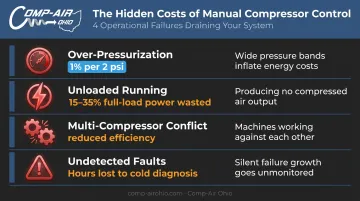
Manual or basic start/stop control creates a predictable set of problems that compound as facilities grow:
- Over-pressurization from wide pressure bands — operators set conservative buffers that inflate system pressure; every 2 psi increase at full output costs roughly 1% more energy
- Wasted power from unloaded running — compressors cycle on and off but spend significant time unloaded, burning 15–35% of full-load power without producing usable air
- Multi-compressor conflict — individual machines respond to local pressure signals rather than system demand, causing them to work against each other and produce more air than needed at lower efficiency
- Undetected fault development — problems grow silently without condition monitoring; technicians arrive to a failed compressor with no fault history and spend hours diagnosing before repair even begins
These aren't edge cases — they're the daily reality for facilities still relying on manual management. As a facility adds compressors, production lines, or shifts, each of these problems scales with it. Manual management doesn't improve with complexity; it falls further behind.
Getting the Most Value from Automation Controls
Factory defaults are a starting point, not a finish line. These steps close the gap between a functional system and one optimized for your facility:
- Start with a compressed air audit — map peak and off-peak demand, pressure requirements by zone, and which compressors are most efficient at different load levels; Comp-Air Ohio offers compressed air audits specifically for this purpose
- Configure the system controller for your profile — sequencing logic, pressure setpoints, and load-sharing rules should reflect real demand patterns, not assumptions
- Turn alerts into action plans — fault logs and threshold alerts only produce value when someone acts on them; define who responds, how quickly, and with what resources
- Track KPIs over time — benchmark energy consumption per unit of compressed air produced, monitor unloaded run hours, and compare planned vs. unplanned maintenance events quarter over quarter
For Northern Ohio facilities running Gardner Denver equipment, Comp-Air Ohio provides factory-trained service support and OEM expertise to configure, maintain, and optimize automation control systems — from Governor™ controller setup to Air Command system integration. Call (440) 237-6700 to schedule a compressed air system evaluation and get specific recommendations for your facility.
Conclusion
Air compressor automation controls deliver value through operational outcomes — measurable ones. Tighter pressure control reduces energy waste from the first billing cycle. Centralized visibility cuts the time between fault occurrence and resolution. Condition monitoring prevents the failures that generate emergency repair costs and production losses.
These advantages compound over time. As the system is tuned to actual demand patterns, energy savings increase. Faster fault response protects production schedules in ways that show up in reduced downtime costs and on-time delivery rates.
The areas where automation pays off most:
- Pressure management — eliminates chronic over-pressurization and associated energy waste
- Fault response — shortens the gap between detection and resolution
- Condition monitoring — stops failures before they become emergency repair events
Facilities that extract the most value from automation controls treat compressed air as a managed, data-driven system, not a fixed overhead line item that runs unmonitored in the background.
Frequently Asked Questions
What are the main controls on a compressor?
The five main types are start/stop, load/unload, modulating inlet, variable speed drive (VSD), and network/system controls. Each offers progressively greater efficiency — VSD and network controls deliver the best energy performance in variable-demand applications.
What sensor is used to control an air compressor in automatic mode?
Pressure transducers are the primary sensing element. They continuously measure system or discharge pressure and signal the controller to load, unload, increase motor speed, or decrease output to maintain the target setpoint. Temperature sensors also play a role in protecting the machine, triggering shutdowns or alerts when operating parameters exceed safe ranges.
What is pneumatic automation?
Pneumatic automation uses compressed air to power and control automated equipment — actuators, cylinders, valves, and air-driven tools. Compressor automation controls ensure the air supply driving these systems stays reliable, consistent, and within the pressure range the equipment requires, preventing both production interruptions and pneumatic component wear from pressure fluctuations.
How much energy can air compressor automation controls save?
Savings vary by application, but the DOE identifies 20–50%+ reductions from compressed air system improvements. CAGI reports properly sized VSD compressors can cut energy costs by roughly one-third, with one documented case showing a 19-month payback.
What is variable speed drive (VSD) control on an air compressor?
VSD control adjusts the compressor motor's speed in real time to match actual air demand rather than running at constant full speed. This eliminates energy wasted during unloaded operation and holds output within a narrow pressure band. Most multi-shift manufacturing environments see the greatest efficiency gains from VSD.
Can older air compressors be retrofitted with automation controls?
Many older compressors can be retrofitted with modern programmable controllers that replace basic start/stop panels, adding fault diagnostics, pressure trend logging, and remote monitoring without a full equipment replacement. Contact Comp-Air Ohio at (440) 237-6700 to assess retrofit options for your existing equipment.