That creates a serious gap. Unlike general manufacturing, food processing plants face contamination risks that turn a compressor purchase into a food safety decision. Oil aerosols, moisture, and airborne particulates can all reach your product — and the consequences go well beyond equipment damage. General food recall costs average $8.2M per producer/processor, and compressed air contamination is one of the harder-to-detect vectors.
This guide covers the top oil-free air compressors for food processing, how to match the right system to your facility's risk zones, and what to look for when evaluating brands.
Key Takeaways
- Food processing requires oil-free compressed air — oil-lubricated units create contamination risk in direct-contact and packaging zones
- ISO 8573-1 Class 0 is the industry purity benchmark for food-grade air — a key purchasing spec, not an FDA mandate
- Top compressor choices: Gardner Denver EnviroAire, Atlas Copco Z Series, Quincy QOF, ELGi OF Series, and Ingersoll Rand Sierra
- Match compressor type to duty cycle: rotary screw for continuous runs, scroll or piston for intermittent use
- Local service infrastructure and response time matter as much as the compressor spec itself
Why Food Processing Demands Specialized Air Compressors
Not all compressed air in a food facility carries the same risk. Industry guidance divides applications into three categories:
- Direct contact — air that touches food or food-contact surfaces
- Non-contact high-risk — air near open product or packaging that will hold food
- Non-contact low-risk — general plant utilities, powering equipment with no proximity to food
Each zone needs a different air purity specification. Applying the wrong treatment level is both a compliance exposure and a cost problem: over-engineering low-risk zones wastes energy, while under-treating high-risk zones creates contamination liability.
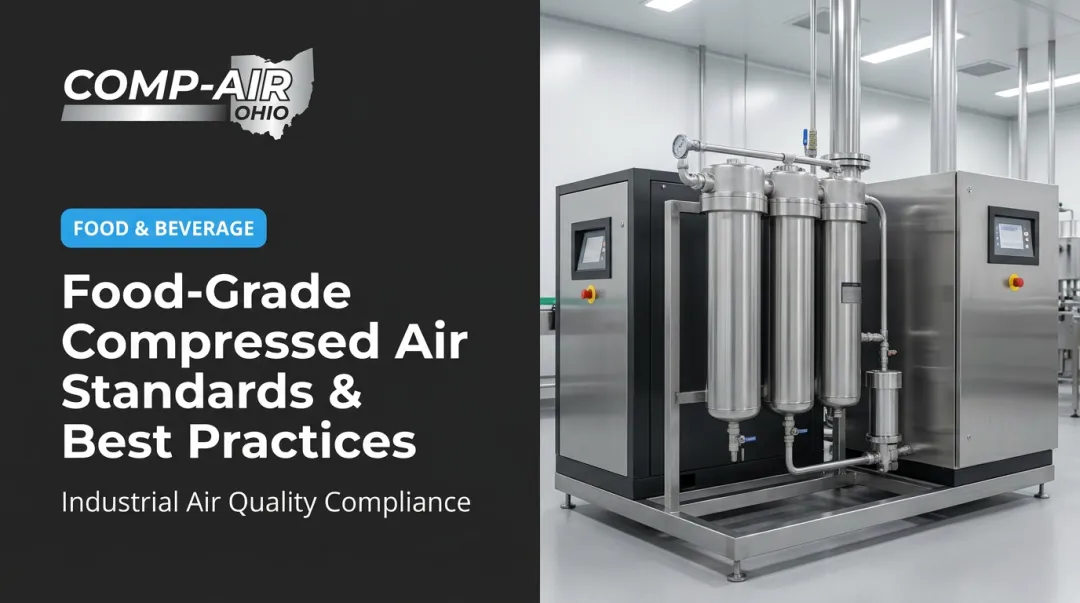
The Three Contamination Threats
Oil Aerosols
Oil aerosols are the most regulated contamination concern. Even trace carryover causes taste and odor problems in direct-contact applications, and it's largely undetectable until product complaints or a regulatory inspection surfaces it.
Moisture
Moisture enables microbial and fungal growth inside distribution piping. Once established, biofilms continuously shed spores into the air stream, with no visible warning at the point of use.
Particulates
Particulates carry microbial spores from ambient air drawn into the compressor inlet. Ambient air can contain vast concentrations of microorganisms and dirt particles per cubic metre, making effective inlet filtration and downstream treatment non-negotiable.
Why Oil-Lubricated Compressors Fall Short
Each of those three threats is harder to control when oil is present in the system. Oil-lubricated compressors can reach high purity levels with coalescing and activated carbon filtration, but for direct food-contact or high-risk applications, the filtration chain introduces its own failure points:
- Oil carryover increases under low-load conditions, precisely when many food lines run during changeovers
- Downstream filtration requires strict maintenance; a missed service interval increases contamination risk
- Regulatory liability shifts to you if contamination occurs, regardless of filtration claims
For low-risk zones, oil-lubricated compressors using NSF H1 food-grade lubricants (such as Gardner Denver's AEON 6000FG, which meets FDA 21 CFR 178.3570 for incidental contact) remain appropriate, provided you clearly document the risk zone classification.
ISO 8573-1 Class 0 Explained
ISO 8573-1:2010 is the international standard specifying purity classes for compressed air particles, moisture, and oil. Class 0 sits above Class 1 and is defined by the user and supplier as more stringent than Class 1's total oil limit of ≤0.01 mg/m³.
Regulatory note: ISO 8573-1 Class 0 is not mandated by FDA or FSMA. FDA 21 CFR Part 117 requires that compressed air mechanically introduced into food be treated to prevent contamination, but stops short of specifying a purity class. Class 0 functions as the industry's accepted benchmark for food-grade applications.
Matching Treatment to Risk Zone
| Zone | Application | Pressure Dewpoint Target | Dryer Type |
|---|---|---|---|
| Direct contact | Air touching food | -40°F (-40°C) PDP | Desiccant dryer |
| Non-contact high-risk | Open product proximity, packaging | -40°F (-40°C) PDP | Desiccant dryer |
| Non-contact low-risk | General plant equipment | +38°F (+3°C) PDP | Refrigerated dryer |
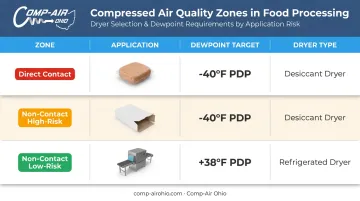
Getting this right prevents both under-treatment and expensive over-engineering of general utilities.
Top Air Compressors for Food Processing
The compressors below were evaluated on oil-free certification status, demonstrated use in food and beverage applications, energy efficiency features, and availability of local service support.
Gardner Denver – EnviroAire Series
Gardner Denver has manufactured compressors since 1859, and the EnviroAire Series is their dedicated oil-free line for food and beverage environments where contamination risk cannot be accepted. All EnviroAire models are ISO 8573-1 Class 0 certified, delivering 100% oil-free and silicone-free air.
The range covers a broad capacity spectrum:
- EnviroAire S/ES Series: 3–10 HP, 8–126 CFM — oil-less rotary scroll for smaller or intermittent applications
- EnviroAire VS Series: 15–110 kW with variable speed drive — 30–50% energy savings compared to fixed speed
- EnviroAire T/TVS Series: 75–315 kW, fixed and variable speed configurations for high-volume continuous production
The Governor touchscreen controller with iConn remote monitoring tracks operational performance in real time, flagging potential issues before they cause unplanned downtime. ASME-certified pressure vessels and cULus listing complete the compliance credentials.
| Attribute | Details |
|---|---|
| Technology | Oil-free rotary screw; variable speed drive (VSD) available |
| Key Certifications | ISO 8573-1 Class 0, ASME certified, cULus listed, CSA approved |
| Best For | Direct food contact, high-risk packaging, continuous food and beverage production |
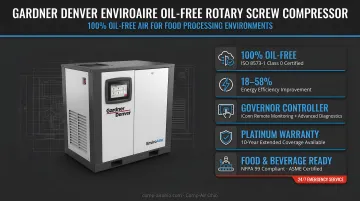
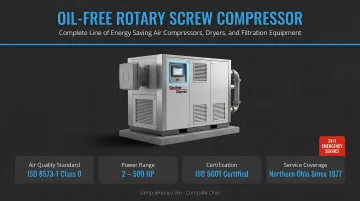
Comp-Air Ohio, the authorized Gardner Denver distributor serving Northern Ohio since 1977, supports EnviroAire installations with local sales, compressed air audits, and 24/7 emergency service for contract customers. Complete system builds are available with ZEKS desiccant dryers (-40°F PDP standard, -100°F options) and refrigerated dryers paired with food-grade aluminum piping.
Atlas Copco – Z Series (ZR/ZT)
Atlas Copco became the first compressor manufacturer to achieve ISO 8573-1 Class 0 certification in 2010. Their Antwerp production facility holds ISO 22000 Food Safety Management certification specifically for Z type Class 0 compressors, dryers, and filters.
The ZR/ZT range spans 15–900 kW (42–5,310 CFM), with VSD and VSD+ options delivering up to 35% energy cost reduction. SMARTlink remote monitoring supports predictive maintenance for high-uptime production environments.
| Attribute | Details |
|---|---|
| Technology | Two-stage oil-free rotary screw; VSD/VSD+ available |
| Key Certifications | ISO 8573-1 Class 0, ISO 22000 (production facility) |
| Best For | Large-scale continuous food processing; bottling and high-throughput packaging lines |
Quincy Compressor – QOF Series
Quincy's QOF Series uses oil-less scroll technology and is positioned as ISO 8573-1 Class Zero compliant, covering 2–30 HP (4–86.5 CFM). The scroll design suits intermittent and lower-demand food processing applications where the capital cost of a full rotary screw system isn't justified.
Quincy's EQ (Efficiency Quotient) program conducts energy audits against best practices — useful for food plants looking to quantify compressed air efficiency before committing to capital upgrades.
| Attribute | Details |
|---|---|
| Technology | Oil-less scroll |
| Key Certifications | ISO 8573-1 Class Zero compliant |
| Best For | Smaller food processing operations; intermittent applications with lower continuous air demand |
ELGi – OF Series
ELGi holds both ISO 8573-1 Class 0 certification and ISO 22000 Food Safety Management certification on its production facility — one of the few manufacturers to carry both simultaneously. The OF Series covers 45–450 kW in air-cooled and water-cooled configurations, making it scalable for growing food plants.
ELGi's documented food industry applications include flour milling (Polselli in Italy) and food preparation and packaging (E2M Kitchen), demonstrating real-world deployment across multiple food sub-segments.
| Attribute | Details |
|---|---|
| Technology | Two-stage oil-free rotary screw; air-cooled and water-cooled |
| Key Certifications | ISO 8573-1 Class 0, ISO 22000 (production facility) |
| Best For | Dairy, beverage, and packaged food plants with scalable compressed air needs |
Ingersoll Rand – Sierra Oil-Free Series
Ingersoll Rand's Sierra Series covers 37–75 kW (50–100 HP) with two-stage oil-free rotary screw technology, positioned for mid-range food processing volumes. The Sierra is listed as ISO 8573-1:2010 Class 0 certified and is offered alongside integrated air treatment options, which helps facilities with limited floor space avoid a separate dryer installation.
| Attribute | Details |
|---|---|
| Technology | Two-stage oil-free rotary screw with integrated air treatment options |
| Key Certifications | ISO 8573-1 Class 0 certified |
| Best For | Mid-range food processing facilities needing a compact, integrated oil-free solution |
How We Selected the Best Air Compressors for Food Processing
Not every compressor marketed for food processing actually belongs there. To narrow this list, we applied three non-negotiable filters:
- Verified oil-free certification to ISO 8573-1 Class 0 or equivalent food-grade standard — not just marketing claims
- Documented use in food and beverage applications — manufacturer case studies, food-industry certifications, or industry-specific product lines
- Service infrastructure availability — a compressor that can't be serviced quickly in your region is a liability in a 24/7 food production environment
Beyond those filters, we assessed additional factors:
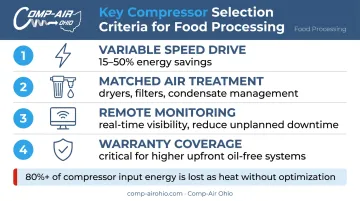
- Variable speed drive (VFD) availability, with verified savings data — VFDs on compressed air systems can deliver 15–50% annual energy savings where load profiles vary, and more than 80% of compressor input energy is otherwise lost as heat
- Matched air treatment options (dryers, filters, condensate management) available from the same supplier or distributor
- Remote monitoring capability, since real-time performance visibility directly reduces unplanned downtime — an expensive event in food production
- Warranty coverage period, which matters more for oil-free technology given its higher upfront cost
On compressor type selection: Rotary screw compressors handle continuous, high-volume production lines efficiently. Oil-free scroll or piston compressors (like the Quincy QOF) are more cost-effective for intermittent demand or smaller-scale food operations. Matching compressor type to your actual run schedule prevents paying for capacity you don't need — or running equipment into the ground trying to cover demand it wasn't sized for.
The bigger mistake is buying on sticker price alone. Contamination events, production halts, and regulatory responses carry costs that dwarf the price difference between a Class 0 certified system and a cheaper alternative.
Conclusion
Food-grade air compressor selection is ultimately a food safety decision. The compressor must deliver certified oil-free air consistently across every production shift, with a service infrastructure that prevents extended downtime when something goes wrong.
Before finalizing a selection, evaluate:
- Total cost of ownership: energy consumption, maintenance frequency, service response time
- Scalability: can the system grow with production volume without full replacement?
- Certification alignment: does the compressor's certification match your specific zone requirements (contact, high-risk, low-risk)?
If those criteria point toward a complete, matched system backed by local support, Comp-Air Ohio serves food and beverage processors across Northern Ohio with Gardner Denver EnviroAire oil-free systems (ISO 8573-1 Class 0 certified), matched ZEKS dryers and filtration, food-grade piping systems, and 24/7 emergency service for contract customers. Call (440) 237-6700 to discuss your facility's compressed air requirements.
Frequently Asked Questions
What type of air compressor is best for food processing?
Oil-free rotary screw compressors are the industry standard for food processing, particularly for direct food-contact or high-risk packaging environments. They deliver ISO 8573-1 Class 0 certified air with no oil contamination risk, and their continuous-duty design suits the production demands of most food facilities.
What does ISO 8573-1 Class 0 mean for food-grade compressed air?
ISO 8573-1 Class 0 is the highest oil purity classification in the standard, exceeding Class 1's ≤0.01 mg/m³ limit and defined by agreement between user and supplier. It's the accepted industry benchmark for food-contact and high-risk environments, though it is not explicitly required by FDA regulation.
Can oil-lubricated compressors be used anywhere in a food processing plant?
Yes, in non-contact low-risk zones (powering general plant equipment with no proximity to food), oil-lubricated compressors may be acceptable when using NSF H1 food-grade lubricants and appropriate downstream filtration. They are not suitable for direct food-contact or high-risk packaging applications.
What is the difference between a rotary screw and a piston air compressor for food processing?
Rotary screw compressors provide continuous, energy-efficient air delivery suited to high-volume production lines running extended shifts. Oil-free piston or scroll compressors are better matched to intermittent or lower-demand applications, offering a lower upfront cost where continuous duty isn't required.
How often should food-grade air compressors be serviced?
Service intervals vary by manufacturer and model. Consult your specific compressor manual for documented intervals. Regular inspection of filters, dryers, and condensate management systems is required to maintain air purity and support regulatory compliance, regardless of compressor type.
What air treatment equipment is needed alongside a food-grade air compressor?
Food-contact applications require desiccant dryers (targeting -40°F PDP), coalescing filters, and activated carbon filters to remove particulates, oil aerosols, and vapors. Lower-risk zones can use refrigerated dryers achieving approximately +38°F PDP. The right setup depends on your facility's risk zone classification.