Introduction
Moisture in compressed air is one of the most damaging and underestimated threats in industrial environments. According to CAGI's Compressed Air Treatment guide, unchecked moisture causes pipeline rust and scale, washes out lubricants, creates sluggish valves and cylinders, triggers instrument malfunction, contaminates products like paint, and freezes in exposed lines.
Refrigerated and desiccant air dryers are the two dominant solutions for removing that moisture. They differ in the dew points they achieve, the environments they handle, and what they cost to run. Choosing the wrong one means overspending on capability you don't need — or fielding a system that fails under real conditions.
This article breaks down how each dryer type works, where each fits best, and how to match the right technology to your application, environment, and budget.
Key Takeaways
- Refrigerated dryers hit ~38°F dew point — enough for most general manufacturing and standard production (ISO Classes 4–6)
- Desiccant dryers reach -40°F to -100°F, making them the only viable option for pharmaceutical, food, medical, and semiconductor applications (ISO Classes 1–3)
- Desiccant systems cost more to buy and run — but for critical processes, they're not optional
- Choose based on four factors: required dew point, ISO class, ambient exposure, and total cost of ownership
Refrigerated vs Desiccant Air Dryer: Quick Comparison
Here's how refrigerated and desiccant dryers stack up across the criteria that drive most selection decisions.
| Criteria | Refrigerated Dryer | Desiccant Dryer |
|---|---|---|
| Pressure Dew Point | ~34–40°F (+1–4°C) | -40°F to -100°F (-40°C to -73°C) |
| ISO Air Quality Class | Classes 4–6 | Classes 1–3 |
| Initial Cost | Lower | Higher |
| Operating Cost | Lower | Moderate to high (purge air is key cost driver) |
| Maintenance | Simpler; refrigerant circuit, drain valve | More complex; desiccant replacement every 2–5 years |
| Cold Environment Use | Not suitable at or below 32°F | Suitable for sub-freezing piping |
| Best Applications | General manufacturing, machine tools, packaging, body shops | Pharma, food, medical, semiconductor, paint booths, outdoor piping |
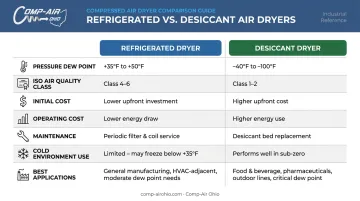
Start with dew point. Match the technology to what your process actually requires, then evaluate cost and maintenance from there.
What Is a Refrigerated Air Dryer?
How It Works
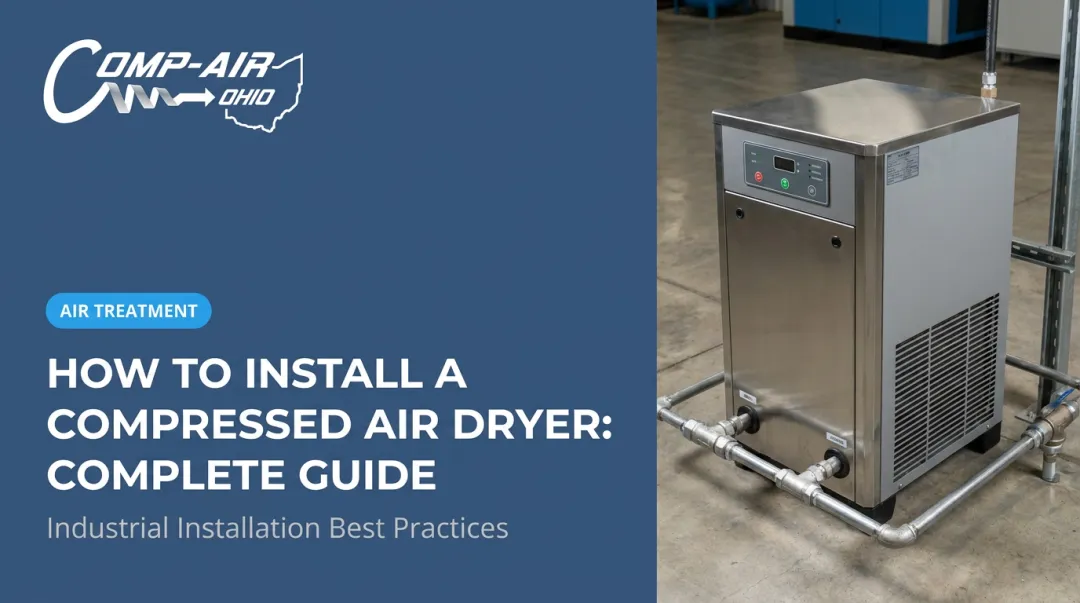
Compressed air enters the dryer and passes through an air-to-air heat exchanger, where warm outgoing air pre-cools the incoming stream. It then moves through an air-to-refrigerant heat exchanger, where a refrigerant circuit chills the air to approximately 33–40°F.
That temperature drop condenses water vapor into liquid droplets, which collect in a moisture separator and exit through an automatic drain valve. The dried air is then reheated before leaving the dryer to prevent condensation in downstream lines.
According to Sullair, modern refrigerated dryers deliver a pressure dew point of 34–40°F and remove 98% of moisture — making them the most widely used compressed air dryer type in industrial settings.
Cycling vs. Non-Cycling Models
That performance comes in two configurations, each suited to different demand profiles. Gardner Denver's refrigerated dryer lineup covers both:
- Non-cycling dryers (RNC, RGD, GTRC Series): The refrigeration compressor runs continuously. Simple, reliable, and cost-effective — consistent 38°F dew point regardless of load. Best for facilities with steady, high-demand compressed air usage.
- Cycling dryers (XGCY Series, 10–24,000 CFM): The refrigeration compressor shuts off during low-demand periods. XGCY Series True-Cycling operation can deliver energy savings up to 80% at partial load. Higher upfront cost, lower long-term energy spend.
Three cycling variants exist: thermal mass, digital scroll, and variable speed drive (VSD). Each reduces part-load energy consumption in a different way — thermal mass dryers, for example, show specific power of 1.67 kW/100 SCFM at 10% load compared to 5.36 kW/100 SCFM for a non-cycling unit at the same load.
Operating Limits
One hard boundary: refrigerated dryers cannot produce a dew point below 32°F, because condensate freezes at that threshold. For any facility where compressed air piping runs outdoors or through unheated spaces in Northern Ohio winters, a refrigerated dryer is not viable. The moisture remaining in the dried air will freeze in exposed lines.
Typical Applications
Refrigerated dryers are the standard choice for:
- General assembly and fabrication shops
- Machine tools and CNC operations
- Woodworking and furniture manufacturing
- Packaging lines
- Laundry and dry cleaning facilities
- Automotive body shops (non-paint air)
Gardner Denver's refrigerated dryer lines — built to ISO 9001 and ISO 8573-1 standards — span 2.5 CFM through 24,000 CFM, so Comp-Air Ohio can size a unit to the exact airflow requirements of any Northern Ohio facility on this list.
What Is a Desiccant Air Dryer?
How It Works
Rather than cooling air to condense moisture, desiccant dryers use adsorptive material (activated alumina, silica gel, or molecular sieves) to capture water vapor directly from the compressed air stream. Most designs use a dual-tower configuration: one tower dries the incoming air while the other regenerates its desiccant charge. This allows continuous, uninterrupted operation.
CAGI confirms that regenerative desiccant dryers achieve pressure dew points of -40°F to -100°F, mapping directly to ISO 8573-1 Classes 1, 2, and 3 — dew point levels that refrigerated technology cannot reach.
Three Regeneration Types
The regeneration method is the primary cost and performance differentiator within the desiccant dryer category:
| Type | Purge Air Consumption | Cost Profile | ZEKS Model |
|---|---|---|---|
| Heatless | 15–18% of capacity | Lowest upfront, highest operating cost | Eclipse ZPB Series (90–5,000 SCFM) |
| Heated (externally) | ~7% of capacity | Mid-range both ways | Eclipse ZHA Series (150–8,000 SCFM) |
| Heated blower-purge | ~1.25% or near zero | Highest upfront, lowest operating cost | Eclipse ZBA Series (150–8,000 SCFM) |
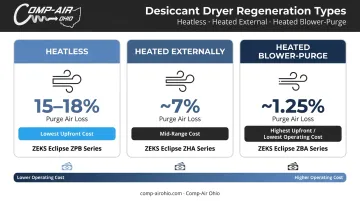
For facilities with high compressed air demand and significant energy costs, the blower-purge configuration pays back faster despite its higher capital cost. Where initial spend is the constraint, heatless models like the ZEKS Hydronix MPS Series (20–60 SCFM) offer a practical entry point — with optional -80°F or -100°F dew points available.
Where Desiccant Is Required
Applications that need desiccant drying fall into two clear categories:
Regulated or process-critical applications require ultra-dry air by code or specification:
- Pharmaceutical and biotech manufacturing (FDA Q7A requires compressed gases to be qualified and monitored where they affect API quality)
- Medical facilities (NFPA 99 requires medical air dryers to maintain a dew point below 32°F frost point at all demand levels)
- Food and beverage direct-contact applications (ISO 8573-1 Class 2, -40°C pressure dew point, is a common guideline)
- Semiconductor and electronics fabrication
Environmental exposure drives desiccant use when ambient conditions create freeze risk:
- Outdoor piping runs in sub-freezing climates
- Cold storage facilities
- Automotive paint booths
Many automotive facilities use a hybrid approach: a refrigerated dryer handles general shop air, while a point-of-use desiccant dryer serves the paint booth. The result is cost-efficient drying across the bulk system with precision dew point control only where finish quality demands it.
Kaeser reports typical desiccant service life of 3–5 years for heatless dryers and 2–3 years for heated dryers. Rising dew point, oil-coated beads, and bead dusting are the key degradation indicators to watch.
Upstream filtration is critical to reaching that full service life. Coalescing pre-filters must remove oil aerosol before it contacts the desiccant bed — Comp-Air Ohio carries ZEKS ZFF flanged filters and HDF mist eliminators designed specifically for this protection.
Refrigerated vs. Desiccant: Which Should You Choose?
The Decision Framework
Three questions drive the choice:
- What pressure dew point does your process require? If general manufacturing at indoor ambient temperatures, 38°F is typically sufficient (ISO Class 4–6). If pharmaceutical, food, medical, or semiconductor, you need -40°F or lower (ISO Classes 1–3).
- Will piping or equipment be exposed to temperatures at or below 32°F? If yes, refrigerated is disqualified regardless of other factors.
- Do regulatory or quality standards apply? NFPA 99 for medical air, ISO 8573-1 Class 1–3 for pharma and food, and similar requirements mandate desiccant technology.
Situational Recommendations
Choose a refrigerated dryer when:
- Your facility runs standard manufacturing, fabrication, or pneumatic tooling
- Piping stays in temperature-controlled indoor environments
- ISO Class 4–6 meets your quality standard
- Minimizing total cost of ownership is the priority
Choose a desiccant dryer when:
- Your process is moisture-sensitive (pharmaceutical, food processing, medical device, semiconductor)
- Any part of your compressed air distribution runs outdoors or through unheated spaces
- ISO Class 1–3 is required by regulation or application standard
- Product spoilage, compliance exposure, or equipment damage from moisture carryover makes ultra-dry air non-negotiable
Consider both dryers when:
- Your facility has mixed air uses — for example, a plant that runs general shop air for pneumatic tools but also operates a precision paint line or a dedicated pharmaceutical filling station
- A central refrigerated dryer handles the bulk demand economically, with a point-of-use desiccant dryer covering the critical application
Getting the Sizing Right
Selecting the right dryer type is only the first step. Proper sizing requires evaluating:
- Flow rate (CFM/SCFM) at actual operating conditions
- Inlet air temperature — lower inlet temps reduce heat load on refrigerated dryers
- Operating pressure
- Ambient temperature in both the compressor room and the piping distribution path
- Downstream application requirements and applicable ISO quality class
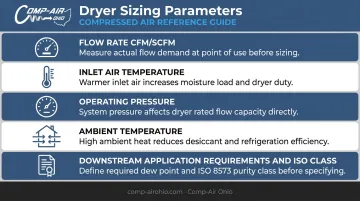
Comp-Air Ohio conducts compressed air system assessments covering all of these parameters. Contact us at (440) 237-6700 to arrange a consultation.
Conclusion
Refrigerated dryers are the practical, cost-efficient choice for most standard industrial applications — lower capital cost, simpler maintenance, and entirely adequate performance for ISO Class 4–6 processes at indoor ambient temperatures. Desiccant dryers are indispensable when air quality standards, sub-freezing conditions, or moisture-sensitive processes require dew points that refrigerated technology can't achieve.
Choosing the wrong technology has measurable consequences:
- Product spoilage or contamination from excess moisture in the air stream
- Corroded pipelines and fittings that shorten system life
- Frozen control lines in outdoor or sub-freezing installations
- Inflated energy bills from an oversized desiccant purge cycle
Match the dryer to your actual dew point requirement, operating environment, and process sensitivity — not just the purchase price or the highest-spec option. If you're unsure which technology fits your application, Comp-Air Ohio's team can assess your compressed air system and recommend the right solution for your facility.
Frequently Asked Questions
Is a desiccant dryer the same as a refrigerated air dryer?
No — they use different technologies. Refrigerated dryers cool compressed air to condense moisture, achieving approximately 34–40°F pressure dew point. Desiccant dryers use adsorptive media to remove water vapor, achieving -40°F to -100°F. They serve different application requirements and ISO quality classes.
Why use a refrigerated air dryer?
Refrigerated dryers remove liquid moisture from compressed air, preventing pipeline corrosion, protecting pneumatic equipment, and eliminating visible water at the point of use — at lower capital and operating cost than desiccant alternatives. They're the right choice for the majority of general-purpose industrial applications.
Is a refrigerated air dryer a dehumidifier?
They both remove moisture, but they're fundamentally different. A refrigerated air dryer operates on pressurized compressed air and is engineered to industrial air quality standards. A dehumidifier conditions ambient room air at atmospheric pressure — different systems, different performance metrics, different purposes.
How long does desiccant last in an air dryer?
Desiccant life is typically 3–5 years for heatless dryers and 2–3 years for heated dryers under normal operating conditions. Degradation signs include a rising dew point, oil-coated desiccant beads, and bead dusting. Proper upstream filtration significantly extends service life.
Can I use both a refrigerated and desiccant dryer in the same system?
Yes — many facilities do. A refrigerated dryer handles general compressed air demand economically, while a point-of-use desiccant dryer serves critical applications requiring ultra-dry air, such as paint booths, pharmaceutical filling lines, or laboratory instrument air.
What dew point do I need for my compressed air application?
General manufacturing typically requires ISO Class 4–6 (approximately +38°F pressure dew point), where a refrigerated dryer is suitable. Pharmaceutical, food contact, medical, and cold-environment applications require ISO Class 1–3 (-40°F or lower), meaning desiccant technology is required. Consult a compressed air specialist to confirm your application's requirement before selecting equipment.