This guide is written for operations managers, engineers, and procurement teams in food and beverage, pharmaceuticals, electronics, aerospace, and manufacturing. Understanding PSA at a mechanical level matters because the generator is only part of the equation — the compressed air system feeding it determines whether the whole setup actually works.
Many facilities invest in PSA nitrogen generation without fully grasping its performance dependencies and limitations. This guide covers how the process works end-to-end, what affects output quality, and when PSA is — and isn't — the right choice.
Key Takeaways
- PSA nitrogen generation uses carbon molecular sieves to selectively trap oxygen, producing nitrogen at purities up to 99.999%
- Two alternating pressure vessels — one adsorbing, one regenerating — enable continuous, uninterrupted nitrogen output
- Inlet air must be clean, dry, and properly pressurized — moisture or oil contamination irreversibly damages CMS media
- PSA outperforms membrane technology for applications requiring purity above 99.5%, including electronics, pharmaceuticals, and food packaging
- On-site PSA generation eliminates cylinder delivery dependence and cuts long-term gas supply costs
What Is PSA Nitrogen Generation?
PSA (Pressure Swing Adsorption) is a non-cryogenic, on-site gas separation process that uses pressure differentials and solid adsorbent materials to isolate nitrogen from compressed atmospheric air. It operates without cryogenic equipment, chemical processing, or external gas delivery — everything runs from your existing compressed air supply.
The result is a continuous, controllable supply of nitrogen at operator-specified purity and flow rate — produced on demand, at the point of use.
How PSA Compares to the Alternatives
| Technology | Mechanism | Purity Range | Best For |
|---|---|---|---|
| PSA | Carbon molecular sieve adsorption | Up to 99.999% | High-purity, medium-to-high flow applications |
| Membrane | Hollow fiber gas permeation | Up to ~99.5% | Low-flow, moderate-purity, space-constrained use |
| Cryogenic | Liquefaction + fractional distillation | Ultra-high purity | Very large-volume industrial supply |
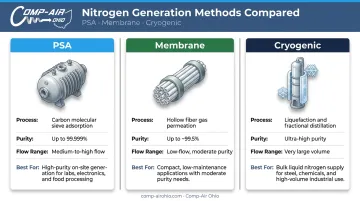
That comparison points to where each technology fits. Membrane systems are simpler and quieter, but they can't reach the purity levels PSA delivers. Cryogenic production suits bulk supply but requires significant capital and infrastructure. PSA sits between the two — flexible, adaptable to varying flow demands, and capable of the purity levels most industrial applications actually need.
How PSA Nitrogen Generation Works
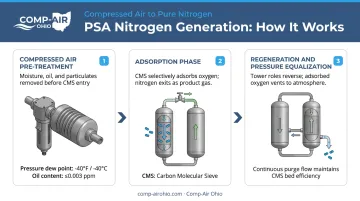
The core operating principle comes down to molecular size. Oxygen molecules are physically smaller than nitrogen molecules and diffuse into the microscopic pores of CMS material under pressure. Nitrogen molecules, too large to enter those pores, bypass the sieve and exit as product gas. Drop the pressure, and the CMS releases its trapped oxygen — ready to adsorb again.
According to peer-reviewed ACS research on CMS air separation, this selectivity is kinetic: oxygen adsorbs significantly faster than nitrogen, which is what makes the separation practical at industrial scale.
Step 1: Compressed Air Pre-Treatment
Before entering the PSA generator, compressed air must pass through a dryer and coalescing/carbon filters. The targets:
- Pressure dew point: Below 8°C (Atlas Copco); Parker specifies 4°C or better for their systems
- Oil carryover: Below 0.01 mg/m³ — even trace oil aerosols permanently coat CMS surfaces and reduce adsorption capacity
- Particulates and moisture: Removed by coalescing filtration upstream
Refrigerated dryers typically achieve dew points of 3–10°C. Desiccant dryers reach -40°C — preferred for the most demanding applications. Gardner Denver's dryer lineup, available through Comp-Air Ohio, includes both refrigerated (XGCY Series, X Series) and desiccant options (DGH Series, DHP Series) sized to meet PSA inlet requirements.
Step 2: Adsorption Phase (Nitrogen Separation)
Clean, dry compressed air enters Tower A at operating pressure (typically 7–13 bar). Oxygen, CO₂, and moisture molecules diffuse into the CMS pore structure and adsorb. Nitrogen, which cannot enter the pores, flows through and collects as product gas.
Two variables control output purity:
- Cycle timing: How long each tower spends in adsorption before switching — shorter cycles favor higher purity at the cost of throughput
- Air factor: The ratio of compressed air consumed to nitrogen produced — typical PSA systems run an air factor of 3:1 to 7:1 depending on target purity, making this the primary driver of operating cost
Step 3: Regeneration and Pressure Equalization
While Tower A adsorbs, Tower B regenerates. Pressure in Tower B is released, stripping the CMS of its trapped oxygen and venting it to exhaust. A controlled nitrogen purge from Tower A clears the desorbed gases from Tower B. Once pressures equalize, the towers switch roles.
Tower B begins adsorbing while Tower A regenerates. This cycling continues automatically — if cycle timing drifts or purge flow is insufficient, purity drops before any alarm triggers, which is why monitoring air factor in real time matters for consistent output.
Why Industries Choose PSA for On-Site Nitrogen Generation
Supply Reliability
PSA systems run continuously, 24/7, without dependence on cylinder deliveries or bulk liquid nitrogen logistics. For time-sensitive manufacturing or packaging operations, this eliminates supply chain risk: no delivery scheduling, no emergency resupply calls, no production stoppages waiting on a delayed shipment.
Purity Levels That High-Demand Industries Actually Require
PSA systems reach up to 99.999% nitrogen purity. To put that in context:
- Electronics/semiconductor: SEMI C3.49 specifies bulk nitrogen at 99.99999% — PSA serves as on-site supply for process steps requiring controlled atmospheres during soldering and chip processing
- Pharmaceuticals: USP Nitrogen specifies not less than 99.0% by volume
- Food and beverage MAP: EU Regulation 231/2012 for food additive E941 requires not less than 99% nitrogen assay, with oxygen below 1%
Membrane generators simply can't reach the upper end of that range. For applications requiring consistent purity above 99.5%, PSA is the only on-site option.
Cost of Ownership
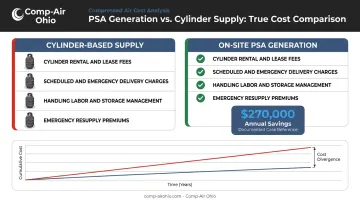
On-site generation removes costs that add up fast in cylinder-dependent operations:
- Cylinder rental and lease fees
- Scheduled and emergency delivery charges
- Handling labor and storage management
- Emergency resupply premiums during supply disruptions
A documented case reported by Compressed Air Best Practices found $270,000 in annual savings after switching to on-site generation — specific to that installation, but representative of the scale available to mid-to-large industrial consumers.
Sustainability
PSA draws from ambient air and requires no chemical inputs. Eliminating cylinder deliveries directly reduces truck traffic and associated fuel emissions. For facilities in food processing, pharmaceuticals, and aerospace — where environmental reporting is already required — that reduction counts toward ESG targets with no separate initiative needed.
Key Factors That Affect PSA Nitrogen Generation Performance
Inlet Air Quality Requirements
This is where most operational problems originate. The CMS is sensitive to three contamination types:
- Moisture: Pressure dew point must stay below ~8°C. Bulk water contacting CMS causes irreversible degradation — the adsorbent must be replaced, not recovered
- Oil: Above 0.01 mg/m³, oil aerosols coat CMS surfaces and permanently reduce adsorption capacity. Oil-injected compressors require high-efficiency coalescing and activated carbon filtration upstream
- Operating conditions: Most systems specify 7–13 bar inlet pressure and ambient temperatures of 10–25°C. Operating outside either range reduces both output and purity
The Purity-Flow Rate Tradeoff
Higher purity comes at the cost of flow rate. A generator producing 99% nitrogen at a given flow rate cannot produce 99.999% at the same rate — the cycle must slow down and the air factor increases. This is why system sizing must happen at the specification stage. You cannot dial up purity during operation without degrading output volume.
Purity decisions also affect how hard the CMS works — and that directly determines how long it lasts.
CMS Lifespan and Maintenance
Parker's documentation states a minimum CMS service life of at least 10 years, subject to correct operation. What accelerates degradation:
- Moisture events from dryer failure or undersized drying capacity
- Oil carryover from insufficient filtration upstream
- Operating the system beyond its rated purity-flow envelope
CMS replacement requires specialized disassembly and repacking by a qualified technician — plan for scheduled service, not a field repair.
Scale and Configuration
Higher flow demands require more CMS volume. Sizing decisions that seem minor at the planning stage compound quickly at scale:
- Large applications may need multi-tower or modular configurations
- Altitude reduces available air density, cutting effective throughput
- Ambient temperature swings affect both output volume and purity consistency
PSA vs. Membrane Nitrogen Generators: How to Choose
Both PSA and membrane generators produce nitrogen on-site, but they suit different purity targets, flow rates, and operating conditions. The table below covers the key decision criteria.
| Criterion | PSA | Membrane |
|---|---|---|
| Maximum purity | Up to 99.999% | Up to ~99.5% |
| Flow capability | 15–2,353 CFM | 1–153 CFM |
| Startup time | Minutes to reach steady-state purity | Near-instant |
| Noise | Exhaust blow-off peaks during cycling | Quiet — no pressure pulsation |
| Moisture sensitivity | High — irreversible CMS damage | Lower sensitivity |
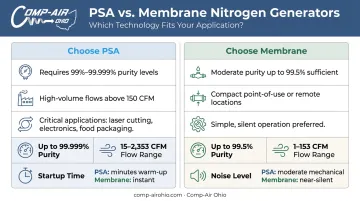
Choose PSA when:
- Required purity is consistently above 99.5%
- High flow must be paired with high purity
- Nitrogen contacts product directly (food packaging, pharmaceutical blanketing, electronics assembly)
Choose membrane when:
- Purity of 90–99% is sufficient
- The installation is mobile, space-constrained, or noise-sensitive
- Compressed air inlet conditions are difficult to fully control
The Gardner Denver XGN2 and GDN2 Series, available through Comp-Air Ohio, cover both technologies. PSA systems run from 15 to 2,353 CFM; membrane systems from 1 to 153 CFM — so facilities can match the technology to their actual purity and flow requirements.
Common Issues and Misconceptions
Three misconceptions consistently lead to undersized systems, degraded performance, or failed installations — all avoidable at the planning stage.
"The PSA generator is a self-contained solution."
Generator performance depends entirely on inlet air quality. An undersized, moisture-carrying, or oil-contaminated compressed air supply will degrade the CMS, reduce purity, and shorten system life — even when the generator itself is functioning correctly. The compressor, dryer, and filtration train are prerequisites, not accessories.
"I can get higher purity by adjusting a setting."
Purity is determined by CMS capacity, cycle timing, and flow rate — not a dial. Pushing a system beyond its design purity-flow envelope produces off-spec nitrogen while depleting the CMS faster. Purity targets must be defined at the sizing stage.
"Adsorption and absorption are the same thing."
Adsorption (what PSA uses) is a surface phenomenon where gas molecules bind to a solid material — reversible under pressure changes. Absorption, per IUPAC, involves gases dissolving into a bulk liquid phase — a different and irreversible process. That surface-level, pressure-dependent binding is exactly why the CMS regenerates: no chemical reaction occurs, so depressurization releases the captured oxygen and restores capacity.
When PSA Nitrogen Generation May Not Be Appropriate
PSA works well within a defined range — but outside that range, it becomes the wrong tool. Three scenarios where it typically falls short:
- Flow demand exceeds roughly 60,000 scfh. Air Products identifies PSA as economical from under 2,000 scfh up to that threshold; above it, cryogenic production typically costs less per unit of nitrogen.
- The facility can't supply adequately treated compressed air. An oil-injected compressor without sufficient filtration, a missing dryer, or inconsistent supply pressure will cause chronic performance problems regardless of generator quality.
- The application only needs 90–95% purity. Installing a high-purity PSA system for a task that membrane technology handles comfortably wastes both capital and energy.
Warning signs that PSA is being used inappropriately:
- Purity readings persistently below specification despite regular maintenance
- Frequent CMS replacement cycles
- Oversized buffer tanks compensating for insufficient generator capacity
In each case, the right move is to reassess actual purity requirements, flow demand, and compressed air infrastructure before selecting or replacing equipment.
Conclusion
PSA nitrogen generation is a proven technology for industrial on-site nitrogen production. But its output is only as good as the compressed air infrastructure feeding it. Compressor selection, air treatment, and system sizing are not secondary considerations: they determine whether the nitrogen coming out of the generator meets spec or doesn't.
Understanding how the process works, what degrades it, and where it's the wrong fit allows facilities to make equipment decisions grounded in actual operating requirements.
For facilities in Northern Ohio evaluating compressed air infrastructure to support on-site nitrogen generation, Comp-Air Ohio provides complete Gardner Denver compressed air systems — compressors, dryers, filtration, and nitrogen generators — with local service support backed by over 150 years of Gardner Denver engineering.
Frequently Asked Questions
What purity level can a PSA nitrogen generator realistically achieve?
PSA generators can achieve up to 99.999% purity, with some systems reaching 99.9995%. That said, achievable purity at a given flow rate depends on CMS capacity and system sizing — higher purity at higher flow requires a larger or more advanced generator configuration.
What is the difference between PSA and membrane nitrogen generators?
PSA uses carbon molecular sieves to selectively adsorb oxygen and achieves higher purity (up to 99.999%), while membrane generators use hollow fiber barriers and top out around 99.5%. Membrane systems are simpler, quieter, and better suited for low-flow or mobile applications.
What type of compressed air system is needed upstream of a PSA nitrogen generator?
Inlet air must be dry (pressure dew point below ~8°C), filtered to below 0.01 mg/m³ oil content, and delivered at stable pressure within the generator's rated range — requiring a properly sized compressor, air dryer, and appropriate coalescing and carbon filtration.
How long does a PSA nitrogen generator last, and what maintenance does it require?
With clean inlet air and scheduled maintenance, Parker documents a CMS minimum service life of at least 10 years. Key maintenance priorities are protecting the CMS from moisture and oil exposure, and regularly inspecting valves, controls, and upstream air treatment equipment.
Is PSA nitrogen generation suitable for food and beverage applications?
Yes. PSA is widely used in food and beverage for modified atmosphere packaging (MAP), inert blanketing, and beverage dispensing. Under FDA GRAS status (21 CFR Part 184.1540), nitrogen used in food contact applications must meet established purity standards — a threshold PSA consistently meets with proper system sizing.