Introduction
Hydrovane rotary vane compressors are built to last — the manufacturer claims over 100,000 operating hours, equivalent to 8 hours a day for 40 years. That longevity depends almost entirely on one thing: consistent, correct oil maintenance.
Skip or delay oil changes, and the consequences stack up fast. Accelerated vane and bearing wear, overheating, higher energy draw, and unexpected downtime are all predictable outcomes of neglected lubrication. In a production environment, an unplanned compressor failure rarely costs just the repair bill — it costs the hours your line sits idle.
This guide covers everything Northern Ohio operators need to know:
- Which oil types and viscosities Hydrovane recommends
- OEM-specified change intervals for different operating conditions
- A step-by-step oil change process
- Warning signs that lubrication may already be failing
- A practical preventive maintenance schedule
Key Takeaways
- Hydrovane compressors require OEM-approved lubricants — using the wrong oil risks warranty issues and internal damage
- Change intervals per the HV04–HV45 manual: 2,000 hours for mineral oil, 4,000 hours for synthetic — or 12 months, whichever comes first
- Dark, milky, or particulate-contaminated oil means change it now — don't wait for the scheduled interval
- Oil changes are the lowest-cost, highest-return maintenance task available for any rotary vane compressor
- Keep detailed service records — they protect your warranty and flag patterns before they become failures
Why Oil Changes Matter for Your Hydrovane Compressor
Hydrovane rotary vane compressors depend on oil for three simultaneous jobs: lubrication, sealing, and cooling. Oil injected into the compression chamber forms a microns-thick film at vane tips, creates hydrodynamic bearings at rotor journals, and removes heat from the compression process — as detailed in CAGI's compressed air handbook.
Let that film degrade, and you lose all three functions simultaneously.
How Oil Degrades
Oil doesn't fail suddenly. It deteriorates gradually through:
- Oxidation — produces acids, sludge, and varnish that restrict oil passages and thicken the lubricant
- Thermal breakdown — high operating temperatures cause mineral oil viscosity to drop, leading to metal-to-metal contact
- Moisture contamination — water in the compression cycle mixes with oil, promoting corrosion and emulsification
- Particulate buildup — airborne contaminants accumulate over time, turning clean oil into an abrasive slurry
Once oil starts degrading, internal friction increases. Research from Klueber confirms that viscosity loss from heat leads directly to metal-to-metal friction, premature wear, varnish deposits, and higher energy consumption — all of which compound over time.
The Compliance and Safety Angle
Degraded oil doesn't just stay inside the compressor. Oil carryover into the compressed air stream is a real concern, particularly for food and beverage, pharmaceutical, and medical facilities. ISO 8573-1:2010 classifies compressed air purity by particles, water, and total oil content. Class 1 requires less than 0.01 mg/m³ of oil; Class X permits above 5 mg/m³. Contaminated oil makes meeting tighter thresholds far harder — and in regulated industries, that's not just a performance issue.
The Cost Comparison
The math is straightforward:
| Maintenance Action | Approximate Cost |
|---|---|
| Aftermarket oil change kit (e.g., KO82) | ~$60 |
| Hydrovane airend replacement (e.g., 50410-101) | ~$6,260+ |
A routine oil change costs a fraction of one hour of emergency downtime, let alone a seized bearing or full airend replacement. At $60 versus $6,260+, the decision to stay on schedule makes itself.
What Oil Does a Hydrovane Compressor Use?
Using the wrong lubricant in a Hydrovane compressor is one of the most common — and most preventable — causes of premature failure. Standard motor oil, generic hydraulic oil, and multi-purpose industrial oils are not suitable. They can cause foaming, deposit buildup, and accelerated oxidation in a rotary vane compression environment.
OEM-Approved Lubricants
The Hydrovane HV04–HV45 User Handbook (ST 16135-00) identifies two approved lubricant categories:
- Fluid Force Red 2000 — mineral-based, formulated specifically for rotary vane compressors, with a 2,000-hour service interval
- HPO (Synthetic) — synthetic formulation approved for the extended 4,000-hour drain interval
The Fluid Force 2000Hr SDS confirms it is a highly refined mineral oil with additives, revised as recently as March 2023. The Hydrovane V04 service manual is explicit: "Only use genuine Hydrovane parts and FLUID FORCE RED 2000 or an APPROVED OIL" and "do not mix lubricants."
Mineral vs. Synthetic: Which to Choose
| Factor | Mineral (Fluid Force Red 2000) | Synthetic (HPO) |
|---|---|---|
| Drain interval | Every 2,000 hours | Every 4,000 hours |
| Best for | Standard duty, moderate ambient temperatures | High duty cycle, elevated ambient heat |
| Cost per change | Lower upfront | Higher upfront, fewer changes annually |
| Mixing with other oils | Never — full flush required before switching | Never — full flush required before switching |
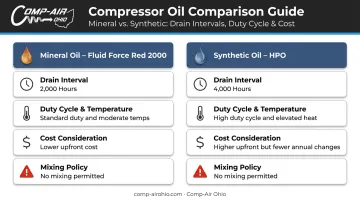
For Northern Ohio operators running compressors in continuous production or in facilities with high ambient temperatures, synthetic oil's extended interval typically reduces total annual maintenance cost. For lighter-duty intermittent applications, the mineral option works well.
Once you've identified the right oil type, sourcing the correct product matters just as much. Comp-Air Ohio stocks genuine Gardner Denver and Hydrovane-approved lubricants, including AEON-series formulations, for both OEM compatibility and warranty compliance. If you're unsure which product applies to your specific model, the technical team at (440) 237-6700 can confirm the correct specification.
Step-by-Step: How to Change Oil in a Hydrovane Compressor
Before you start, gather your supplies:
- Drain pan
- Correct-grade OEM-approved oil
- Replacement oil filter
- Gloves and eye protection
- Your model's service manual
Step 1 — Safety and Isolation
Per the Hydrovane manual and OSHA 1910.147 lockout/tagout requirements:
- Stop the compressor
- Isolate from mains electrical supply and lock the isolator in the OFF position
- Close the air outlet valve to isolate from the airline system
- Do not proceed until the pressure gauge reads zero
- Allow the unit to cool to a safe handling temperature
Step 2 — Drain the Old Oil
Section 9.8 of the Hydrovane manual outlines the drain sequence:
- Remove the filler plug first — this allows air to enter and promotes full drainage
- Position your drain pan beneath the drain point
- Remove the drain plug or turn the drain tap
- Allow complete drainage before proceeding
The manual does not specifically call for warm-oil draining, but oil that has reached operating temperature flows more completely than cold oil.
Step 3 — Replace the Oil Filter
Section 9.9 covers filter replacement:
- Unscrew the filter counterclockwise
- Apply a small amount of fresh oil to the new filter's seal gasket
- Install hand-tight only — do not use a wrench to over-tighten
Over-tightening can crack the filter housing or distort the seal, creating a leak point.
Step 4 — Refill with Approved Oil
Section 9.10 specifies the refill procedure:
- Remove the level plug
- Fill with OEM-approved oil only
- Stop filling when oil begins to overflow from the level plug hole — this confirms correct fill level
- Replace the level plug and clean any spillage
- The sight glass should appear full — do not overfill
Overfilling causes foaming and oil carryover into the compressed air stream.
Step 5 — Post-Change Verification
- Run the compressor briefly
- Re-check the sight glass level
- Inspect the drain plug and filter base for any seepage
- Verify normal operating pressure and temperature on gauges
- Log the date, hour meter reading, oil type used, and technician name
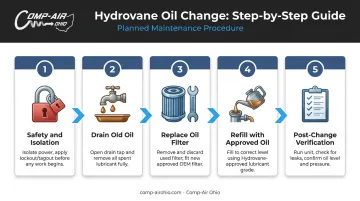
A documented service record protects your warranty coverage and gives you a clear baseline for tracking future service intervals.
Signs Your Hydrovane Compressor Needs an Oil Change
Scheduled intervals set a baseline, but oil condition can deteriorate faster depending on operating environment. Watch for these signs and act on them regardless of where you are in the maintenance cycle.
Visual Oil Condition Checks
Check the sight glass or take a dipstick sample and look for:
- Dark brown or black oil — oxidation and thermal breakdown have progressed significantly
- Milky or cloudy appearance — moisture contamination; the Compressed Air Challenge recommends draining water from the air/lubricant reservoir daily
- Visible particles or sediment — mechanical wear debris or external contamination has entered the sump
If the oil looks wrong, change it regardless of where you are in the interval.
Performance Warning Signs
These operational symptoms can all trace back to degraded oil:
- Unusual mechanical noise — knocking or rattling during operation
- Elevated discharge temperature that's climbing above normal
- Higher energy draw for the same output — a sign of increased internal friction
- Oil appearing downstream in compressed air lines or at filter drains
If any of these symptoms appear together, treat it as an urgent signal — don't wait for the next scheduled service date.
Operational Triggers
Change the oil when any of these conditions apply:
- You've reached the manufacturer's hour interval (2,000 or 4,000 hours depending on oil type)
- The 12-month calendar mark arrives, even if hours haven't accumulated
- The compressor resumes operation after an extended shutdown
- Operating conditions have been unusually dusty, hot, or humid — all of which accelerate degradation
Hydrovane Compressor Oil Change Schedule
The Hydrovane HV04–HV45 User Handbook (ST 16135-00 Iss E 05/2009) specifies two oil schedules depending on the lubricant used. The 12-month calendar rule applies to both — whichever threshold arrives first triggers the service.
Reference Maintenance Schedule
| Task | Frequency |
|---|---|
| Check oil level (sight glass) | Daily — unit off and depressurized |
| Check oil condition visually | Weekly |
| Oil change + filter replacement (Fluid Force Red 2000 mineral) | Every 2,000 hours or 12 months |
| Oil change + filter replacement (HPO synthetic) | Every 4,000 hours or 12 months |
| Adjust intervals for harsh conditions | Continuous high-duty operation, high ambient heat, dusty environment |
| Consider oil sampling analysis | Every 6 months or 1,000–2,000 hours (Compressed Air Challenge guidance) |
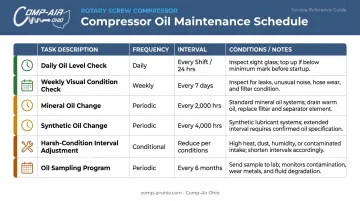
The Compressed Air Challenge also recommends periodic laboratory analysis of compressor fluids to verify actual lubricant condition. This is especially useful for high-duty-cycle facilities looking to extend drain intervals based on data rather than default schedules.
Northern Ohio operators running Hydrovane units under service contracts with Comp-Air Ohio benefit from scheduled preventive maintenance visits that handle oil changes, filter replacements, and full system inspections on a pre-set calendar. This removes the burden of interval tracking from facility staff and eliminates the risk of a missed service triggering an failure. Their 24/7 emergency service is available for contract customers at (440) 237-6700.
Conclusion
Oil changes are the most fundamental maintenance task for a Hydrovane compressor — and the most cost-effective. These machines are built to exceed 100,000 operating hours, but that lifespan depends entirely on following the right lubricant, interval, and service documentation requirements.
Keep these three practices consistent:
- Use only OEM-approved lubricants — Fluid Force Red 2000 for standard applications, HPO synthetic for extended intervals
- Follow the change intervals in your model's service manual (typically every 2,000 hours)
- Maintain service records that log run hours, oil type used, and the technician who performed the work
For Northern Ohio facilities, Comp-Air Ohio's factory-trained technicians are available for scheduled preventive maintenance and emergency service calls across the region.
Frequently Asked Questions
What oil does a Hydrovane compressor use?
Hydrovane compressors require an OEM-approved rotary vane lubricant. The HV04–HV45 manual specifies Fluid Force Red 2000 (mineral) or HPO (synthetic) as approved products. Using non-approved oils — including standard motor oil or generic hydraulic fluid — can cause foaming, deposits, and accelerated internal wear.
How often should Hydrovane compressor oil be changed?
The Hydrovane HV04–HV45 manual specifies every 2,000 operating hours for the 2,000-hour mineral oil schedule, and every 4,000 hours for the HPO synthetic schedule — or every 12 months, whichever comes first. High-temperature, high-dust, or continuous-duty environments warrant shorter intervals.
How do I check the oil level on a Hydrovane compressor?
Hydrovane compressors have a sight glass on the oil sump. Check it daily with the unit stopped and fully depressurized. The sight glass should appear full; if it's only partially full, top up with the correct OEM-approved oil to the specified level.
Can I use synthetic oil in my Hydrovane compressor?
Yes, if you use the HPO synthetic specifically approved by Hydrovane/Gardner Denver for your model. Synthetic oil supports the extended 4,000-hour drain interval. Switching from mineral to synthetic requires a full flush — never mix the two oil types in the same sump.
What happens if I don't change the oil in my Hydrovane compressor?
Degraded oil loses its lubricating, sealing, and cooling properties. Left unchecked, expect:
- Increased vane and bearing wear
- Rising operating temperatures and higher energy consumption
- Oil carryover into the compressed air stream
- Premature component failure, including airend damage
Do I need to replace the oil filter at every oil change?
Yes. The Hydrovane service schedule requires a filter change at every oil interval — both 2,000-hour and 4,000-hour. A fresh oil fill with a contaminated filter defeats the purpose of the service. Contact Comp-Air Ohio at (440) 237-6700 for the correct filter part number for your model.