Introduction
Without a shared definition of "clean," compressed air specifications become meaningless: one supplier's "dry" is another's "acceptable moisture." ISO 8573-1:2010 solves this by establishing a universal purity classification framework that engineers, auditors, and equipment suppliers can use to specify, compare, and verify air quality at any point in a compressed air system.
Getting it wrong has real consequences: product contamination in food or pharma operations, accelerated corrosion from excess moisture, and failed audits under food safety certification schemes.
The scale of the problem is easy to underestimate. According to CAGI's Compressed Air Purity Guide, general industrial air contains roughly 4,000,000 particles per cubic foot and atmospheric oil vapor concentrations of 0.05 to 0.50 mg/m³ — concentrations that multiply when air is compressed to 100 psi.
This article breaks down the standard's classification structure, contaminant limits, correct notation, and what achieving compliance actually requires — so you can specify the right air quality class for your application and verify you're meeting it.
Key Takeaways
- ISO 8573-1 classifies compressed air across three independent dimensions: solid particles, water (pressure dew point), and total oil content
- Quality classes run 0–6; lower numbers mean stricter purity — Class 0 requires written agreement between user and supplier
- Purity is always expressed as [A:B:C] (particle : water : oil class) — "Class 2 air" with no notation is technically meaningless
- Downstream treatment equipment — dryers, filters, separators — determines the class achieved, not the compressor alone
- Compliance degrades over time — point-of-use testing is the only way to confirm a class is being maintained
What ISO 8573-1 Represents in Compressed Air Systems
ISO 8573-1:2010 (Edition 3) is Part 1 of a nine-part series published by the International Organization for Standardization. Its sole function is classification: it defines maximum allowable concentrations of three contaminant types — solid particles, water, and total oil — at a specified measurement point in a compressed air system.
The standard is not a test method. Parts 2 through 9 of the ISO 8573 series handle measurement — covering oil aerosol (Part 2), humidity and dew point (Part 3), particle content (Part 4), oil vapor (Part 5), and viable microorganisms (Part 7), among others. Specifying ISO 8573-1 compliance without also referencing the relevant measurement parts means there's no defined way to verify it.
What the Standard Does Not Cover
A few limits engineers regularly assume are in the standard — but aren't:
- Microbial contamination — not addressed in the Part 1 class table; ISO 8573-7 covers viable microorganism testing separately
- Gaseous contaminants (CO, CO₂) — handled outside the Part 1 framework under other parts and application-specific safety codes
- Equipment selection — the standard defines what purity is required, not how to achieve it
In regulated industries, ISO 8573-1 is used alongside frameworks like HACCP, SQF, and FSSC 22000. It provides the air quality benchmark; those schemes define the broader food safety or pharmaceutical compliance context.
System-Point-Specific Classification
One of the most commonly misunderstood aspects of the standard: the quality class applies to a defined measurement point, not to the compressor itself. A dryer outlet, a header tap, a filling machine nozzle — each can have a different assigned class, and each needs to be verified independently. This distinction is critical for both system design and audit documentation.
The Three Contaminant Classes Defined by ISO 8573-1
The standard treats particles, water, and oil as independent axes. A system can achieve particle Class 1 while sitting at oil Class 4 — so all three dimensions must be specified and verified separately.
The table below reproduces the ISO 8573-1:2010 purity class structure as reported by CAGI and Parker:
| Class | Particles 0.1–0.5 µm (max/m³) | Particles 0.5–1.0 µm (max/m³) | Particles 1.0–5.0 µm (max/m³) | Water (Pressure Dew Point) | Total Oil (mg/m³) |
|---|---|---|---|---|---|
| 0 | User/supplier specified — stricter than Class 1 | User/supplier specified | User/supplier specified | User/supplier specified | User/supplier specified |
| 1 | ≤ 20,000 | ≤ 400 | ≤ 10 | ≤ −70°C | ≤ 0.01 |
| 2 | ≤ 400,000 | ≤ 6,000 | ≤ 100 | ≤ −40°C | ≤ 0.1 |
| 3 | — | ≤ 90,000 | ≤ 1,000 | ≤ −20°C | ≤ 1 |
| 4 | — | — | ≤ 10,000 | ≤ +3°C | ≤ 5 |
| 5 | — | — | ≤ 100,000 | ≤ +7°C | — |
| 6 | — | — | ≤ 5 mg/m³ (mass) | ≤ +10°C | — |
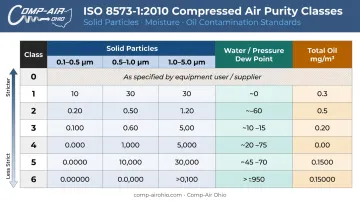
Solid Particles
Particle class is defined by count per cubic meter, segmented across three size bands: 0.1–0.5 µm, 0.5–1.0 µm, and 1.0–5.0 µm. Classes 1 through 4 use particle count limits; Class 6 shifts to mass concentration (mg/m³) for coarser contamination scenarios.
Post-compression filtration is essential precisely because of what compression does to ambient air. Atmospheric air contains particles ranging from 0.002 to 100 µm — roughly 85% smaller than 2.0 µm. When 7 ft³ of ambient air compresses to 1 ft³ at 100 psi, every one of those particles concentrates at the same ratio.
Water Content (Pressure Dew Point)
Water class is expressed as pressure dew point (PDP) — the temperature at which moisture in compressed air at line pressure begins to condense. Lower (more negative) PDP = drier air = stricter class:
- Class 1: PDP ≤ −70°C (ultra-dry; requires heated desiccant dryers)
- Class 2: PDP ≤ −40°C (desiccant dryer required)
- Class 4: PDP ≤ +3°C (refrigeration dryer output)
Moisture is the most operationally damaging contaminant in most industrial systems. It drives corrosion in distribution piping, supports microbial growth in food-contact applications, and causes pneumatic component failure through ice formation or condensate pooling.
Total Oil Content
Oil class covers all forms: liquid aerosols, mists, and vapor, expressed as a single total concentration in mg/m³:
- Class 1: ≤ 0.01 mg/m³
- Class 2: ≤ 0.1 mg/m³
- Class 4: ≤ 5 mg/m³
- Class 0: User/supplier defined, stricter than Class 1 — limits must be agreed in writing
Atmospheric air already contains hydrocarbon vapors at 0.05 to 0.50 mg/m³. An oil-free compressor drawing in ambient air will still deliver oil vapor in the compressed output. Reaching Class 1 oil requires active downstream treatment — coalescing filtration plus activated carbon adsorption — regardless of compressor type.
How ISO 8573-1 Quality Classes Are Specified and Applied
The [A:B:C] Notation
Purity is always written as three positions in order: particle class : water class : oil class.
Examples from supported industry benchmarks:
- [2:2:1] — direct food contact process air (supported by CAGI and BCAS Guideline 102)
- [1:1:0] or [1:2:0] — electronics manufacturing / clean dry air applications (Parker guidance)
- [2:4:2] — general purpose pneumatic applications (Parker guidance for instrument air: approximately [2:<4:3])
Specifying "ISO Class 2 compressed air" without the full notation is technically incomplete. Particle Class 2 says nothing about moisture or oil — a system could simultaneously have Class 5 water content. When quoting equipment or preparing audit documentation, write out all three positions — [2:2:1], not just "Class 2."
Industry Applications
| Sector | Typical Specification | Notes |
|---|---|---|
| Direct food contact | [2:2:1] | CAGI/BCAS supported benchmark |
| Electronics / CDA | [1:1:0] to [1:3:0] | Class 0 oil frequently required |
| Pharmaceutical / sterile | [1:2:0] or [1:2:1] | Verify against applicable GMP requirements |
| General industrial / pneumatics | Particle 2–3, Water 4–5, Oil 2–3 | Lower criticality, refrigeration dryer typically sufficient |
Regulatory Context
Regulatory frameworks set contamination control requirements but approach ISO 8573-1 differently:
- FDA 21 CFR 117.40(g) requires compressed air used on food or food-contact surfaces to be treated to prevent contamination — but does not specify ISO class numbers
- SQFI Air and Other Gases guidance explicitly references ISO 8573-1:2010 as a baseline for general compressed air quality and requires monitoring for particles, water, oil, and microbiological contaminants
- BRCGS, FSSC 22000 require filtered, controlled compressed air in food contact applications — verify current clause references against the licensed standard text before citing in compliance documentation
Point-of-Use vs. Header Verification
A class assigned at the dryer outlet is not automatically maintained at the point of use. Several factors degrade air quality between the header and the application:
- Pipe scale accumulating in aging distribution lines
- Worn or degraded gaskets introducing contamination
- Condensate pooling in poorly sloped runs
- Exhausted downstream filter elements past service life
Point-of-use testing is the only reliable verification method for audit purposes.
Comp-Air Ohio's team works with Northern Ohio facilities to specify the right equipment configuration for each measurement point, connecting the stated class to the correct dryer, filtration stage, and distribution infrastructure needed to maintain it.
Achieving and Verifying ISO 8573-1 Compliance
The Treatment Chain
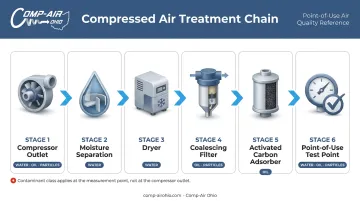
Achieving a stated quality class requires thinking in terms of a sequential treatment chain from compressor outlet to point of use — not individual component selection.
Water class:
- Refrigeration dryers → PDP ≈ +3°C → Water Class 4
- Desiccant/adsorption dryers → PDP down to −40°C or −70°C → Water Classes 2–1
Oil class:
- Coalescing filters → remove liquid aerosols and fine mists
- Activated carbon adsorbers → remove vapor-phase hydrocarbons; required for Class 1 or 2 oil
Particle class:
- Particulate filtration stages sized to the target class micron rating
- Downstream placement matters — filters positioned after dryers perform more consistently
Comp-Air Ohio supplies Gardner Denver EnviroAire Series oil-free compressors and ZEKS dryers specifically to support this treatment chain approach. Reaching a verified class means matching the right downstream equipment to the compressor output — compressor type alone does not determine air quality.
Verification Testing
Compliance is confirmed through testing using methods from the ISO 8573 series:
| What's measured | ISO Part | Current edition |
|---|---|---|
| Oil aerosol / liquid oil | ISO 8573-2 | 2018 |
| Pressure dew point / humidity | ISO 8573-3 | 1999 |
| Particle content | ISO 8573-4 | 2019 |
| Oil vapor | ISO 8573-5 | 2025 |
Field testing has specific requirements:
- Dew point meters must be calibrated for line pressure
- Oil sampling requires isokinetic protocols for valid results
- Testing should occur after system stabilization, not at startup
- Each defined measurement point must be tested individually
ISO 12500 Filter Testing Standards
Knowing how compliance is verified leads to the next question: how do you evaluate the filters themselves? ISO 12500 is the complementary standard that defines how compressed air filters are tested by manufacturers:
- Part 1 (2007): Oil aerosol removal — coalescing filters
- Part 2 (2007): Oil vapor removal — activated carbon adsorbers
- Part 3 (2009): Particulate removal efficiency (0.01 to 40.0 µm range)
Understanding ISO 12500 alongside ISO 8573-1 lets engineers evaluate and compare filter performance claims on consistent terms, rather than accepting marketing specifications at face value.
Common Misinterpretations of ISO 8573-1 in Practice
Three errors show up repeatedly in industrial and regulated environments:
1. "Oil-free compressor = ISO oil class compliance"
Oil-free compressors eliminate lubricant carryover from the compression stage — but atmospheric hydrocarbon vapors drawn in through the intake are still present and concentrated during compression. As Parker's technical guidance confirms, achieving Class 1 or 2 oil requires downstream coalescing and activated carbon filtration regardless of compressor design. The compressor type determines the source of contamination, not the final purity class.
2. Single-number class designations
"Class 2 compressed air" is not a specification — it's an incomplete label. Without the [A:B:C] notation, two of the three contaminant dimensions are undefined. This is a frequent source of procurement and audit errors: a system meeting particle Class 2 may simultaneously have oil Class 5. Specify "ISO 8573-1 Class 2.2.2" rather than "Class 2 air" in every specification document, purchase order, and compliance report.
3. Assuming installation compliance = ongoing compliance
A correctly designed system at commissioning does not stay in class indefinitely. Filter elements exhaust, pipe scale builds up in aging distribution headers, seasonal humidity shifts intake moisture loading, and biofilm can develop in stagnant sections of food-grade piping.
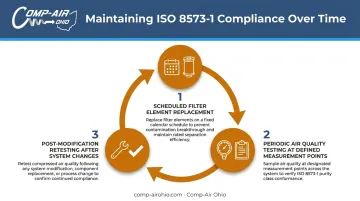
Compliance is an ongoing operational condition. Maintaining it requires:
- Scheduled filter element replacement per manufacturer intervals
- Periodic air quality testing at defined measurement points
- Post-modification retesting whenever system changes affect downstream purity
Frequently Asked Questions
What does ISO 8573-1 Class 0 mean, and when is it required?
Class 0 is not a fixed numerical limit in the standard. It's a user-defined specification that must be stricter than Class 1 across all three contaminant dimensions, with the exact limits agreed in writing between the equipment user and supplier. It's typically specified for ultra-clean applications like semiconductor fabrication or sterile pharmaceutical processing.
What is the difference between ISO 8573-1 and the full ISO 8573 series?
ISO 8573-1 defines the purity classification framework: the classes and contaminant limits. Parts 2 through 9 define the test methods used to actually measure each contaminant type (oil aerosol, dew point, particle count, oil vapor, microorganisms, etc.).
How do I determine which quality class my application requires?
Class selection depends on whether air contacts product directly or indirectly, which regulatory scheme applies (FDA, SQF, NFPA 99), and the sensitivity of downstream equipment. Consult the relevant industry scheme documentation, the standard's application guidance, or a compressed air specialist to assign the correct [A:B:C] designation for each point of use.
Does ISO 8573-1 apply at the compressor outlet or point of use?
The standard applies to a defined measurement point — typically the point of use or immediately after the air treatment train, not the compressor outlet. Air quality can degrade through distribution piping, so only point-of-use testing confirms the class is being maintained where it matters.
How often should compressed air be tested for ISO 8573-1 compliance?
Food safety and pharmaceutical certification schemes generally require at minimum annual testing. Facilities with critical processes or previous non-conformances often test quarterly. After any system change — new equipment, piping modifications, filter replacements — retesting at affected points is recommended before returning to production.
What happens if compressed air doesn't meet the specified class?
Consequences vary by industry. In food and pharma settings, non-conforming air risks product contamination, failed audits, and jeopardized certifications. Across all industries, excess moisture accelerates corrosion and pneumatic wear, and downstream equipment warranties may be voided if the specified air quality class isn't maintained.