According to the U.S. Department of Energy, compressed air accounts for roughly 10% of electricity use in a typical industrial facility — and can exceed 30% in some plants. That makes compressor selection a financial decision, not just a technical one.
This guide covers the five main types of industrial air compressors, how each works, what each is best suited for, and the factors that should drive your selection.
Key Takeaways
- Industrial compressors fall into two categories: positive displacement and dynamic compression
- The five main types are rotary screw, reciprocating, centrifugal, rotary vane, and scroll
- Oil-free compressors are required in food, pharma, and medical settings — contamination risk makes lubrication type non-negotiable
- Electricity accounts for ~76% of a compressor's 10-year lifecycle cost — energy efficiency should drive selection, not sticker price
- Wrong sizing — in either direction — increases total cost of ownership and reduces reliability
What Is an Industrial Air Compressor?
An industrial air compressor converts power — from an electric motor or combustion engine — into pressurized air stored as potential energy. Unlike consumer or professional-grade models, industrial compressors are engineered for continuous or high-volume demand across manufacturing and process environments, with higher horsepower ranges, greater CFM output, and compliance with standards like ISO 8573-1 for air quality and ASME for pressure vessels.
Compressed air is commonly called the "fourth utility" in industrial settings — used alongside electricity, gas, and water to power operations across a wide range of sectors. Common applications include:
- Pneumatic tools and automated machinery
- Process controls and instrumentation
- Conveyor and material handling systems
- Packaging, assembly, and quality testing lines
Industries ranging from automotive and food & beverage to pharmaceutical and aerospace all depend on reliable compressed air as a core production utility.
Positive Displacement vs. Dynamic Compression
Every industrial compressor operates on one of two principles.
Positive displacement compressors draw air into a chamber, mechanically reduce its volume, and discharge compressed air at consistent pressure — regardless of flow fluctuations. This category includes rotary screw, reciprocating, rotary vane, and scroll compressors.
Dynamic compression works differently. Rotating impellers accelerate air to high velocity; a diffuser then converts that kinetic energy into pressure. Because output is sensitive to flow demand, this approach suits high-volume, steady-load operations. Centrifugal and axial compressors use this principle.
| Feature | Positive Displacement | Dynamic (Centrifugal) |
|---|---|---|
| Pressure stability | High — consistent output | Variable — sensitive to load |
| Best fit | Most industrial plant-air applications | Very large, stable, high-HP operations |
| Examples | Rotary screw, reciprocating, scroll | Centrifugal |
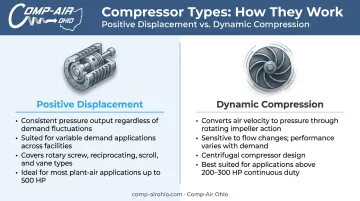
In practice, the majority of industrial facilities — from machine shops to food processing lines — run positive displacement equipment. Dynamic compression typically enters the picture above 200–300 HP, where the scale of demand justifies its infrastructure costs.
Types of Industrial Air Compressors
No single compressor type is universally best. The right choice depends on pressure requirements (PSI), airflow volume (CFM), duty cycle, air purity needs, available footprint, and energy costs.
Rotary Screw Compressors
Rotary screw compressors are the most widely deployed industrial compressor type, holding over 45% of the industrial air compressor market as of 2023. Two meshing helical rotors turn in opposite directions, trapping and progressively compressing air as it moves toward the discharge port. They are designed for 100% duty cycle continuous operation.
Oil-Injected vs. Oil-Free
Oil-injected models use oil for sealing, cooling, and lubrication. They work well for general industrial air when paired with proper downstream filtration. Oil-free variants eliminate oil from the compression stage entirely, producing cleaner air without additional treatment.
For pharmaceutical, food processing, electronics, and medical applications, Gardner Denver's EnviroAire Series (available through Comp-Air Ohio) delivers ISO 8573-1 CLASS 0 certified air across multiple configurations — from 3–10 HP scroll-based models up to two-stage units reaching 422 HP.
Variable Speed Drive (VSD) Technology
VSD technology adjusts motor speed in real time to match actual air demand. According to Atlas Copco, this can reduce compressor energy costs by 35–50% depending on load profile and application.
Gardner Denver's LRS Series VSD compressors (10–400 HP, available through Comp-Air Ohio) use the Governor™ touchscreen controller with iConn remote monitoring, enabling proactive performance management and sequencing of up to four compressors.
Best suited for: Continuous manufacturing, automotive assembly, packaging lines, machine tools, and any facility requiring steady, high-volume air over extended hours.
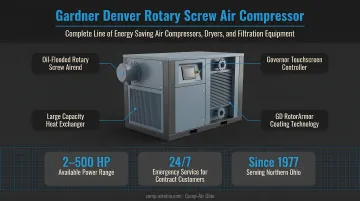
Key limitations: Higher upfront cost than reciprocating compressors; oil-injected versions require downstream treatment for clean-air applications; may be over-specified for low-volume or intermittent-use scenarios.
Reciprocating (Piston) Compressors
Reciprocating compressors use a crankshaft-driven piston that draws air on the downstroke and compresses it on the upstroke. Available in:
- Single-stage: Typically rated around 25–125 PSI
- Two-stage: Two compression cycles in series, reaching higher pressures
The defining characteristic is intermittent duty design. These compressors are not built for continuous operation — extended duty cycles lead to overheating and accelerated wear. CAGI confirms reciprocating compressors as the right fit for intermittent-demand applications, not sustained plant-wide air supply.
Gardner Denver's R-Series and PL-Series reciprocating compressors (stocked by Comp-Air Ohio) are engineered for demanding work environments. The PL-Series handles up to 250 PSI with pressure-lubricated bearings for extended life — backed by a 5-year pump warranty.
Best suited for: Auto body shops, woodworking operations, machine tool maintenance, laboratories with lower air volume needs, and as backup or supplemental units alongside primary rotary screw systems.
Key limitations: Not suitable for continuous operation; higher noise and vibration than rotary types; more frequent maintenance on valves, piston rings, and gaskets.
Centrifugal Compressors
Centrifugal compressors use one or more high-speed rotating impellers to accelerate air radially outward; a diffuser converts velocity into pressure. Because no oil contacts the compression stage, they are inherently oil-free.
CAGI identifies the economic threshold for centrifugal compressors at over 250–300 horsepower, making them the domain of large-scale industrial operations, not typical mid-sized manufacturing plants. Common applications include steel production, chemical and petrochemical processing, large automotive facilities, and power generation.
Key strengths:
- Oil-free air by design
- Very high flow capacity at scale
- Low maintenance on compression elements
Key limitations:
- Surge risk when operating at low flow — pressure/flow conditions outside the stable range can cause rapid damage
- Substantial capital investment
- Not economical for small or mid-sized facilities
Comp-Air Ohio's core product portfolio focuses on rotary screw, vane, scroll, and reciprocating technologies. For centrifugal compressor inquiries at large-scale HP requirements, their technical team can advise on appropriate sourcing through the Gardner Denver dealer network.
Rotary Vane Compressors
Rotary vane compressors use a cylindrical rotor mounted eccentrically inside a housing. Spring-loaded vanes extend from rotor slots, trapping and compressing air as the rotor turns and cavity volume decreases.
Gardner Denver's Hydrovane technology is engineered for 100,000+ operating hours without an expensive airend replacement or refurbishment. That longevity comes from three design choices: slow-speed direct drive operation (1,760 RPM), white metal bearings instead of roller bearings, and a "wears in, not out" principle where performance improves as components bed in.
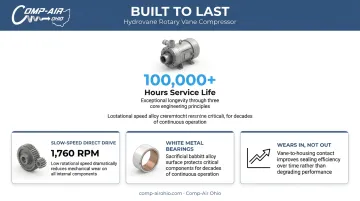
Comp-Air Ohio carries the full Hydrovane lineup from the compact V/VR Series (2–10 HP) up to the HV Series (15–60 HP), including regulated speed (RS) variable speed variants for energy efficiency.
Best suited for: Light-to-medium industrial applications, packaging, machine tools, and auto body shops where quiet, smooth airflow and long service life matter.
Key trade-offs: Lower efficiency at higher pressures; narrower flow range than rotary screw compressors.
Scroll Compressors
Scroll compressors use two interlocking spiral elements — one fixed, one orbiting — that progressively trap and compress pockets of air toward the center discharge port. No oil contacts the compression process, making them inherently oil-free and low-noise.
Current scroll compressors are generally rated in the 2–30 HP range, making them unsuitable for high-volume plant-wide production air. Gardner Denver's EnviroAire S Series (3–10 HP, 9–126 CFM at 116 PSI), carried by Comp-Air Ohio, is ISO 8573-1 CLASS 0 certified and NFPA 99 compliant for medical air applications.
Best suited for: Dental offices, laboratories, medical facilities, pharmaceutical research, and semiconductor manufacturing where low noise, compact footprint, and certified oil-free air are the priority.
Key trade-offs: Limited to lower flow rates and horsepower — not a fit for high-volume industrial production.
How to Choose the Right Industrial Air Compressor
Start With a Demand Analysis
Establish required PSI and CFM based on the total connected load of all tools and equipment at peak simultaneous demand, plus a buffer for growth. Undersized compressors cause pressure drops and production slowdowns; oversized ones waste energy running unloaded.
Match the Duty Cycle
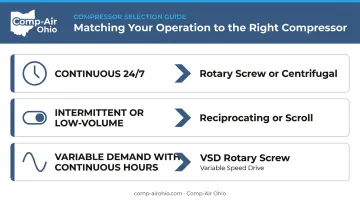
| Operation Type | Recommended Compressor |
|---|---|
| Continuous (3 shifts, 24/7) | Rotary screw or centrifugal |
| Intermittent or low-volume | Reciprocating or scroll |
| Variable demand with continuous hours | VSD rotary screw |
Address Air Quality Requirements
For pharmaceutical, food and beverage, medical, and semiconductor operations, air purity is non-negotiable. ISO 8573-1 defines purity classes for particles, water, and oil — Class 0 is specified by the user or supplier to be more stringent than Class 1 (which sets oil at ≤0.01 mg/m³). This requirement typically mandates oil-free compressor technology plus downstream treatment with dryers and filters.
Comp-Air Ohio supports ISO Class Zero compliance by pairing Gardner Denver's certified oil-free compressors with ZEKS dryers, HDF mist eliminators, and high-efficiency filtration as a complete system.
Factor in Total Cost of Ownership
Per DOE data, electricity accounts for approximately 76% of a compressed air system's 10-year cost — more than equipment purchase price and maintenance combined. A rotary screw with VSD technology costs more upfront, but for most facilities running variable loads, the energy savings recover that premium within 2–4 years.
Evaluate Service Infrastructure
Long-term energy costs and long-term reliability share the same dependency: the service network behind the machine. Comp-Air Ohio has supported Gardner Denver sales, service, and parts across Northern Ohio since 1977, with factory-trained technicians and 24/7 emergency support for contract customers across all makes and models.
Common Mistakes to Avoid
Most specification errors come down to three recurring problems — and each one is avoidable.
1. Selecting on Upfront Price Alone
The cheapest compressor rarely delivers the lowest total cost. A VSD rotary screw unit with a higher initial price typically pays back its premium through energy savings, especially in facilities with variable air demand. Factor in lifecycle costs before committing.
2. Over- or Under-Specifying the Unit
Oversizing causes frequent unloaded running, which wastes energy. Undersizing forces the compressor to run at maximum capacity continuously, accelerating wear. Neither outcome is acceptable. Proper demand profiling — mapping actual CFM requirements across shifts — eliminates both errors.
3. Ignoring Air Quality Requirements
Oil-lubricated compressors used in food processing or pharmaceutical applications without adequate downstream filtration create contamination risk and regulatory exposure. FDA food CGMP regulations require compressed air introduced into food — or used on food-contact surfaces — to be treated to prevent contamination. Specify oil-free equipment or proper filtration before deployment, not after.
Frequently Asked Questions
What are the different types of industrial air compressors?
The five main types are rotary screw, reciprocating (piston), centrifugal, rotary vane, and scroll compressors. They fall under two compression principles — positive displacement and dynamic — with each type suited to different pressure ranges, flow volumes, duty cycles, and air purity requirements.
What is the difference between a positive displacement and a dynamic air compressor?
Positive displacement compressors (rotary screw, reciprocating) mechanically reduce a fixed air volume to build pressure, delivering stable output across variable demand. Dynamic compressors (centrifugal) use high-speed impellers to convert air velocity into pressure, making them efficient at very large scale but sensitive to changes in flow demand.
Which type of industrial air compressor is most energy-efficient?
Rotary screw compressors with Variable Speed Drive (VSD) technology deliver 35–50% energy cost reductions versus fixed-speed units, making them the top choice for continuous industrial duty. Centrifugal compressors lead at very high horsepower scales, while reciprocating compressors suit intermittent, lower-volume applications.
When should I choose an oil-free compressor over an oil-lubricated one?
Choose oil-free when trace contamination would compromise product quality or regulatory compliance, as in pharmaceutical, food and beverage, medical, and semiconductor manufacturing. ISO 8573-1 Class 0 certification is the governing standard for these applications.
What PSI and CFM do I need for industrial applications?
Requirements vary widely by application and must be determined by profiling all connected pneumatic equipment at peak simultaneous demand. Estimating without proper analysis leads to costly over- or under-sizing — consult a compressed air specialist for a documented demand analysis.
How long do industrial air compressors last?
With proper maintenance, rotary screw compressors commonly reach 10–20+ years of service, while Hydrovane rotary vane compressors are designed for 100,000+ operating hours. Consistent preventive maintenance with OEM parts is the primary driver of longevity across all compressor types.