The global oil-free air compressor market reached $13.4 billion in 2025 and is projected to grow to $17.6 billion by 2033 — a trajectory driven not by a single regulatory mandate, but by sustained contamination-control pressure across manufacturing sectors. For Northern Ohio facilities evaluating their compressed air infrastructure, 2026 is a practical moment to reassess whether oil-lubricated systems still meet their purity, compliance, and efficiency requirements.
This guide reviews five leading oil-free industrial air compressors, evaluated on air purity certification, compressor technology, energy efficiency, industrial capacity range, and compliance with applicable standards.
Key Takeaways
- Oil-free compressors eliminate contamination at the source, with no downstream oil mist or filtration workarounds required
- ISO 8573-1 Class 0 is the highest air purity rating — oil content is user/supplier-specified, stricter than any fixed-limit class
- Electricity accounts for roughly 76% of a typical 10-year compressed air system cost — energy efficiency is the dominant TCO driver
- Top 2026 platforms: Gardner Denver EnviroAire T Series, Atlas Copco ZR/ZT, Ingersoll Rand Nirvana, Kaeser CSG/DSG/FSG, and ELGi OF Series
- Service infrastructure and OEM parts availability matter as much as the compressor spec sheet
Why Industrial Facilities Are Switching to Oil-Free Air Compressors
What "Oil-Free" Actually Means
Not all oil-free compressors are built the same. In industrial-grade designs, oil is excluded from the compression chamber entirely through one of several engineering approaches:
- Specialized rotor coatings (such as Gardner Denver's RotorArmor) that bond chemically and mechanically to rotors and housings, maintaining compression efficiency without lubrication oil
- PTFE-graphite or food-grade polymer coatings used by several manufacturers, though these can wear over time and reduce performance
- Water injection used in some rotary screw designs as both a coolant and sealant
- Ceramic cylinders in reciprocating configurations for low-capacity applications
The result: no oil enters the compression chamber, so no oil can enter the downstream air stream — even when downstream filtration is bypassed or fails.
ISO 8573-1 and the Class 0 Question
ISO 8573-1:2010 is the current published standard governing compressed air purity. Its oil classifications are:
| Class | Total Oil Concentration |
|---|---|
| Class 0 | Specified by user/supplier; stricter than Class 1 |
| Class 1 | ≤ 0.01 mg/m³ |
| Class 2 | ≤ 0.1 mg/m³ |
| Class 3 | ≤ 1.0 mg/m³ |
Class 0 is not a single universal number. It means the agreed-upon oil limit is more stringent than Class 1, defined in the procurement specification along with the test method and acceptance criteria.
That distinction matters for procurement teams. Regulated industries use Class 0 as their benchmark, but specifications should document the exact concentration limit — not just reference "Class 0" generically.
Why Facilities Are Making the Switch
The business case for oil-free adoption comes down to five factors:
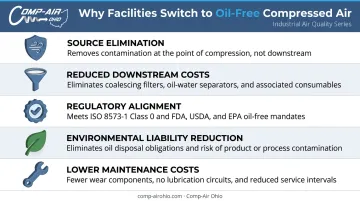
- Eliminates oil mist at the source rather than relying on downstream filtration to catch it
- Reduces downstream costs — fewer coalescing filters and filter change-outs compared to oil-lubricated systems
- Regulatory alignment: FDA drug GMP (21 CFR Part 211), FDA food CGMP (21 CFR Part 117), and NFPA 99 medical air requirements all mandate contamination prevention; oil-free design is the most defensible approach
- Removes used oil disposal and oil separator maintenance, reducing environmental liability
- Cuts recurring maintenance costs by eliminating oil changes, oil filters, and separator elements entirely
Best Oil-Free Air Compressors for Industrial Use in 2026
These five compressors were selected based on verified air purity certification, compressor technology, published energy efficiency data, industrial capacity range, and compliance with applicable standards.
Gardner Denver – EnviroAire T/TVS Series
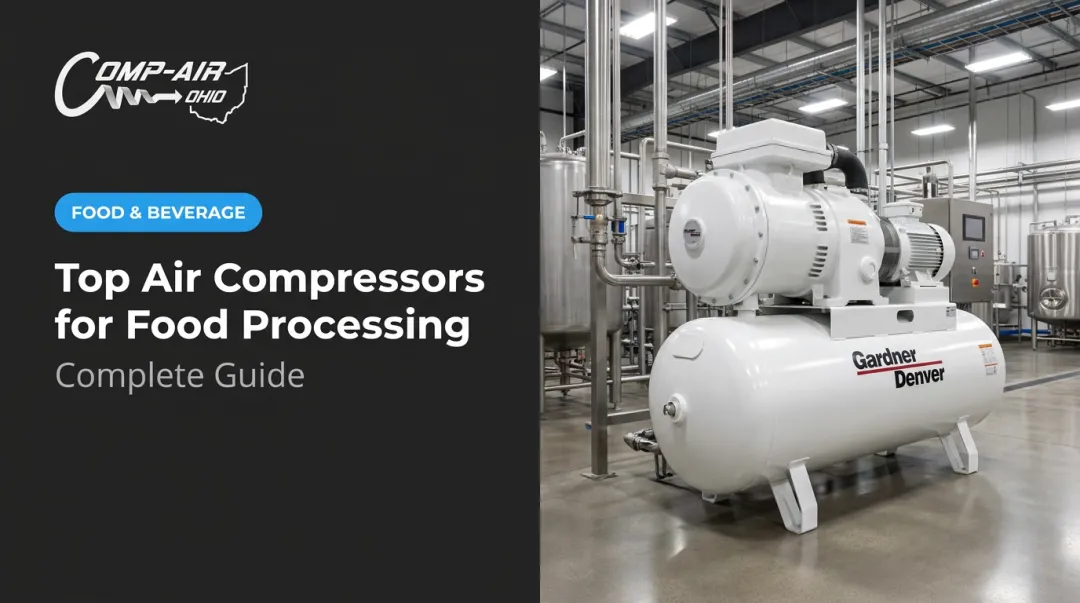
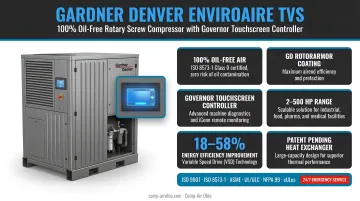
Gardner Denver has been manufacturing compressed air equipment since 1859. The EnviroAire T/TVS Series is their two-stage oil-free rotary screw platform, covering 75–315 kW (100–422 HP) at working pressures from 4–10 bar g (58–145 PSIG) — sized for demanding continuous-duty industrial applications.
The fixed-speed T models and variable-speed TVS models are independently tested and certified to ISO 8573-1 Class 0 for total oil content (aerosol, liquid, and vapour), delivering 100% oil-free and silicone-free air across the full product range.
Key technical differentiators:
- GD RotorArmor coating bonds chemically and mechanically to rotor and housing surfaces, outlasting softer PTFE-graphite coatings used by some competitors
- Closed-loop water cooling maintains near-isothermal compression, keeping discharge temperatures stable and specific power low
- TVS variable speed models deliver up to 35% energy savings by matching output to actual demand
- Governor™ touchscreen controller monitors pressure, motor speed, stage temperatures, and flow on a 7- or 10-inch display, with web server access for remote review
- iConn remote monitoring sends proactive alerts before problems affect production
The EnviroAire T/TVS also operates in ambient temperatures up to 45°C (113°F), making it suitable for plant environments where heat management is a concern.
| Factor | Detail |
|---|---|
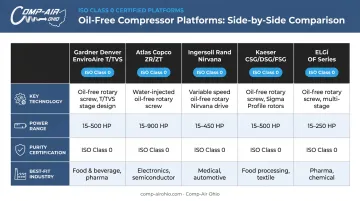
| Key Technology | Two-stage oil-free rotary screw; RotorArmor coating; iConn remote monitoring; Governor™ touchscreen |
| Power Range | 75–315 kW / 100–422 HP |
| Purity Certification | ISO 8573-1 Class 0 (independently tested, full range) |
| Best For | Pharmaceutical, food & beverage, medical devices, semiconductor, aerospace |
Comp-Air Ohio is an authorized Gardner Denver distributor serving Northern Ohio since 1977, offering sales, service, repair, OEM parts, and 24/7 emergency service for contract customers across the full EnviroAire lineup.
Atlas Copco – ZR/ZT Series
Atlas Copco's ZR (water-cooled) and ZT (air-cooled) Series are among the most widely deployed oil-free rotary screw platforms in heavy industrial environments globally, covering 15–900 kW (20–1,207 HP) at pressures up to 13 bar(g) / 189 PSIG — among the broadest capacity ranges in this category.
The ZR/ZT Series carries ISO 8573-1 Class 0 certification and integrates with Atlas Copco's SMARTLINK remote monitoring platform, which captures live equipment data and generates operational insights on uptime, energy efficiency, and machine health.
Published efficiency claims from Atlas Copco: VSD models deliver up to 35% energy savings, with heat recovery potential of up to 94% of electrical input energy — enough to offset meaningful heating loads in facilities with process heat requirements.
| Factor | Detail |
|---|---|
| Key Technology | Two-stage oil-free rotary screw with intercooling; SMARTLINK remote monitoring |
| Power Range | 15–900 kW / 20–1,207 HP |
| Purity Certification | ISO 8573-1 Class 0 |
| Best For | Large-scale manufacturing, chemical processing, power generation, high-continuity operations |
Ingersoll Rand – Nirvana Oil-Free Series
Ingersoll Rand's Nirvana Series targets facilities where energy cost reduction is the primary driver. The platform uses a Hybrid Permanent Magnet (HPM) Variable Speed Drive motor that maintains efficiency across a wider load range than conventional induction motors, reducing the losses that occur at part-load in traditional fixed-speed designs.
Published energy savings reach up to 35% versus fixed-speed units. The Nirvana Series carries ISO 8573-1:2010 Class 0 certification, with US-market capacity in the 37–75 kW (50–100 HP) range. Ingersoll Rand's broader oil-free portfolio extends further through the E-Series and Sierra lines.
Key technical differentiators:
- HPM motor sustains high efficiency at partial loads where induction motors lose performance
- Single-stage oil-free rotary screw design in a compact footprint
- Class 0 certification covers the full operating range, not just peak conditions
| Factor | Detail |
|---|---|
| Key Technology | Hybrid Permanent Magnet (HPM) VSD motor; single-stage oil-free rotary screw |
| Power Range | 37–75 kW / 50–100 HP (Nirvana line) |
| Purity Certification | ISO 8573-1:2010 Class 0 |
| Best For | Operations with variable air demand where energy cost reduction is the primary objective |
Kaeser – CSG/DSG/FSG Series
Kaeser's US oil-free rotary screw range covers 50–450 HP (140–1,770 CFM) across the CSG, DSG, and FSG Series. The platform is built around Kaeser's proprietary Sigma Profile rotor geometry, engineered to minimize internal pressure differential and maximize volumetric efficiency.
Performance data from Kaeser's 2024 CSG release: the updated design delivers up to 16% more flow and up to 19% improvement in specific performance versus conventional rotor profiles.
Key technical differentiators:
- Sigma Profile rotor geometry reduces internal pressure drop, improving volumetric efficiency
- Sigma Control 2 smart controller provides real-time monitoring with network connectivity for remote access and service alerts
- All series carry ISO 8573-1 Class 0 certification across the full capacity range
| Factor | Detail |
|---|---|
| Key Technology | Sigma Profile oil-free rotary screw; Sigma Control 2 with network connectivity |
| Power Range | 50–450 HP / 140–1,770 CFM |
| Purity Certification | ISO 8573-1 Class 0 |
| Best For | Food & beverage, textile, packaging, and electronics requiring consistent high-purity air |
ELGi – OF Series
ELGi's OF Series covers 60–500 HP in air-cooled (60–250 HP) and water-cooled (125–500 HP) configurations at 100–145 PSI, making it a competitive total-cost-of-ownership option for facilities requiring Class 0 air across mid-to-large capacity ranges.
The platform uses an η-V rotor design to reduce compression-stage pressure losses, combined with a PTFE-based food-grade internal coating that blocks both oil contamination and metal particle ingress. Accessible internal components keep labor time low during scheduled maintenance. The OF Series carries ISO 8573-1 Class 0 certification.
| Factor | Detail |
|---|---|
| Key Technology | η-V rotor design; food-grade PTFE internal coating; two-stage compression; water or air cooling |
| Power Range | 60–500 HP |
| Purity Certification | ISO 8573-1 Class 0 |
| Best For | Pharmaceutical, food processing, electronics, and laboratories with competitive TCO requirements |
How We Chose the Best Oil-Free Air Compressors
The most common procurement mistake is selecting a compressor on price or brand recognition alone — without verifying the purity class certified, the technology's fit for your duty cycle, or whether local service support exists. Any one of those gaps can mean compliance failures or preventable downtime.
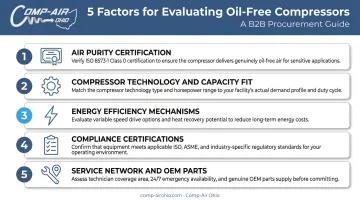
The five evaluation factors used in this comparison:
ISO 8573-1 air purity certification — Class 0 vs. Class 1, and whether the certification covers the full product range or specific models only. Procurement specs should reference the concentration limit, test method, and acceptance certificate — not just "Class 0."
Compressor technology and capacity fit — Two-stage rotary screw designs dominate heavy industrial applications for their specific power efficiency. Matching HP/kW range to actual facility demand prevents both undersizing and costly oversizing.
Energy efficiency mechanisms — Energy typically represents over 70% of compressor lifecycle cost according to CAGI. VSD technology and two-stage compression with intercooling deliver the highest efficiency gains — verified VSD savings commonly reach up to 35%.
Compliance certifications for regulated industries — Class 0 air purity is table stakes across industrial platforms. Secondary certifications — NFPA 99, ASME, UL, cULus — vary by model and must be verified against the specific unit datasheet before purchasing for regulated applications.
Service network depth and OEM parts availability — A Class 0 compressor that goes offline for three weeks waiting on an airend component is not a compliant compressed air system. Proximity to factory-trained technicians and locally stocked OEM parts is the difference between a two-day repair and a three-week shutdown.
Conclusion
In regulated industrial environments, the compressor you select directly affects product safety, regulatory standing, and production continuity. Oil-free air is a quality assurance and compliance requirement — and the wrong choice creates real exposure across all three.
When evaluating options, calculate Total Cost of Ownership across a 10-year operating horizon. Key factors include:
- Energy consumption at your specific duty cycle
- Maintenance intervals and labor requirements
- Local service availability and response times
- OEM parts lead times during unplanned failures
A lower-priced unit with a weaker service network often costs more over time.
Comp-Air Ohio has been serving industrial facilities across Northern Ohio as an authorized Gardner Denver distributor since 1977. Their team offers sales, service, repair, OEM parts, compressed air audits, and 24/7 emergency service for contract customers across Gardner Denver's full oil-free compressor lineup — including the EnviroAire T/TVS Series. If your facility is assessing air purity requirements or evaluating an oil-free upgrade, contact Comp-Air Ohio at (440) 237-6700 to discuss your specific capacity and compliance needs.
Frequently Asked Questions
Which air compressor is best for industrial use?
For contamination-sensitive or regulated environments, oil-free rotary screw compressors are the correct choice. Oil-lubricated rotary screw compressors remain suitable for general manufacturing where air purity is not critical. The right answer depends on required air purity class, duty cycle, and the compliance standards governing your industry.
Which is better — oil or oil-free air compressors?
Oil-lubricated compressors offer lower upfront cost and are well-suited to general industrial applications where product contact is not a concern. Oil-free compressors are required where air purity is critical — pharmaceutical, food processing, medical, and electronics manufacturing — with ISO 8573-1 defining which purity class applies to your specific application.
What does ISO 8573-1 Class 0 mean for oil-free compressors?
Class 0 is the highest purity rating in the ISO 8573-1:2010 framework. It means the agreed-upon oil concentration limit is more stringent than Class 1 (≤0.01 mg/m³) and is specified jointly by the user and supplier. Procurement specs should document the exact limit, test method, and acceptance certificate — not rely on "Class 0" as a standalone claim.
What types of oil-free air compressors are used in industrial settings?
Three main types are used in industrial settings:
- Oil-free rotary screw — most common for continuous, heavy-duty industrial use
- Oil-free reciprocating/piston — suited to lower-capacity or intermittent applications
- Water-injected rotary screw — used where cooling efficiency and air purity are both priorities in high-capacity settings
What industries are required to use oil-free air compressors?
Pharmaceutical, food and beverage, medical/healthcare, semiconductor, electronics, and aerospace are the primary sectors where oil-free air is operationally essential or mandated by applicable standards. FDA GMP regulations (21 CFR Parts 117 and 211) and NFPA 99 for medical air systems each require contamination prevention in compressed air applications.
How often do oil-free industrial air compressors need maintenance?
Oil-free compressors eliminate oil changes and separator replacements, but still require periodic air filter replacement, airend inspections, and cooling system checks. Specific intervals depend on operating hours and the OEM's recommendations for the exact model. Consult the operations manual or an authorized service provider for guidance. Preventative maintenance contracts help maximize uptime and protect warranty coverage.