Introduction
For most industrial facilities, compressed air is quietly one of the largest electricity expenses on the books. According to ENERGY STAR, it accounts for 10–30% or more of a plant's total electricity consumption — and overall system efficiency can be as low as 10–15%, with 80–93% of input electrical energy lost as heat.
The waste rarely arrives all at once. Leaks multiply unnoticed, pressure settings drift upward over time, and aging equipment runs less efficiently each year — producing a slow, steady rise in electricity spend that rarely triggers an alarm until the bill does.
Compressed air costs are not fixed. They are shaped by equipment choices, operating habits, and system design — and all three are addressable. This article breaks down each area so Northern Ohio facility managers can identify exactly where the biggest savings opportunities are hiding.
Key Takeaways
- Compressed air systems routinely waste energy through excess pressure, undetected leaks, and poor demand matching
- Fixed-speed compressors running against variable demand are a structural inefficiency built into the equipment choice itself, not a maintenance failure
- Savings come from three directions: better equipment decisions, improved daily management, and a well-maintained system environment
- No single fix works universally — the right starting point depends on where your costs originate
- A compressed air audit is the fastest way to find out
How Air Compressor Energy Costs Build Up Over Time
Compressed air waste rarely arrives all at once. It builds gradually — a slow leak here, a filter that needs replacing there, a pressure setpoint bumped up six months ago to compensate for a distribution problem that was never fixed. Each source adds a small daily cost. Over weeks and months, those costs compound into a meaningful line on the energy bill.
What makes this pattern hard to catch is that it rarely triggers an alarm. Equipment continues running. Production continues. But electricity consumption keeps climbing.
Three patterns accelerate this cost buildup:
- Deferred maintenance — clogged filters and aging seals force the compressor to work harder
- Pressure creep: setpoints get raised to compensate for distribution losses instead of addressing root causes
- Capacity mismatch — a production expansion or shift change pushes a marginally sized system into chronic inefficiency
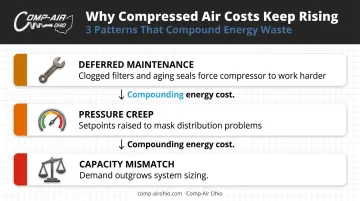
By the time the problem shows up clearly on an energy bill, the underlying causes have usually been building for months.
Key Energy Cost Drivers in Compressed Air Systems
To cut compressed air costs, you first need to know where they come from. Four drivers account for the majority of avoidable compressed air energy waste.
Excess System Pressure
The DOE/Compressed Air Challenge sourcebook states that for systems operating around 100 psig, every 2 psi increase in discharge pressure adds approximately 1% to energy consumption. When unregulated uses like leaks represent 30–50% of air demand, that penalty climbs to 1.6–2% per 2 psi.
Many facilities run pressure 10–20 psi higher than actual need — not because the process requires it, but because leaks and undersized piping are robbing usable pressure downstream. The compressor compensates by working harder, and that extra energy cost compounds every operating hour.
Air Leaks
DOE Tip Sheet #3 puts average leak losses at 20–30% of total compressor output in typical industrial systems. This is the average for facilities without active leak management programs, not a worst-case figure.
Leaks worsen progressively. Fittings loosen, connections age, and hose connections wear. Without a recurring detection program, a facility that starts at 10% loss can easily reach 30% within a few years.
Fixed-Speed Compressors Against Variable Demand
A fixed-speed rotary screw compressor running unloaded — producing no useful air — still consumes 15–35% of full-load power. For most facilities, air demand fluctuates by shift, day of week, and season. A fixed-speed unit can't adjust; it runs at full motor speed regardless, and that unloaded power draw adds up fast.
This isn't a maintenance problem — it's a structural mismatch that gets locked in at the time of purchase.
Pressure Drop in the Distribution System
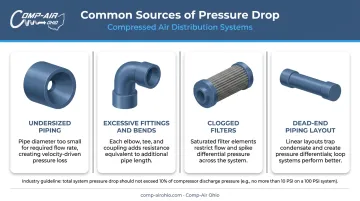
According to CAGI's Technical Brief on Pressure Drop, a well-designed system should see no more than 10% pressure drop between the compressor and any point of use. Exceeding that threshold forces higher discharge pressure — and triggers the 1% energy penalty per 2 psi.
Common contributors include:
- Undersized piping that restricts flow at peak demand
- Excessive fittings and bends adding cumulative resistance
- Clogged filters restricting air passage
- Dead-end piping layouts with no return loop
These issues are often built into the original system design, then worsen as the system ages and demand grows.
Cost-Reduction Strategies for Air Compressors
The most effective strategies depend on where cost originates. A facility dominated by leak losses needs a different first move than one with an oversized fixed-speed compressor. The following strategies are organized by the type of change they require.
Strategies That Change Equipment Decisions
These decisions have the longest-lasting impact because they set the system's energy baseline.
Right-size the compressor to actual demand. Oversized compressors frequently run unloaded — consuming 15–35% of full-load power while producing nothing useful. Matching compressor capacity to real CFM demand (not theoretical peak) prevents this waste from day one. Storage receivers and proper demand profiling are the tools; a compressed air audit provides the data.
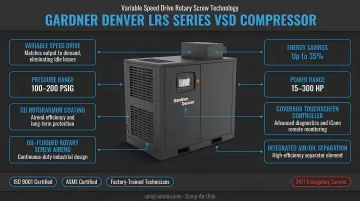
Upgrade to variable speed drive (VSD) technology when demand fluctuates. VSD compressors adjust motor speed to match actual air demand in real time. When demand drops, the motor slows — rather than running full speed and venting excess. Gardner Denver's LRS Series VSD compressors, available through Comp-Air Ohio, span 10–400 HP and cover the demand profiles of most Northern Ohio industrial facilities.
For facilities also upgrading air treatment equipment, Gardner Denver's X Series Large Refrigerated Dryers feature a patent-pending heat exchanger delivering 18–58% energy efficiency improvement over conventional designs.
One important note: VSD compressors are most effective in variable-demand applications. At sustained full load, a fixed-speed unit can be more efficient due to drive losses in VSD systems.
Design the distribution system for low pressure drop. Pipe diameter, loop versus dead-end layout, fitting count, and storage receiver sizing all determine how much pressure the compressor must generate to deliver usable air at end-use points.
Comp-Air Ohio's aluminum Quick-Lock and Big-Lock piping systems — built from marine-grade aluminum with corrosion-resistant interiors — maintain full bore integrity for the life of the system. Unlike iron piping, which corrodes internally over time and gradually restricts flow, aluminum delivers consistently low pressure drop without degradation.
Replace inappropriate compressed air uses with lower-energy alternatives. For low-pressure applications (roughly 15–60 psi range), low-pressure blowers can serve the same function at a fraction of the energy cost. Compressed Air Best Practices documented a case where 300 cfm at 40 psig required 30 hp versus 60 hp at 100 psig — a savings of up to $9,400 annually. Engineered air nozzles also replace open-pipe blow-off setups with focused airstreams that require less volume and lower pressure.
Strategies That Change How the System Is Managed
Well-designed systems still waste energy when managed poorly. These operational strategies address ongoing cost.
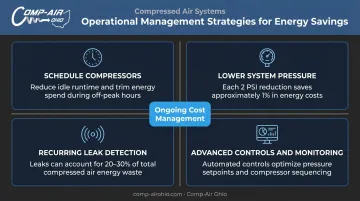
Schedule compressors around production hours. Overnight runs, weekend operation, and idling during plant shutdowns add up fast. Kaeser estimates that a 100 HP compressor running continuously costs approximately $75,000/year in electricity at $0.10/kWh. Even partial reductions — shutting down compressors during a weekend shift — translate directly to eliminated cost.
Set system pressure at the lowest effective level. When pressure drops at a point of use, find and fix the cause — don't raise the setpoint. Investigate leaks, check filter condition, and assess pipe sizing. Once distribution problems are addressed, most facilities can reduce operating pressure meaningfully. Per the DOE rule of thumb, every 2 psi reduction saves roughly 1% in energy.
Run a formal, recurring leak detection program. Leaks are not a one-time fix. New ones develop continuously as connections age and fittings loosen. Ultrasonic detection leads the industry for a reason — it finds leaks that visual and auditory inspections miss entirely. Facilities without recurring programs see leak rates climb steadily; the DOE's target is 5–10% of total system flow, well below the 20–30% average.
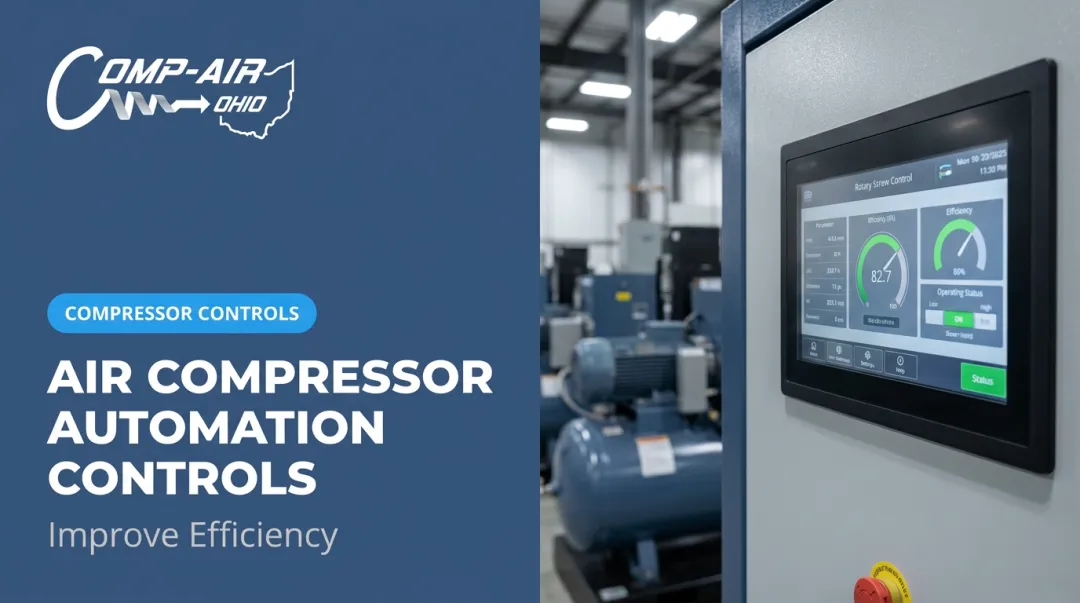
Deploy advanced controls and real-time monitoring. For multi-compressor systems, master controllers maintain a narrow, stable pressure band and sequence units to avoid competing or running unnecessarily. Gardner Denver's Governor touchscreen controller — standard on LRS Series and Electra TSV models — provides real-time diagnostics, machine status data, and historical trend logging. The integrated iConn remote monitoring platform flags potential issues before they become failures, giving facility managers continuous visibility into energy performance without requiring a technician on-site.
Strategies That Change the System Context
In many facilities, the biggest efficiency opportunities aren't in the compressor itself — they're in the components and environment surrounding it.
Replace timer-based condensate drains with zero-loss automatic drains. Timer drains discharge a fixed volume of compressed air on a schedule, regardless of actual condensate levels. Fluid-Aire Dynamics estimates this wastes approximately $150/year per valve in compressed air. Zero-loss drains discharge only condensate, eliminating that waste entirely. Comp-Air Ohio carries Gardner Denver DS2 Series and ZEKS SDD200H zero-loss drains — both engineered specifically for this purpose.
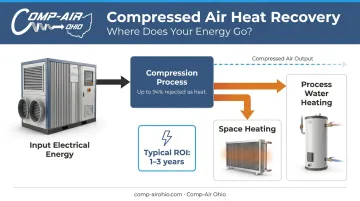
Capture waste heat from the compression process. Gardner Denver's internal documentation puts the figure at approximately 94% of input electrical energy rejected as heat. The DOE/CAC sourcebook confirms that heat recovery units can redirect 50–90% of available thermal energy to space heating, process water heating, or other thermal loads. Gardner Denver offers heat recovery as both a factory-fitted option and a retrofit kit for existing installations. According to Compressed Air Best Practices, ROI for heat recovery is typically one to three years — making it one of the highest-return investments in a compressed air system.
Optimize inlet air conditions. Compressors work harder drawing in warm, humid air. TLV's data shows that drawing 10°C (50°F) outdoor air instead of 30°C (86°F) indoor air reduces energy consumption by approximately 3%. Locating the compressor inlet to access the coolest, cleanest available air source is a low-cost change with a measurable payback.
Conclusion
Reducing compressed air energy costs starts with correctly identifying where waste originates. A facility losing 25% of its air to leaks needs a detection and repair program as its first move. A plant running a fixed-speed compressor against a variable demand profile needs to evaluate VSD technology. A system with an inflated pressure setpoint needs distribution work before anything else.
No single intervention works everywhere. The systems that consistently hold their efficiency gains are the ones treated as managed utilities — tracked, maintained on a schedule, and reassessed when production demands shift. Equipment degrades, demand changes, and leaks develop regardless of how well the system was originally designed.
Comp-Air Ohio has been helping Northern Ohio facilities manage compressed air as a controlled operating cost since 1977. If you're unsure where your system's losses originate, a compressed air audit is the practical starting point. Contact Comp-Air Ohio at (440) 237-6700 to schedule one.
Frequently Asked Questions
Are air compressors energy-efficient?
Compressed air is inherently energy-intensive — the DOE and ENERGY STAR report that 80–93% of input electrical energy is lost as heat, with overall system efficiency as low as 10–15%. Modern VSD compressors, heat recovery systems, and proper system management can substantially reduce the net energy cost per unit of useful air produced.
How do you save energy in an air compressor?
Start with whichever of these actions addresses your facility's largest cost driver:
- Fix air leaks before any other upgrade
- Reduce system pressure to the minimum effective level
- Upgrade to VSD technology if demand fluctuates across shifts
- Schedule compressor shutdowns during non-production hours
- Deploy modern controls to eliminate idle energy waste
How much do air leaks cost a facility annually?
It depends on leak size, system pressure, and operating hours. TLV's example puts a single 1 mm leak at roughly $505/year at moderate operating pressure. Facilities without formal leak detection programs typically lose 20–30% of total compressed air production to leaks — a proportional hit to the facility's entire compressed air electricity bill.
What is a VSD compressor and how does it save energy?
A VSD compressor adjusts its motor speed to match actual air demand in real time. When demand drops, the motor slows — rather than running at full speed and venting excess capacity. This eliminates the energy penalty of unloaded fixed-speed operation, making VSD particularly valuable for facilities with variable shift patterns or seasonal demand swings.
How does lowering system pressure reduce energy costs?
Per the DOE/CAC rule of thumb, every 2 psi reduction in operating pressure saves approximately 1% in energy for systems around 100 psig. Many facilities run well above their actual process requirements because they've raised setpoints to compensate for leaks or undersized piping. Fixing those root causes usually allows a meaningful pressure reduction that compounds into significant savings.
What is heat recovery in a compressor system and is it worth it?
Heat recovery captures the thermal energy a compressor rejects during operation — up to 94% of input electricity — and redirects it to space heating, process water heating, or other thermal loads. Compressed Air Best Practices reports a typical ROI of one to three years, making it among the fastest-payback investments in a compressed air system.