This guide covers what compressed air quality testing actually involves: which contaminants matter, how each is tested, how to read results against ISO 8573-1 purity classes, and how to build a monitoring program that holds up over time.
Key Takeaways
- Compressed air carries four main contaminants: water vapor, oil (aerosol and vapor), solid particles, and viable microorganisms
- ISO 8573-1 classifies air purity separately for particles, water, and oil (written as [Particles:Water:Oil])
- Testing methods vary by contaminant — each type of contamination requires a different instrument and sampling approach
- Always collect samples at the point of use, not just at the compressor outlet
- A structured monitoring program catches contamination problems before they become failures
What You Need to Test Compressed Air Quality
Effective testing starts before you connect a single piece of sampling equipment. The right tools, correct sampling locations, and a system running under normal conditions are all prerequisites. Skip any one of them and the results will mislead you.
Tools and Access Requirements
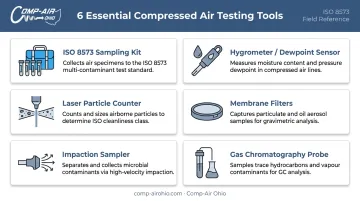
According to Compressed Air Best Practices, conduct sampling at the point of use to ensure air meets purity requirements where it's actually consumed. An on-site testing setup requires:
- ISO 8573 sampling kits — most include all necessary sampling media for lab submission
- Hygrometer or dewpoint sensor — for in-line moisture measurement
- Laser particle counter — provides particle size distribution data required for ISO classification
- Membrane filters — capture particulate and oil aerosol for laboratory analysis
- Impaction sampler — required for viable microorganism testing per ISO 8573-7
- Gas chromatography probe — for oil vapor (C6+ hydrocarbons) analysis
Don't collect samples only at the compressor outlet. Distribution piping, flexible hoses, o-rings, and fittings all introduce contamination downstream. The compressor outlet can pass cleanly while a rubber hose 30 feet away sheds particles directly into the process.
Preconditions and Setup
Before collecting any sample, confirm these conditions are met:
- Run under normal load — startup and light-load operation produce different air chemistry than real production conditions
- Stabilize pressure — confirm the system has reached its normal operating pressure before sampling begins
- Purge the sampling line — flush briefly before collecting to clear residual contamination from the line itself
- Sample at multiple points — include both near the treatment equipment and at end-use locations
If coordinating all of this during active production is difficult, Comp-Air Ohio's service technicians collect samples on-site during routine maintenance visits across Northern Ohio. Call (440) 237-6700 to schedule air quality testing alongside your next service visit.
The Four Key Contaminants in Compressed Air and How to Test for Each
The Compressed Air & Gas Institute (CAGI) and ISO 8573-1 identify four contaminant categories that affect compressed air quality. Each requires a different testing approach and carries different risks depending on the application.
Water Vapor and Moisture
When air is compressed, its pressure dewpoint rises sharply: moisture concentrates rapidly. Liquid water in the system causes corrosion, pipe blockages, and pressure drop, and in food or pharmaceutical applications it creates a direct contamination pathway.
Testing methods:
- Hygrometers / dewpoint sensors — measure pressure dewpoint directly in the air stream; most common for on-site measurement (governed by ISO 8573-3)
- Detector tubes — collect a discrete sample for water vapor analysis
- Spectroscopic analysis — identifies water presence through wavelength spectrum testing
ZEKS desiccant dryers carried by Comp-Air Ohio achieve dewpoints as low as -100°F, corresponding to ISO 8573-1 Class 1 for water. Refrigerated dryer models deliver a standard 38°F pressure dewpoint (Class 4), suitable for general manufacturing applications.
Oil (Aerosol and Vapor)
Oil enters compressed air from lubricants in oil-lubricated compressors. It appears in two distinct forms: aerosol (fine droplets) and vapor (gaseous hydrocarbons, C6+). Testing for only one form produces incomplete and misleading results. ISO 8573-1 measures total oil as the sum of liquid oil, aerosol, and vapor combined.
Testing methods:
- Membrane collection + spectrometer analysis — captures oil aerosol per ISO 8573-2
- Gas chromatography sampling probe — measures oil vapor per ISO 8573-5; effective for C6+ compounds
For facilities running oil-lubricated rotary screw compressors, downstream filtration is the primary defense. Comp-Air Ohio stocks ZEKS HDF Mist Eliminators, which achieve oil outlet concentrations as low as 0.01 ppm from a 2 ppm inlet. High-efficiency after-filters in the XGCY Series deliver ISO Class 1 oil quality with 99.999%+ removal of solids ≥0.01 micron.
For food direct-contact, pharmaceutical, and semiconductor applications where even trace oil is unacceptable, Gardner Denver's EnviroAire Series oil-free compressors carry ISO 8573-1 Class 0 certification. That eliminates oil contamination risk at the source rather than managing it downstream.
Solid Particles
Particulate contamination has multiple entry points: ambient intake air, pipe scale, rust from internal moisture corrosion, worn internal components, and — critically — rubber hoses and o-ring fittings downstream of point-of-use filters. As Parker notes, atmospheric dust, rust, and system-generated debris all contribute to particle loading.
Testing methods:
- Laser particle counter — analyzes a sample in approximately 10 minutes; provides particle size distribution across the 0.1–5.0 micron ranges required for ISO 8573 classification
- Filter/membrane microscopy — captures particles ≥0.1 micron on a gridded membrane for visual inspection
For critical applications, replace flexible rubber hoses downstream of filters with aluminum piping. Comp-Air Ohio supplies Quick-Lock and Big-Lock aluminum piping systems manufactured from marine-grade aluminum, which are non-corrosive, shed zero particles, and are rated to 300 PSI with a lifetime warranty on pipe and fittings.
Viable Microorganisms
Bacteria, yeast, and mold enter through the air intake or grow in moisture-rich areas of the distribution system. In food processing, pharmaceutical manufacturing, and medical device production, microbial contamination can trigger product recalls, regulatory action, or batch rejection.
One important clarification: ISO 8573-1 does not assign numeric purity classes for microorganisms. ISO 8573-7 defines the sampling methodology, but facility-specific action limits must come from your environmental monitoring program, BRCGS clause 4.5.3, or applicable regulatory guidance.
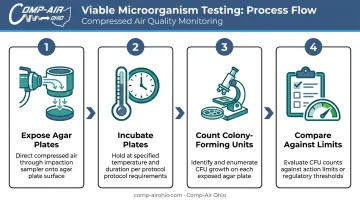
Testing method: Multi-point impaction samplers are the standard approach. The process follows these steps:
- Expose aerobic or anaerobic agar plates to a controlled volume of compressed air using an impaction sampler
- Incubate plates for the required duration at the specified temperature
- Count colony-forming units (CFUs) on each plate
- Compare results against your internal action limits or regulatory thresholds
How to Interpret Your Compressed Air Test Results
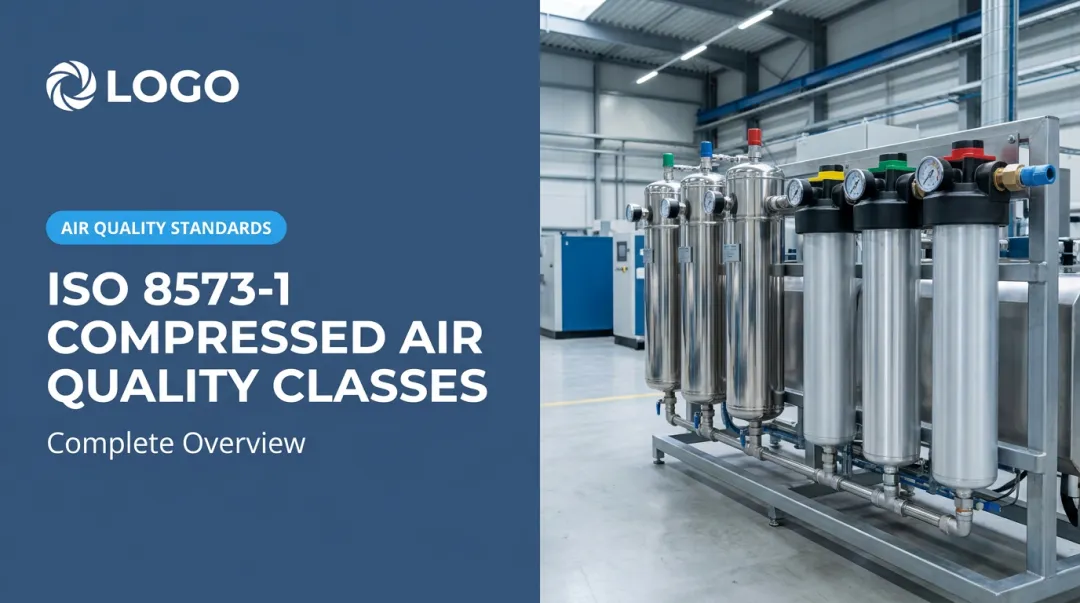
ISO 8573-1:2010 is the standard framework for evaluating compressed air purity. It assigns separate classes for particles, water, and oil, written in the format [Particles : Water : Oil]. A designation of [2:2:1] means Class 2 for particles, Class 2 for water (dewpoint ≤ -40°C), and Class 1 for oil (≤0.01 mg/m³).
ISO 8573-1:2010 Purity Class Reference
| Class | Particles (1–5 µm, /m³) | Water (Pressure Dewpoint) | Oil (mg/m³) |
|---|---|---|---|
| 0 | User/supplier specified | User/supplier specified | User/supplier specified |
| 1 | ≤10 | ≤ -70°C | ≤0.01 |
| 2 | ≤100 | ≤ -40°C | ≤0.1 |
| 3 | ≤1,000 | ≤ -20°C | ≤1.0 |
| 4 | ≤10,000 | ≤ +3°C | ≤5.0 |
| 5 | ≤100,000 | ≤ +7°C | — |
| X | >100,000 | Liquid water present | >5.0 |
Source: CAGI Compressed Air Purity Guide
Reading Your Results
Passing results meet or exceed your facility's specified ISO class for all three contaminants. For food and beverage indirect contact, [2:2:1] is a commonly referenced benchmark — the right class depends on your application and risk profile.
Minor issues — one class below target (Class 3 when Class 2 is required) — typically point to filter degradation, dryer inefficiency, or an overdue maintenance interval. Replace filters, verify dryer function, and retest within a defined timeframe.
When results are worse than a one-class miss, you're likely dealing with a systemic problem. Out-of-spec results (Class X, or measurements exceeding Class 4–5 limits) commonly trace back to:
- Oil-seal failure in the compressor
- Clogged or bypassed filters
- Condensate drain failure
- Contaminated intake air
Halt any production processes using the affected air stream, investigate the root cause, and bring in a certified service provider.
A Note on Baseline Testing
If you haven't tested before, start without a predefined class target. Understand what class your system naturally produces first, then set specifications accordingly. Imposing Class 1 targets on a system producing Class 3 without understanding why sets you up for repeated failures.
For microorganisms, compare results against your environmental monitoring program limits or applicable regulatory guidance (FDA aseptic processing guidance, BRCGS Issue 9 clause 4.5.3, or SQF Edition 9 section 11.5.5.2 for food manufacturers).
Setting Up a Compressed Air Quality Monitoring Program
A single test tells you where the system stood on one day. Compressed air quality shifts with seasonal intake air variation, filter wear, changing production demand, and equipment age. A formal monitoring program keeps those shifts visible before they become problems.
Step 1 — Document the System
Record all system components: compressor type and model, dryer type and dewpoint rating, filtration stages and grades, piping material, storage receiver locations, and point-of-use filter positions. This baseline map is your troubleshooting reference when results deviate.
Step 2 — Define Sampling Points and Frequency
- Include a mix of product-contact and non-product-contact outlets
- Quarterly testing is standard practice for most manufacturing environments
- SQF Edition 9, section 11.5.5.2 requires food manufacturers to monitor at a risk-based frequency, with annual testing as the minimum
- Add sampling after any maintenance event, equipment change, or unexpected quality issue
Step 3 — Review Trends and Act Early
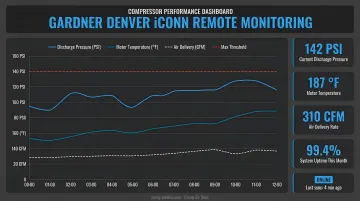
Single-point results matter less than directional trends. A dewpoint that climbs one class each quarter signals a declining dryer, often weeks before it fails a critical audit. Continuous monitoring tools — such as Gardner Denver's iConn system — track compressor performance between scheduled tests, flagging pressure drops, temperature spikes, or runtime anomalies that often appear before air quality degrades.
Step 4 — Match Corrective Actions to the Problem
| Issue Severity | Response |
|---|---|
| Filter differential pressure high | Replace filters (short-term) |
| Dewpoint drifting, oil rising | Upgrade filtration or dryer equipment (mid-term) |
| Recurring oil contamination | Switch to oil-free compressor — eliminates oil at the source (long-term) |
Common Errors and Safety Best Practices When Sampling
Testing Errors That Produce False Results
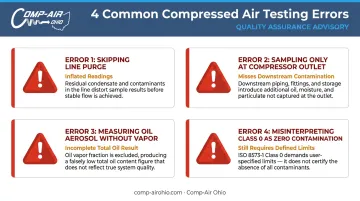
- Skipping line purge before sampling traps residual contamination and inflates readings
- Sampling only at the compressor outlet misses contamination the distribution system adds downstream
- Testing oil aerosol without oil vapor (or vice versa) produces a partial result — both must be measured to calculate total oil per ISO 8573-1
- Treating Class 0 as zero contamination — it means user/supplier-specified limits more stringent than Class 1, but those limits must still be defined and verified
Interpretation Errors
Don't apply manufacturing air specifications to food, pharmaceutical, or medical applications and assume they're equivalent. These sectors require:
- Tighter purity targets codified in standards like FDA 21 CFR and ISO 13485
- More rigorous documentation than general industrial air quality programs
Safety Precautions
Pressurized sampling is hazardous-energy work. Treat it accordingly:
- Wear eye protection and hearing protection near running compressors
- Never open a sample port without confirming a controlled, safe bleed-down path
- Confirm stable operating pressure before attaching sampling equipment — connecting at fluctuating pressure produces unreliable readings
- Clean the sample port connection before attaching the kit — external contamination introduced at the port skews results
- Follow lockout/tagout procedures when installing or removing any sampling hardware
Per OSHA 1910.242(b), compressed air used for cleaning must be reduced below 30 PSI with chip guarding and PPE — apply the same caution at any open compressed air connection.
Conclusion
Accurate compressed air quality testing requires knowing which contaminants to test for, using the right method for each, collecting samples at points of use, and interpreting results against ISO 8573-1 purity classes. A gap in any part of that process — testing oil aerosol but not vapor, sampling only at the compressor, or applying Class 0 incorrectly — produces false confidence rather than actual control.
Those gaps are also why a structured monitoring program matters as much as the tests themselves. Documented baselines, defined sampling points, and scheduled trend reviews catch drift before it becomes a nonconformance. Facilities that test annually because a standard requires it will eventually be surprised by results that a quarterly program would have flagged months earlier.
Comp-Air Ohio has served Northern Ohio industrial and food processing facilities since 1977. Their team supports compressed air audits, equipment upgrades, and filtration recommendations for your specific application. Call (440) 237-6700 to discuss an air quality audit or filtration solution for your facility.
Frequently Asked Questions
What is compressed air testing?
Compressed air testing involves collecting and analyzing air samples from a compressed air system to measure contaminant levels — particles, water vapor, oil, and microorganisms. Results are compared against a standard such as ISO 8573-1 to confirm the air meets the purity class your application requires.
How much does compressed air testing cost?
Cost depends on the contaminants tested, number of sampling points, ISO class stringency, whether microbial testing is included, and turnaround time. Contact an accredited lab or your compressed air service provider for a quote tailored to your situation.
How often should compressed air quality be tested?
SQF Edition 9 requires food manufacturers to test at a risk-based frequency, with annual testing as the minimum. Quarterly testing is the general industry recommendation for most manufacturing environments. Additional testing should follow any maintenance event, equipment change, or unexpected quality issue.
What are the ISO 8573-1 purity classes for compressed air?
ISO 8573-1 assigns separate purity classes (0 through X) for particles, water, and oil. A designation like [2:2:1] means Class 2 for particles, Class 2 for water (dewpoint ≤ -40°C), and Class 1 for oil (≤0.01 mg/m³). Lower class numbers indicate cleaner air; Class X means the measurement falls outside the defined class range.
Can I test compressed air quality myself, or do I need a professional?
ISO 8573 sampling kits are available for in-house collection, but samples must still be submitted to an accredited laboratory for analysis. On-site professionals are recommended when validated results or regulatory compliance documentation is required — they ensure correct technique and contamination-free collection.
What does 4 CFM at 90 PSI mean?
CFM (cubic feet per minute) is the volumetric flow rate of air the compressor delivers; PSI is the operating pressure at which that flow is rated. This describes output capacity, not air cleanliness. A compressor can deliver 4 CFM at 90 PSI with excellent flow characteristics while still producing air that fails ISO 8573-1 purity requirements.