Nitrogen has long been a proven solution for preserving freshness without chemical preservatives. What's changed is how facilities access it. On-site nitrogen generation has made continuous, cost-effective nitrogen supply achievable for operations of almost any scale.
This guide covers what food and beverage facilities need to know: why nitrogen works, where it's used, how generators function, and what to look for when selecting a system.
Key Takeaways
- Nitrogen displaces oxygen in packaging and storage, slowing oxidation and microbial growth to extend shelf life
- On-site generators (PSA and membrane) produce nitrogen from compressed air, eliminating cylinder deliveries
- Per-unit nitrogen costs drop significantly on-site, with most facilities recouping their investment within one to three years
- Compressed air quality directly determines nitrogen purity — clean, dry, oil-free air is non-negotiable
- System selection depends on required purity level, flow volume, and application requirements
Why Nitrogen Is Essential in Food & Beverage Production
Oxygen is the primary driver of food spoilage. It reacts with fats, proteins, and sugars to produce off-flavors, discoloration, and rancidity — the same process that browns a cut apple within minutes. Beyond quality degradation, oxygen supports aerobic microbial growth, accelerating product deterioration.
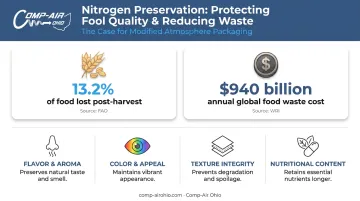
Nitrogen counters this directly. As an inert gas, it doesn't react with food compounds — it's colorless, odorless, and tasteless. By displacing oxygen in packaging or storage environments, nitrogen slows spoilage and protects what matters most:
- Flavor and aroma stability
- Color and visual appeal
- Texture and structural integrity
- Nutritional content
That spoilage problem runs at scale. According to the FAO, 13.2% of food is lost after harvest and before retail, with an additional 19% wasted at retail, food service, and household levels. The World Resources Institute estimates this waste costs the global economy $940 billion annually.
Nitrogen-based preservation is part of the solution — and it carries strong regulatory backing. Under FDA 21 CFR 184.1540, nitrogen is classified as Generally Recognized as Safe (GRAS) for direct food use, permitted as a propellant, aerating agent, and packaging gas.
It makes up roughly 78% of the air we breathe, which is why consumers and regulators accept it readily. That natural profile is a real advantage as clean-label demand grows and skepticism toward synthetic preservatives increases.
Key Applications of Nitrogen Across Food & Beverage
Nitrogen serves a different purpose at nearly every stage of production — preservation, texture, inerting, and pressure management each draw on the same gas for distinct reasons. Here's how it breaks down.
Modified Atmosphere Packaging (MAP)
MAP is the most widespread nitrogen application in food processing. Nitrogen replaces oxygen inside sealed packages , extending shelf life for meats, fish, cheese, bread, snacks, fresh produce, and ready-to-eat products. It preserves color and flavor during transport and retail display.
Nitrogen also serves a physical function: the gas fill inside snack bags (chips, crackers, popcorn) creates a protective cushion that prevents product damage during handling and shipping.
The MAP market reflects the technology's adoption: Grand View Research values the market at $16.03 billion in 2024, with projections reaching $26.18 billion by 2030 at a 7.94% CAGR. Facilities sizing nitrogen systems today should plan for packaging line growth, not just current demand.
Controlled Atmosphere Storage (CAS)
For bulk storage of fruits, vegetables, and grains, nitrogen maintains precise gas ratios that prevent over-ripening and microbial growth. UC Davis recommends 1–2% O₂ and 2–4% CO₂ for Red Delicious apple storage , with nitrogen filling the balance to hit the target atmosphere. FAO guidance on grain storage similarly uses nitrogen flushing to create oxygen-deficient environments, where many stored-grain insects perish below 2% O₂.
Beverage Production
Nitrogen plays distinct roles across different beverage categories:
- Brewing: Nitrogenation dissolves nitrogen into beer, producing the smooth, creamy texture and long-lasting head of nitro stouts and nitro coffees. Dispensing typically uses a 75% N₂ / 25% CO₂ blend, per Brewers Association guidance.
- Winemaking: Used for tank blanketing during aging, bottle purging before filling, and as a transfer gas. Winemaking: Used for tank blanketing during aging, bottle purging before filling, and as a transfer gas. Effective headspace flushing can require up to 5x the headspace volume in nitrogen, per Penn State Extension.
- Coffee: RTD nitrogen coffee production uses nitrogen-infused brite tanks, typically pressurized at 25–30 PSI.
Inerting Processes in Food Production
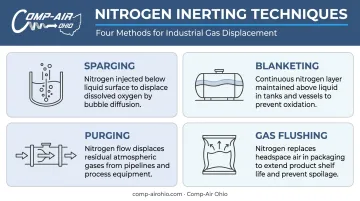
Four core techniques appear across food processing operations:
- Sparging — bubbling nitrogen through liquids (oils, juices, wine) to remove dissolved oxygen before packaging
- Blanketing — maintaining a nitrogen layer over stored ingredients, tanks, or open vessels to prevent oxygen contact
- Purging — displacing oxygen from vessels, pipelines, and process equipment before use
- Gas flushing — replacing the headspace atmosphere in packaging with nitrogen before sealing
Beyond these four, nitrogen is also used as an aerosol propellant for spray oils and creams, for silo blanketing in grain storage, and for pressure transfer of liquid and carbonated beverages — keeping product purity intact across production line movements.
How Nitrogen Generators Work: PSA vs. Membrane Technology
A nitrogen generator takes compressed air — which is approximately 78% nitrogen — and separates nitrogen from oxygen and other gases to produce a continuous on-demand supply. Two technologies accomplish this separation differently.
Pressure Swing Adsorption (PSA)
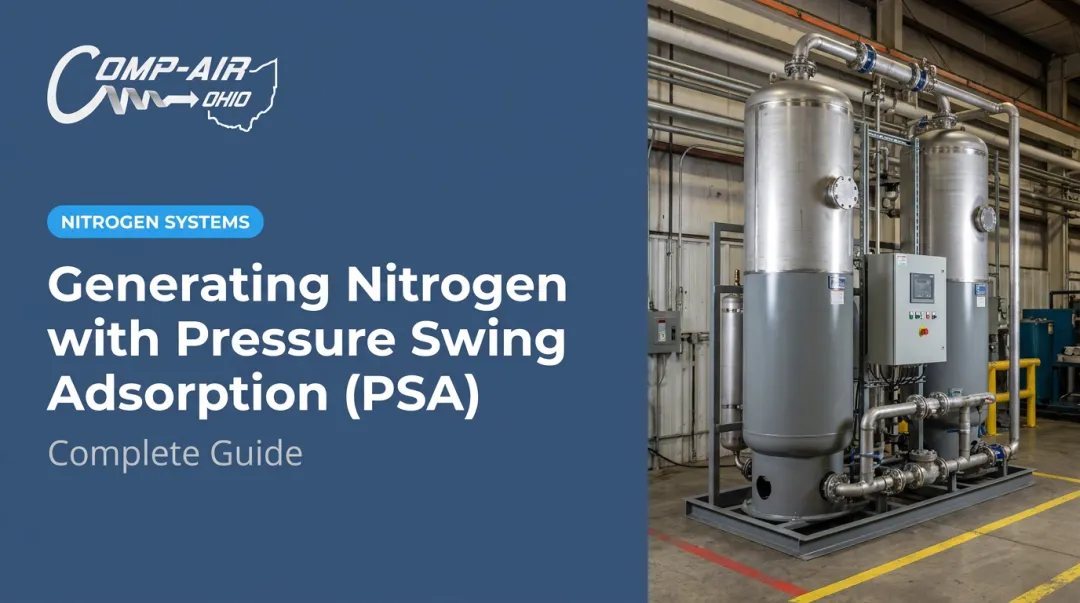
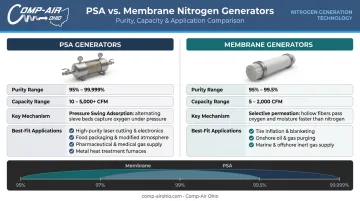
Compressed air passes through towers filled with Carbon Molecular Sieve (CMS), a material that selectively adsorbs oxygen while allowing nitrogen to pass through. The system alternates between two towers: one producing nitrogen while the other regenerates, enabling continuous output.
PSA systems reach purities up to 99.999%, making them the right choice for applications requiring very low residual oxygen. Key specs:
- Purity range: 95% to 99.999% (select configurations reach 99.9995%)
- Capacity: 15 to 2,353 CFM
- Best for: Sparging, wine blanketing, beer nitrogenation, multi-application facilities
Gardner Denver's GDN2 Series PSA generators, available through Comp-Air Ohio, come skid-mounted for straightforward facility integration.
Membrane Nitrogen Technology
Rather than adsorption, membrane systems use a bundle of hollow-fiber membranes. Oxygen, CO₂, and moisture permeate through the membrane walls and vent to atmosphere. Nitrogen — which permeates more slowly — exits into a storage receiver.
Membrane systems are more compact, have fewer moving parts, and require minimal maintenance. Key specs:
- Purity range: 95% to 99.5% (advanced configurations reach 99.9%)
- Capacity: 1 to 153 CFM
- Best for: MAP packaging lines, chip bag flushing, facilities where moderate purity is sufficient
The Gardner Denver XGN2 Series membrane generators, available through Comp-Air Ohio, cover this range in a compact footprint.
Choosing between PSA and membrane comes down to your purity target — which the table below can help clarify.
Matching Purity to Application
| Purity Range | Typical Applications |
|---|---|
| 95–99% | General MAP packaging, chip bag flushing, silo blanketing |
| 99–99.5% | Fresh meat and produce MAP, beverage dispensing blends |
| 99.5–99.999% | Wine blanketing, beer nitrogenation, sparging, process inerting |
These are guidance ranges — actual requirements vary by product, film type, and residual oxygen targets. Comp-Air Ohio can confirm the right purity specification for your application before you size a system.
On-Site Nitrogen Generation vs. Cylinder and Bulk Liquid Supply
Cost Structure Comparison
Cylinder and bulk liquid nitrogen supply carries ongoing costs that compound over time:
- Per-unit gas charges (set by third-party suppliers, subject to market fluctuations)
- Delivery fees and minimum order requirements
- Cylinder rental charges
- Labor for handling, inventory tracking, and changeouts
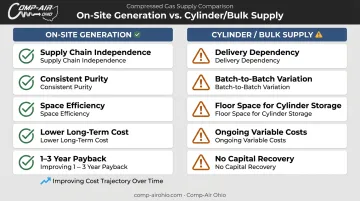
On-site generation involves higher upfront capital investment but eliminates most ongoing variable costs. The facility produces only what it needs, at the purity level required, using electricity as the primary input. Most medium-to-high-volume users recover the capital investment within one to three years, though exact payback depends on current nitrogen consumption, local delivery pricing, and electricity costs. A site-specific cost comparison with an equipment supplier gives the most accurate projection.
Three Operational Advantages Beyond Cost
Cost savings are only part of the case for on-site generation. The operational benefits matter just as much for food and beverage facilities running continuous or high-volume production.
1. Supply chain independence means no delivery windows to schedule around, no shortage risk, and no production stoppages because a truck was delayed. The facility controls its nitrogen supply entirely.
2. Consistent purity is harder to guarantee with cylinders, where batch-to-batch variation is a real risk. On-site generation produces nitrogen at a set, controllable purity level continuously — critical for applications with tight oxygen tolerances.
3. Space efficiency improves immediately once cylinders are removed from the floor. Storing full and empty units creates handling hazards and logistical overhead that on-site generators eliminate entirely.
There's also an environmental case. Regular nitrogen delivery means fuel consumption and emissions from delivery vehicles. On-site generation removes that logistics footprint — a practical sustainability win for food and beverage brands working toward carbon reduction goals.
The Role of Compressed Air Quality in Nitrogen Generation
A nitrogen generator's output quality is only as good as the compressed air feeding it. Air containing oil vapor, moisture, or particulates will contaminate the nitrogen output, compromise food safety, and degrade equipment performance over time.
For food and beverage applications, compressed air feeding a nitrogen generator must be:
- Moisture-free — even low levels of water vapor cause purity failures and shorten equipment life
- Particulate-free — contaminants degrade membrane fibers and PSA sieve beds over time
- Oil-free — any oil carryover into a food-contact nitrogen stream is a direct contamination risk
ISO 8573-1 is the governing standard for compressed air purity, classifying air quality across particles, water, and oil content. Meeting its highest tier is the baseline expectation in food and beverage environments. Gardner Denver's EnviroAire T/TVS Series compressors (available through Comp-Air Ohio) carry ISO 8573-1 Class 0 certification, independently tested and verified for 100% oil-free, silicone-free output. The EnviroAire S & ES Series (3–10 HP) is also NFPA 99 compliant, designed for applications where air purity directly affects product safety.
Required Upstream Air Treatment Components
Before compressed air reaches a nitrogen generator, it should pass through:
- A refrigerated or desiccant dryer to bring moisture down to the required dew point
- Coalescing filters to strip out oil aerosols, particulates, and residual water droplets
- An air receiver tank to buffer demand fluctuations and maintain steady inlet flow
Comp-Air Ohio supplies all of these components — including XGCY and RGD Series refrigerated dryers, ZEKS desiccant dryers down to -100°F dew point, and FIL Series coalescing filters — and can configure them as a single coordinated system upstream of the nitrogen generator.
How to Choose the Right Nitrogen Generator for Your Facility
Key Sizing Inputs
Before selecting a generator, a facility needs to establish four parameters:
- Required purity — determined by the most demanding application on the production floor
- Required flow rate — total nitrogen volume per hour across all production lines, including peak demand periods
- Compressed air supply — available inlet pressure and existing air treatment quality
- Physical constraints — available floor space, utility connections, and future expansion plans
Undersizing is the most common and costly mistake. A generator that can't keep pace with peak production demand creates line stoppages — the problem on-site generation is supposed to solve.
Technology Selection Guide
Choose membrane when:
- Required purity is 99.5% or below
- Application is MAP packaging, general flushing, or blanketing
- Simplicity and minimal maintenance are priorities
- Footprint is constrained
Choose PSA when:
- Required purity exceeds 99.5%
- Applications include beverage nitrogenation, wine blanketing, sparging, or critical inerting
- Multiple high-purity applications will be served from one system
Service and Support
Generator downtime halts production lines, so supplier reliability matters as much as equipment specs. When evaluating suppliers, look for:
- Preventive maintenance programs with documented inspection intervals
- Emergency service response for contract customers
- Access to OEM parts without long lead times
Comp-Air Ohio has served Northern Ohio as an authorized Gardner Denver distributor since 1977. For food and beverage facilities evaluating the XGN2 or GDN2 generator series, they offer maintenance plans, 24/7 emergency response for contract customers, and direct access to OEM parts.
Frequently Asked Questions
What purity level of nitrogen is required for food and beverage packaging?
General MAP packaging typically operates effectively at 95–99%+ purity. More sensitive applications — beverage nitrogenation, wine blanketing, or sparging — may require 99.5% or higher. Requirements vary by product type and residual oxygen targets, so confirm your target oxygen levels before specifying equipment.
What is the difference between PSA and membrane nitrogen generators?
PSA generators use Carbon Molecular Sieve to reach purities up to 99.999%, making them the right fit for demanding applications. Membrane generators use hollow-fiber technology and top out around 99.5% purity — simpler, more compact, and suited to lower-purity needs. The right choice comes down to your required purity and total flow volume.
How does a nitrogen generator connect to an existing facility?
Generators connect to your on-site compressed air supply and feed into a storage receiver tank before distributing to packaging or processing lines. The incoming air must be clean, dry, and oil-free to ISO 8573-1 standards — requiring properly sized dryers and coalescing filters upstream.
How long does it take for an on-site nitrogen generator to pay for itself?
High-volume users typically see payback within one to two years; lower-volume facilities may take longer. The calculation depends on current nitrogen consumption, the price paid per unit for cylinder or bulk delivery, and local electricity rates. Comp-Air Ohio can run a site-specific cost comparison using your actual consumption invoices to give you a clear payback projection.
Is nitrogen safe to use in direct contact with food and beverages?
Yes. Nitrogen is non-toxic, non-reactive, colorless, and tasteless — it makes up roughly 78% of the air we breathe. The FDA classifies it as GRAS under 21 CFR 184.1540 for food contact uses. On-site generators producing food-grade purity nitrogen are safe for direct food and beverage contact applications.
Can one nitrogen generator serve multiple production lines at once?
Yes, provided the system is correctly sized to total facility demand. A distribution manifold and receiver storage system routes nitrogen to multiple lines simultaneously. Sizing is critical: undersized systems create supply shortfalls during peak production, so peak flow requirements across all lines must be assessed before equipment selection.