The challenge is biological and chemical. When ambient air is compressed, every contaminant already present — water vapor, oil aerosols, bacteria, particulate matter — concentrates dramatically. According to BCAS technical guidance, compressing air to 7 bar g concentrates atmospheric contaminants by a factor of 8. That means every microorganism, oil droplet, and dust particle in your intake air arrives downstream in far greater concentrations than it entered.
This article covers what food-grade compressed air actually means, which standards apply (ISO 8573-1, FSMA, SQF/GFSI), where contamination enters the system, and what equipment and treatment methods keep food operations compliant.
Food manufacturers using compressed air near product — whether direct or indirect contact — must meet specific purity thresholds. Failure carries real consequences: rejected product, audit non-conformances, and potential regulatory action under FSMA.
Key Takeaways
- Food-grade compressed air controls four contamination categories: solid particles, water, oil, and microorganisms — with purity levels defined by ISO 8573-1
- Every food facility using compressed air near product must perform a HACCP-based risk assessment and document Critical Control Points
- Point-of-use sterile filtration (0.01 µm, ≥99.999% efficiency) is required at each food-contact point; compressor room filtration alone does not meet compliance
- Oil-free compressors simplify compliance by eliminating lubricant carry-over at the source
- Annual air quality testing at each food-contact point is the minimum requirement under SQF; HACCP risk assessment may require more frequent testing
What Is Food-Grade Compressed Air?
"Food-grade compressed air" isn't a single product — it's a performance standard. The term describes compressed air that has been treated to meet specific purity levels for solid particles, moisture, and oil content, as required by regulatory frameworks and industry standards bodies when used in food production environments.
The FDA doesn't use the phrase "food-grade compressed air" in its regulations, but it does regulate the substance directly. 21 CFR 117.20(g) states: "Compressed air or other gases mechanically introduced into food or used to clean food-contact surfaces or equipment must be treated in such a way that food is not contaminated with unlawful indirect food additives."
That requirement covers four primary contaminant categories that any compliant system must address:
- Solid particulates — atmospheric dust, pipe scale, rust from aging distribution systems
- Water — both liquid condensate and water vapor, which promotes microbial growth
- Oil — liquid aerosol and vapor, sourced from the compressor or atmospheric carry-over
- Viable microorganisms — bacteria and fungi concentrated during compression
Classifying Contact Risk: Direct vs. Indirect
Not all compressed air use carries the same risk, and the treatment requirements differ accordingly.
| Contact Type | Typical Applications | Treatment Requirement |
|---|---|---|
| Direct | Air-knife drying, sparging, mixing, blowing, inert gas packaging | Highest purity; strictest point-of-use controls |
| Indirect | Conveyor cleaning, pneumatic actuators, packaging manipulation | Food-grade treatment required; criteria vary by scheme and risk assessment |
| Non-contact | Equipment operation away from any food zone | Lower inherent risk, but formal risk assessment still required |
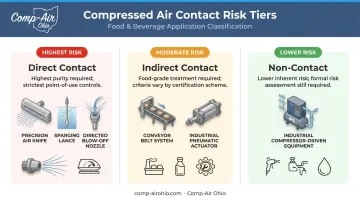
Non-contact systems are the most commonly overlooked. Leaks in distribution piping and poor system design can create unexpected exposure paths — exactly the kind of gap a formal risk assessment catches before an auditor does.
Key Standards and Regulations for Food-Grade Compressed Air
ISO 8573-1: The International Air Quality Framework
ISO 8573-1:2010 is the primary international standard for defining compressed air purity. It assigns classes to compressed air quality across three dimensions:
| Class | Solid Particles (1–5 µm) | Water (Pressure Dew Point) | Total Oil |
|---|---|---|---|
| 0 | User/supplier specified; more stringent than Class 1 | User/supplier specified | User/supplier specified |
| 1 | ≤10 per m³ | ≤ −70°C | ≤0.01 mg/m³ |
| 2 | ≤100 per m³ | ≤ −40°C | ≤0.1 mg/m³ |
| 3 | ≤1,000 per m³ | ≤ −20°C | ≤1 mg/m³ |
| 4 | ≤10,000 per m³ | ≤ +3°C | ≤5 mg/m³ |
Lower class numbers mean cleaner air. BCAS technical guidance indicates direct food and beverage contact air should meet or exceed ISO 8573-1:2010 [2:2:1] — meaning Class 2 for particles, Class 2 for water (−40°C dew point), and Class 1 for oil content.
Class 0 does not mean zero contamination. It means the specification is more stringent than Class 1 and must be defined by the user and supplier. Gardner Denver's EnviroAire and PureAire series compressors are independently certified to ISO 8573-1 Class 0 for oil content, providing the highest baseline purity before downstream filtration is applied.
Meeting those purity targets, however, is only part of the picture — U.S. regulatory frameworks determine how facilities must document and control compressed air throughout the production environment.
FSMA, HACCP, and FDA Compliance
The FDA's Food Safety Modernization Act requires covered food facilities to prepare a written food safety plan, conduct a formal hazard analysis, and establish preventive controls for identified hazards. Compressed air contact points are among the most commonly overlooked Critical Control Points in food manufacturing.
HACCP applied to compressed air means:
- Identify every point where air contacts food directly or indirectly
- Risk-assess each point for contamination potential
- Establish controls — filtration, drying, point-of-use filtration
- Document and monitor — maintain records of monitoring frequency, corrective actions, and verification
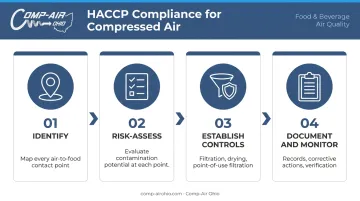
FSMA compliance is not satisfied by system design alone. Under 21 CFR Part 117, monitoring records, corrective action documentation, and verification records must be available for inspection.
SQF, GFSI, and Industry Scheme Requirements
Third-party audit schemes carry their own compressed air requirements that align with — and in some cases extend beyond — FSMA obligations.
SQF Code Edition 9, Section 11.5.5, contains two key requirements:
- Compressed air contacting food or food-contact surfaces must be clean and present no food safety risk
- Systems must be maintained, regularly monitored, and tested at minimum annually — with frequency driven by risk
GFSI-recognized schemes take similar positions:
- BRCGS Issue 9, clause 4.5.3: Compressed air in direct contact with product must be filtered at point of use
- IFS Food v8, clauses 4.9.10.1–4.9.10.2: Direct-contact compressed air must be monitored based on risk and must not pose contamination risks
- FSSC 22000: Certification requirements include ISO/TS 22002-1:2009 prerequisite programs, which address compressed air as part of infrastructure and work environment controls
ISO 8573-1 purity classes serve as the practical benchmark across these schemes, though individual audit bodies may add requirements beyond these baselines.
Common Sources of Contamination in Compressed Air Systems
Understanding where contamination enters is the first step toward controlling it. There are three distinct entry points.
Intake Air Contamination
Ambient air drawn into the compressor isn't clean — it contains atmospheric dust, water vapor, oil aerosols from nearby equipment or vehicles, and microorganisms. The EPA's Building Assessment Survey and Evaluation (BASE) study of 100 U.S. office buildings reported average outdoor bacterial concentrations of 470 CFU/m³. All of that microbial load gets compressed along with everything else, arriving downstream at significantly higher concentrations.
Compressor-Introduced Contamination
Oil-lubricated compressors introduce lubricant carry-over through normal operation and worn seals. BCAS reports that older reciprocating compressors may generate 100–200 mg/m³ of oil carry-over — far exceeding food-grade limits — while atmospheric oil vapor alone can range from 0.05 to 0.5 mg/m³ before compression.
Distribution piping adds another layer of risk. Even when upstream filtration is working correctly, aging or poorly maintained systems can introduce:
- Pipe scale and rust particles
- Particulate debris from interior pipe walls
- Condensate residue accumulating in low-drain points
Microbial Growth in the Distribution System
Air receivers, piping interiors, and condensate traps create warm, moist environments where biofilm forms and microbial populations grow rapidly. A clean test result at installation means nothing six months later if condensate management or filter maintenance has lapsed. Contamination develops over time in any inadequately maintained system — making point-of-use filtration placement and scheduled retesting non-negotiable parts of any food-grade compressed air program.
Achieving Food-Grade Air Quality: Equipment and Treatment Methods
Compressor Selection: Oil-Free vs. Oil-Injected
The compressor you select determines how much treatment burden falls on the downstream system.
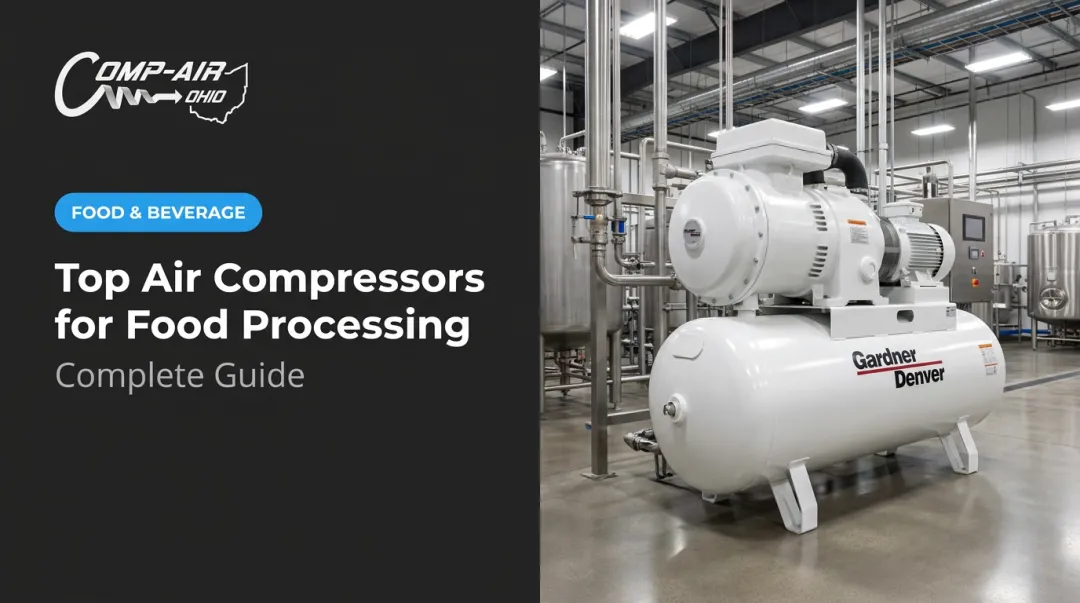
Oil-free compressors — scroll, centrifugal, or oil-free rotary screw designs like Gardner Denver's EnviroAire and PureAir series — eliminate lubricant carry-over from the compression chamber entirely. Certified to ISO 8573-1 Class 0 for oil content, these units are purpose-built for industries where even trace oil contamination is unacceptable. Comp-Air Ohio stocks the full lineup for Northern Ohio food and beverage manufacturers:
- EnviroAire S & ES Series (3–10 HP)
- EnviroAire VS Series (15–37 kW)
- EnviroAire T/TVS Series (37–74 kW)
- PureAir T/TVS Series (90–355 kW)
Oil-injected compressors remain viable in food environments when paired with properly designed multi-stage downstream filtration. The compliance burden increases significantly, though — worn seals or overloaded filter elements create real liability.
If oil-injected equipment is in use, specifying an NSF H1-certified lubricant adds a critical safety layer in the event of filter breakthrough. Gardner Denver's AEON 6000FG and AEON 9000FG are both USDA H1 authorized for exactly this scenario.
Multi-Stage Filtration and Drying
Even with an oil-free compressor, food-contact applications require a complete filtration sequence:
| Stage | Filter Type | Purpose |
|---|---|---|
| Stage 1 | Coalescing pre-filter (1 µm) | Remove bulk liquid, coarse particulates |
| Stage 2 | High-efficiency coalescing filter (0.01 µm) | Remove fine oil aerosols and particulates |
| Stage 2B | Activated carbon filter (0.01 µm, 0.003 ppm oil) | Adsorb oil vapor and odors |
| Stage 3 | Point-of-use sterile/bacterial filter (0.01 µm, ≥99.999%) | Final microbial barrier at food contact point |
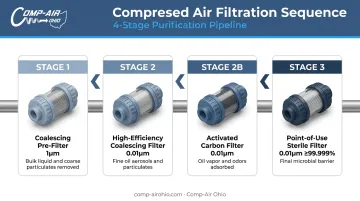
Industry guidance from Parker and Food Safety Magazine specifies 0.01 µm at ≥99.999% efficiency as the recommended sterile filtration specification for food-contact applications.
Point-of-use filtration is not optional. BRCGS Issue 9 clause 4.5.3 explicitly requires it. Biofilm can develop in distribution piping between the compressor room and the point of use. Excellent upstream filtration provides no guarantee at the food contact point — a final filter must be installed as close to the use point as possible.
Drying requirements depend on the application:
- Refrigerated dryers achieve approximately +3°C pressure dew point (ISO Class 4) — adequate for non-contact applications only
- Desiccant dryers achieve −40°C pressure dew point (ISO Class 2) — required for direct or indirect food-contact air, as this dew point inhibits microbial growth in the distribution system
Comp-Air Ohio carries ZEKS Eclipse desiccant dryers from 20 to 8,000 SCFM, available in three regeneration configurations:
- Heatless (ZPB)
- Heated (ZHA)
- Heated blower (ZBA)
All models deliver the −40°F (−40°C) dew point required for food-contact air systems.
Building a Compressed Air Compliance Program
A compliant compressed air system at installation is not the same as a compliant system six months into production. Ongoing compliance requires structured programs, not just good equipment.
Core Program Components
- Air quality testing at each food-contact CCP — minimum annually per SQF, with frequency driven by HACCP risk assessment and historical results
- Filter element replacement on manufacturer-specified schedules (ZEKS Grade A activated carbon elements require replacement at 6 months or 4,000 hours, whichever comes first)
- Dryer performance verification — checking that dew point targets are being achieved, not just that the dryer is operational
- Sterile filter integrity validation — verifying filter elements haven't been compromised by pressure surges or improper installation
Documentation for Audit Readiness
Auditors under FSMA, SQF, BRCGS, and GFSI schemes will look for records, not just equipment. Your documentation package should include:
- Maintenance logs with dates and technician records
- Air quality test results with sampling method notation (ISO 8573 analytical protocols)
- Differential pressure readings across filter stages
- Corrective action records when results fall outside specification
- Staff training documentation
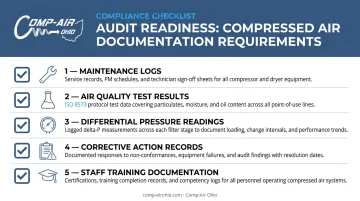
These records aren't optional. Under 21 CFR Part 117, monitoring records, verification records, and corrective action documentation are required components of your food safety plan — and the requirement applies to every CCP in your hazard analysis, including compressed air.
Comp-Air Ohio works with Northern Ohio food manufacturers on system design, oil-free Gardner Denver compressors, ZEKS desiccant dryers, and ZEKS multi-grade filtration packages. Facilities that engage a compressed air specialist at the design phase typically avoid the documentation gaps that surface during audits — gaps that are far more difficult and costly to close after a system is already running.
Frequently Asked Questions
Is compressed air safe for use in food processing?
Yes, when properly treated to meet applicable purity standards. Untreated compressed air is never inherently food-safe: compression concentrates atmospheric contaminants by a factor of 8, so bacteria, oil aerosols, and moisture arrive downstream at far higher concentrations than they entered the compressor.
What are the OSHA regulations for compressed air in food processing?
OSHA's primary compressed air regulation, 29 CFR 1910.242(b), focuses on worker safety — specifically limiting cleaning air pressure to under 30 PSI with chip guarding. Food safety purity requirements come separately from the FDA under FSMA and 21 CFR Part 117, which mandate hazard analysis and preventive controls for compressed air as a potential contamination source.
What is ISO 8573 and how does it define compressed air quality?
ISO 8573-1:2010 assigns purity classes to compressed air based on limits for solid particles, water content (pressure dew point), and total oil (aerosol plus vapor). Lower class numbers indicate cleaner air. For direct food-contact applications, BCAS guidance supports targeting Class [2:2:1] — Class 2 for particles and water, Class 1 for oil.
What is BS EN 12021 and how does it relate to food-grade compressed air?
BS EN 12021:2014 is a British/European standard for compressed gases used in respiratory protective equipment. It is not a food-industry standard and should not replace ISO 8573-1 or FSMA requirements for US facilities, though it occasionally appears in food-grade air discussions as a benchmark for very high air quality.
Do I need an oil-free compressor for food-grade compressed air?
Oil-free compressors are strongly recommended because they eliminate lubricant carry-over at the source. Oil-injected compressors can be used with validated multi-stage filtration, but the compliance burden is higher and the risk of carry-over from worn seals or saturated filters creates liability that oil-free systems avoid.
How often should compressed air be tested in food processing facilities?
SQF Code Edition 9 requires testing at minimum once per year. Many GFSI audit programs and risk-based HACCP approaches recommend more frequent testing at high-risk direct-contact points. The testing frequency for your facility should ultimately be driven by your HACCP risk assessment, not just by the minimum scheme requirement.