For industries like pharmaceutical manufacturing, food processing, and semiconductor production, this question carries real weight. Compressed air downtime doesn't just slow production — it can compromise product integrity and regulatory standing. Unplanned downtime can cost industrial operations up to $260,000 per hour, making capital investment decisions around compressor selection and maintenance genuinely consequential.
This guide covers lifespan benchmarks by compressor type, the factors that shorten or extend service life, practical maintenance strategies, and the warning signs that a replacement decision is overdue.
Key Takeaways
- Expected lifespan varies widely by design — scroll compressors need airend overhaul around 20,000 hours, while rotary vane units can exceed 100,000 hours
- Never run an undersized unit at maximum load: duty cycle mismatches are the fastest path to premature failure
- Air leaks waste 20%–30% of compressor output, accelerating wear and raising energy costs
- ISO 8573-1 Class 0 certification is the air quality benchmark for regulated industries — verify that any unit you're evaluating actually carries it
- Proactive maintenance separates a 10-year compressor from a 20-year one — reactive repair almost always costs more in the long run
How Long Do Oil-Free Air Compressors Last?
Lifespan is best measured two ways: operating hours and calendar years. Both matter, but they tell different stories. A compressor running 8 hours a day accumulates wear at roughly a third the rate of one running continuously around the clock. A unit showing modest calendar age might actually have far more hours on it than expected.
Piston (Reciprocating) Oil-Free Compressors
Piston compressors are common in smaller installations and intermittent-use settings. Without oil to buffer friction between moving parts, they experience higher thermal stress on cylinders and seals — making maintenance discipline especially critical.
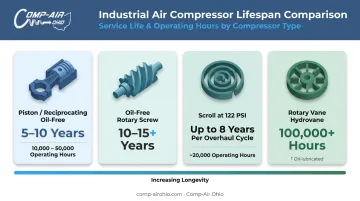
Typical lifespan estimates range from 5–10 years or 10,000–50,000 hours under normal operating conditions, with the lower end reflecting continuous heavy-duty use. Applications with frequent start-stop cycling or high ambient temperatures tend to land closer to the lower end; well-maintained units in controlled environments routinely exceed it.
Rotary Screw Oil-Free Compressors
Oil-free rotary screw compressors are built for industrial continuous-duty environments. They're preferred where steady, high-volume output is non-negotiable. Their airend components — rotors, seals, and bearings — have defined service intervals that must be observed to reach target lifespans of 10–15 years or more.
Gardner Denver's EnviroAire T/TVS and PureAir series represent this category well. Both carry ISO 8573-1 Class 0 certification and are designed for 24/7 operation in pharmaceutical, food and beverage, and electronics manufacturing. Key durability features of the PureAir series include:
- RotorArmor airend coating that bonds chemically and mechanically to rotor surfaces
- Resistance to efficiency loss — conventional soft-layer PTFE coatings degrade by 10%+ over time; RotorArmor does not
- Continuous-duty design built specifically for demanding production environments
Scroll and Rotary Vane Oil-Free Compressors
Scroll compressors operate quietly and with lower mechanical stress, making them well-suited for labs, dental facilities, and medical settings. Verified maintenance data from Compressed Air Best Practices gives a clear picture of their service requirements:
| Service Event | At 122 PSI | At 145 PSI |
|---|---|---|
| Routine maintenance | Every 2,500 hours | Every 2,500 hours |
| Scroll-head service | Every 10,000 hrs / 4 years | Every 5,000 hrs / 2 years |
| Full overhaul | Every 20,000 hrs / 8 years | Every 15,000 hrs / 6 years |
Higher operating pressure compresses the service timeline considerably — a useful reminder that pressure ratings aren't just specifications, they directly affect how long the equipment lasts.
Scroll compressors represent solid longevity for low-pressure applications — but rotary vane technology operates in a different league entirely when it comes to service life. Gardner Denver's Hydrovane line is documented to achieve up to 100,000+ operating hours with no airend change or refurbishment required — a figure backed by their official product specifications. This exceptional durability comes from the design's slow-speed operation (1,760 rpm direct drive), fewer moving parts, and the characteristic that the technology "wears in — not out" as components bed within the rotor-stator unit over time. These are oil-lubricated vane compressors, not oil-free — but the 100,000-hour benchmark provides useful reference context when evaluating any compressor's long-term lifespan potential.
Quick comparison:
| Type | Approximate Lifespan |
|---|---|
| Piston/reciprocating oil-free | 5–10 years |
| Oil-free rotary screw | 10–15+ years |
| Scroll (at 122 PSI) | Up to 8 years per overhaul cycle |
| Rotary vane (Hydrovane) | 100,000+ hours (oil-lubricated) |
Key Factors That Affect Oil-Free Compressor Lifespan
Usage Intensity and Duty Cycle
Running a compressor at or near its maximum rated duty cycle continuously accelerates wear faster than almost any other single factor. Heat builds up in the compression chamber, seals degrade faster, and thermal cycling stresses internal components with every start and stop.
The fix isn't complicated: match compressor size to your actual air demand. An undersized unit running flat out will fail years earlier than a properly sized unit operating at 70–80% capacity. Scroll compressor data makes this concrete — operating at 145 PSI rather than 122 PSI cuts the scroll-head service interval in half.
Maintenance Quality and Frequency
Oil-free compressors are often called low-maintenance, and in some ways that's accurate: no oil changes, no separator element replacements in most designs, no oil disposal. What they do require is consistent attention to the components that compensate for having no lubrication at all.
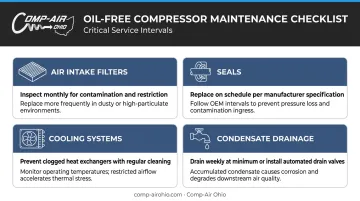
Critical items to keep on schedule:
- Air intake filters — inspect monthly at minimum; replace more frequently in dusty or high-particulate environments
- Seals — plan replacements as scheduled events, not reactive responses; intervals vary by design and application intensity
- Cooling systems — reduced airflow from clogged heat exchangers is a primary cause of overheating failures
- Condensate drainage — weekly at minimum, or automated with drain valves
In oil-lubricated designs, the lubricant absorbs some of the damage from contamination and heat. Without it, skipped maintenance translates directly into accelerated wear.
Operating Environment
Ambient conditions affect compressor longevity directly. Most oil-free rotary screw compressors are rated for standard operation up to 40°C (104°F), with high-ambient variants extending to 50°C (122°F). Manufacturer service data consistently identifies dirty or blocked intake filters as a leading cause of overheating failures.
Environments that shorten compressor life:
- High ambient temperatures (above 40°C without appropriate cooling)
- Dusty or high-particulate surroundings without adequate pre-filtration
- High humidity without downstream drying equipment
- Poor ventilation restricting heat dissipation
A compressor in a clean, temperature-controlled facility will consistently outperform one in a hot, dusty production environment, regardless of the unit's inherent quality.
Build Quality and System Design
Premium engineering directly translates to longer service intervals. Relevant quality indicators to evaluate:
- ISO 9001 certification — verifies the manufacturer follows controlled, audited production processes that reduce unit-to-unit variability
- ISO 8573-1 Class 0 certification — the highest air purity classification; confirms the unit has been tested to deliver zero detectable oil content, not just rated for it
- Proprietary airend protection (such as Gardner Denver's RotorArmor coating) — maintains efficiency over time rather than degrading
- Properly sized downstream equipment — undersized piping creates pressure drop, inadequate drying equipment accelerates moisture-related wear, and missing filtration lets contaminants reach the compressor
System design is often underestimated. Even an excellent compressor fails prematurely when installed into a poorly designed compressed air system.
How to Maximize the Lifespan of Your Oil-Free Air Compressor
Proactive, scheduled maintenance is the single variable most within a facility manager's control. A well-maintained oil-free compressor can exceed its rated service life; a neglected one can fail years early.
Documenting all service activities creates a service history that supports warranty claims — particularly relevant for units covered under Gardner Denver's Platinum 10-Year Extended Warranty, which requires on-schedule maintenance to remain valid.
Routine Maintenance Tasks
Air intake filter — inspect and replace on schedule The intake filter is the first line of defense against contaminants entering the compression chamber. In oil-free designs, there's no oil to buffer particulate ingestion — contamination reaches internal components directly. Inspect monthly; replace more frequently in dusty environments. Gardner Denver's EnviroAire series uses a 99.5% efficient 3-micron heavy-duty filter element, but even high-quality filters lose effectiveness without consistent monitoring.
Receiver tank drainage — manage moisture actively Moisture accumulates in receiver tanks as a natural byproduct of compression. Left undrained, it causes internal corrosion, contaminates the air supply, and reduces effective storage capacity. For food and beverage or pharmaceutical applications, undrained moisture creates compliance exposure, not just a maintenance issue. Install auto-drain valves where possible — CAGI notes that automating condensate removal improves system reliability and reduces the risk of harmful liquid carryover.
Leak detection — survey regularly and repair promptly Air leaks are a significant and often underestimated drain on compressor lifespan. The U.S. Department of Energy reports that leaks typically waste 20%–30% of compressor output in industrial systems, with a cost-effective management target of 5%–10% of total system flow. Beyond energy waste, leaks force the compressor to run longer and cycle more frequently — directly accelerating component wear and shortening service life.
Component-Level Preventive Maintenance
Seal inspection and replacement — treat as a scheduled event Seals are among the highest-wear items in oil-free compressors. They compensate for the absence of lubricant between moving parts and experience thermal expansion stress with every operating cycle. Plan seal replacements per manufacturer specification — waiting for failure typically means extended downtime and potential cascade damage to adjacent components.
Remote monitoring and predictive alerts Gardner Denver's iConn platform, standard on PureAir T/TVS and Electra TS/TSV series compressors, provides real-time visibility into equipment performance with proactive alerts before problems escalate. Rather than discovering a pressure anomaly or temperature excursion during production, facility teams can act on data and schedule maintenance during planned downtime — before a minor fault becomes an unplanned shutdown.
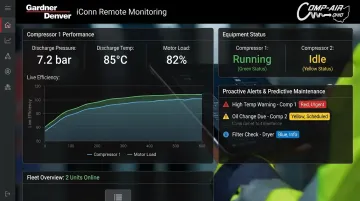
For operations in regulated industries, this predictive capability directly reduces the compliance risk that comes with unexpected equipment failures.
Warning Signs Your Oil-Free Compressor Needs Replacement
Increased Noise and Vibration
Unusual grinding, rattling, or knocking sounds indicate worn internal components — bearings, pistons, or rotors nearing end-of-life. These are structural failures, not maintenance items. When abnormal noise persists after inspecting obvious causes, the repair cost conversation typically becomes a replacement cost conversation.
Declining Efficiency and Higher Energy Consumption
As internal components wear, a compressor works harder to maintain the same output pressure. This shows up as:
- Longer cycle times to reach set pressure
- Inability to hold pressure under demand
- Rising electricity bills without changes in production volume
The energy penalty of a worn compressor compounds over time. Combined with increasing repair frequency, the operating cost of an aging unit often far exceeds what a new, efficient replacement would cost annually.
Repair Frequency and the Replacement Decision
There's no single threshold that makes replacement the clear choice, but several signals point in that direction:
- Repair costs are accumulating at a significant rate relative to what a new unit would cost
- The airend itself requires a full rebuild — airend replacements are expensive and restore only partial useful life
- The unit can no longer meet air quality standards — a direct compliance risk in pharmaceutical, food processing, or semiconductor environments where ISO 8573-1 Class 0 certification is required
CAGI's framework for end-of-life decisions includes maintenance cost trajectory, downtime frequency, parts availability, overhaul risk, and system capacity needs — a more complete picture than any single metric. When multiple factors align unfavorably, replacement is the economically sound choice.
Oil-Free vs. Oil-Lubricated Compressors: Which Lasts Longer?
Oil-lubricated rotary screw compressors can achieve longer raw operating hours with proper maintenance — oil provides constant lubrication that buffers internal wear. Oil-free models face higher thermal and mechanical stress on seals and rotors in the absence of that lubricant.
That comparison, however, understates what oil-lubricated systems require to reach those hours:
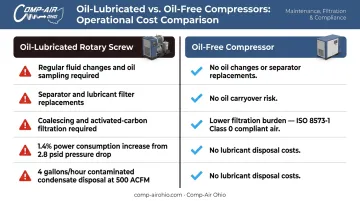
- Regular fluid changes, top-offs, and oil sampling
- Separator elements, in-line lubricant filters, and control-line filters
- Coalescing and activated-carbon filtration to manage oil carryover (typically 3–4 ppm or more from oil-injected compressors)
- A 2.8 psid filtration pressure drop that raises power consumption by approximately 1.4%
- At 500 ACFM, 4 gallons per hour of lubricant-contaminated condensate requiring compliant disposal
All of that adds cost, complexity, and operational risk — particularly oil carryover risk. A 2025 case documented by Fluid Power World found lubricant contamination downstream of dryer and filtration on a lightly loaded oil-lubricated VSD screw compressor, underscoring that even well-maintained systems aren't immune.
For industries where clean air is a regulatory requirement — pharmaceutical, food processing, semiconductor manufacturing — the lifespan comparison becomes secondary. A properly maintained oil-free compressor certified to ISO 8573-1 Class 0 is the only specification that eliminates oil contamination risk at the source.
Gardner Denver's EnviroAire and PureAir series carry this Class 0 certification with third-party verification, meaning the air quality claim reflects a tested result rather than a design target.
Frequently Asked Questions
How reliable are oil-free air compressors?
Modern industrial oil-free compressors are highly reliable when properly maintained. Advances in seal materials, airend coatings, and thermal management have meaningfully improved durability over older designs. Reliability depends most on matching the compressor type and capacity to the application's actual duty cycle demands.
How many hours do oil-free air compressors last?
Lifespan varies by compressor type. Piston/reciprocating models typically run 10,000–50,000 hours; rotary screw designs are built for longer continuous service; scroll compressors generally reach overhaul intervals around 15,000–20,000 hours depending on operating pressure. Where any unit actually lands within its range comes down to maintenance consistency.
Do oil-free air compressors require more maintenance than oil-lubricated ones?
Overall, oil-free compressors require less maintenance — no oil changes, no separator replacements in most designs, no oil disposal. However, their seals and intake filters are high-wear items that need scheduled attention. Neglecting these components leads to premature failure faster than in oil-lubricated models, because there's no lubricant absorbing the effects of contamination or thermal stress.
What are the most common reasons oil-free compressors fail early?
The most frequent causes include operating in hot or dusty environments without adequate filtration, running the unit beyond its rated duty cycle, and delaying seal replacements past manufacturer intervals. Persistent air leaks are also a common culprit — forcing the compressor to run harder than designed just to hold system pressure.
How does operating environment affect oil-free compressor lifespan?
Ambient temperature, humidity, and airborne particulates directly affect longevity. Compressors operating in clean, temperature-controlled spaces (within the 40°C standard ambient limit for most industrial models) consistently outlast those in hot, humid, or dusty conditions. Proper ventilation, pre-filtration, and downstream drying equipment each extend service life — and in demanding environments, they're what separates a 10-year machine from a 5-year one.
When should I replace rather than repair an oil-free air compressor?
Consider replacement when repair costs are climbing toward a significant share of new equipment cost, when the airend needs a full rebuild, or when the unit can no longer meet your air quality standards. In regulated industries, compliance risk from aging equipment is reason enough to act.