For most coffee businesses, that nitrogen still arrives in cylinders. It gets scheduled, delivered, stored, tracked — and occasionally runs out at the worst possible moment. This guide walks through why nitrogen matters across every major coffee application, how on-site generators work, and what to evaluate before choosing one.
Key Takeaways
- Nitrogen serves five distinct coffee applications — dispensing, packaging, pod production, cold brew preservation, and distribution
- PSA generators achieve up to 99.999% purity; membrane generators top out around 99.5%
- A single nitro tap needs roughly 5–10 SCFH; a packaging line may need 200+ SCFH
- Medium-to-high-volume operations typically recover generator costs within 12–14 months
- Upstream compressed air quality directly determines nitrogen purity output; the compressor is an integral part of the system
Why Coffee Businesses Need Nitrogen: Use Cases Explained
Nitrogen isn't a single-use ingredient. Depending on your operation, it may be doing several jobs simultaneously.
Nitro Cold Brew Dispensing
This is the most visible use. Nitrogen is pushed through a restrictor plate, creating cascading microbubbles that produce a creamy head and velvety mouthfeel — without dairy or sweeteners. The gas also suppresses perceived bitterness, which is why nitro cold brew tastes smoother than the same concentrate served flat.
Coffee Packaging and Shelf Life
Nitrogen flushes oxygen from bags before sealing, halting oxidation at the source. Research cited in a Specialty Coffee Association shelf-life literature review found nitrogen-flushed coffee maintained acceptable sensory quality for six months — compared to weeks in air-packaged formats.
A Clemson University study reinforced this: modified-atmosphere packaging can extend shelf life from 2–12 weeks under normal conditions to 20–52 weeks. Valve-sealed bags, cans, and multi-serve containers all benefit from this approach.
K-Cup and Single-Serve Pod Production
Nitrogen inerting inside single-serve pods prevents flavor degradation during transport and extended retail shelf life. Companies like Pod Pack openly advertise nitrogen-flushed filter packs as standard. For boutique roasters launching DTC subscription pods, nitrogen flushing directly determines whether pods arrive fresh or oxidized.
Cold Brew and In-Transit Preservation
Beyond the tap, nitrogen protects coffee at two other vulnerable points in the supply chain:
- Cold brew storage: Nitrogen blanketing on kegs and holding vessels prevents oxidation between brew cycles, maintaining consistency across batches
- Wholesale and export shipping: Roasters distributing at volume use nitrogen to preserve bean quality during transit, before the coffee ever reaches a café
How a Nitrogen Generator Works
Ambient air is roughly 78% nitrogen — meaning the raw material is unlimited and free. Generators extract it continuously using one of two technologies.
PSA (Pressure Swing Adsorption)
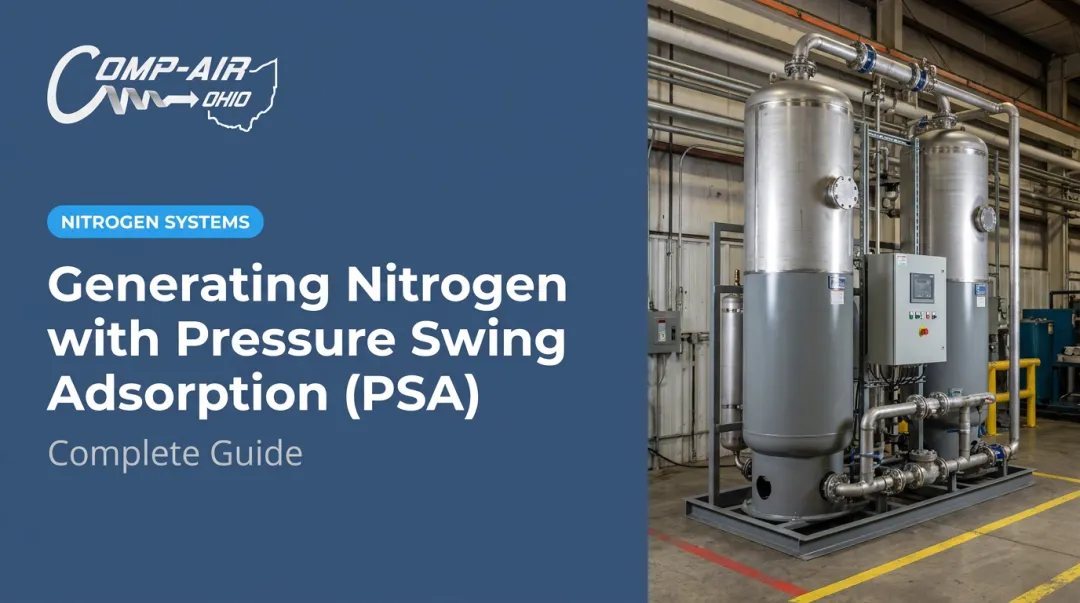
Compressed air passes through towers packed with Carbon Molecular Sieve (CMS) media. CMS selectively adsorbs oxygen and other gases while nitrogen passes through. Dual-bed cycling keeps output continuous: one tower adsorbs while the other regenerates.
PSA systems can achieve purity levels from 95% to 99.999%, which covers everything from nitrogen-flushed packaging lines to modified atmosphere applications in coffee.
Upstream air quality directly affects CMS longevity and purity output. Dust, oil, and moisture in the feed air degrade the adsorbent media over time — so proper filtration and drying upstream isn't optional.
Membrane Separation
Compressed air flows through hollow fiber membrane bundles. Oxygen and moisture permeate through the membrane walls faster than nitrogen, allowing nitrogen-enriched gas to exit the other end.
Membrane systems are simpler mechanically — fewer moving parts, smaller footprint, lower upfront cost. The trade-off is a purity ceiling of roughly 95%–99.5%, which is sufficient for cold brew dispensing but may fall short of packaging requirements.
At a glance, here's how the two technologies compare for coffee applications:
| PSA | Membrane | |
|---|---|---|
| Purity range | 95%–99.999% | 95%–99.5% |
| Best for | Packaging, high-purity use | Cold brew dispensing, taps |
| Footprint | Moderate | Compact |
| Moving parts | More (valve cycling) | Fewer |
| Upfront cost | Higher | Lower |
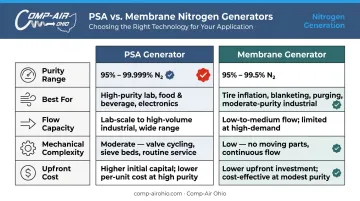
Understanding how each technology performs sets the foundation for matching the right generator to your specific coffee application.
PSA vs. Membrane Nitrogen Generators: Which Is Right for Your Coffee Business?
Choosing between these technologies comes down to purity requirements, flow volumes, and budget — not just price.
| Factor | PSA | Membrane |
|---|---|---|
| Purity range | 95%–99.999% | 95%–99.5% |
| Best for | Packaging, K-cup, high-volume dispensing | Single/multi-tap cold brew dispensing |
| Flow capacity | Higher (scales with modular columns) | Lower-to-mid volume |
| Mechanical complexity | More complex | Simpler — no moving parts beyond compressor |
| Upfront cost | Higher | Lower |
PSA generators are the right call when packaging applications require low residual oxygen, or when you're running extended production shifts across multiple lines. They're modular — capacity can be added as production grows.
For a café running one or two nitro taps, membrane generators are the practical choice — 99.5% purity is sufficient, and there are no moving parts beyond the compressor to worry about.
Both options are available through Comp-Air Ohio via Gardner Denver's XGN2 Series (membrane, 1–153 CFM, 95–99.5% purity) and GDN2 Series (PSA, 15–2,353 CFM, up to 99.999% purity) — with skid-mounted PSA designs available for straightforward installation.
Match the technology to your purity requirement, not your initial budget. Underspecifying purity for a packaging operation creates quality problems that cost more than the savings.
Nitrogen Generator vs. Nitrogen Tank: The Business Case
Tanks are low commitment, low initial investment, and perfectly reasonable for a startup or very low-volume café. But the economics shift decisively once nitrogen consumption reaches a meaningful daily volume.
The Real Cost of Tank Dependency
- Monthly cylinder rental fees accumulate whether you use the nitrogen or not
- Gas costs scale directly with production — every additional keg or packaging run adds to the bill
- Delivery surcharges and distance-based pricing create overhead you can't control
- Stockouts during peak production halt packaging lines or pull your highest-margin menu item
As output grows, those costs compound. Once a generator is installed, producing more nitrogen costs you almost nothing extra.
Supply Reliability
Running out of nitrogen mid-shift isn't a minor inconvenience. For a packaging line, it halts production. For a café, it pulls the highest-margin item off the menu entirely. Generators produce nitrogen continuously and on-demand, so stockouts aren't a scenario you plan around anymore.
That reliability also matters for scheduling — no deliveries to coordinate, no checking tank levels before a busy weekend.
Space and Logistics
Cylinders require dedicated storage space, climate controls, and a reliable delivery schedule. On-site generators fit into existing utility spaces and remove that coordination layer entirely:
- No storage room dedicated to cylinder rotation
- No delivery windows to manage or reschedule
- No last-minute emergency orders during high-volume periods
The ROI Reality
Manufacturers commonly cite payback periods of 12–14 months for food and beverage operations — this is a vendor-supplied figure, not an independent audit, and actual timelines depend on:
- Current monthly nitrogen spend (calculate this first)
- Daily consumption volume and purity requirements
- Electricity and compressor operating costs
- Delivery fees and rental charges at your current supplier
A useful starting exercise: pull your last three months of nitrogen invoices and calculate a monthly average. That number is your baseline for any generator ROI conversation.
Key Specs to Evaluate When Choosing a Nitrogen Generator
Purity Requirements by Application
| Application | Minimum Purity |
|---|---|
| Nitro cold brew dispensing | 99.5%+ |
| Whole bean / ground coffee packaging | 99.5%–99.9% |
| K-cup and single-serve pod flushing | 99.9%+ |
| Cold brew keg blanketing | 99.5%+ |
Even trace residual oxygen accelerates oxidation — degradation becomes measurable below 99.5% purity, which is why pod and single-serve applications demand the tightest spec.
Flow Rate Sizing
Flow rate is the spec most commonly undersized. Match it to your peak simultaneous demand, not your average daily volume.
| Operation Type | Approximate Flow Need |
|---|---|
| Single nitro cold brew tap | 5–10 SCFH |
| Multi-tap café (2–4 taps) | 14–20 SCFH |
| Small roaster / single bag line | 50–200 SCFH |
| Mid-size specialty roaster (1–3 lines) | 200–1,500 SCFH |
| Large commercial roaster / pod filler | 5,000–20,000+ SCFH |
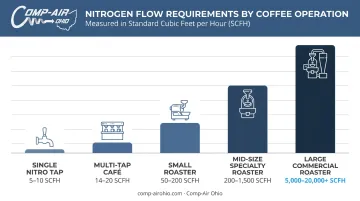
Source: Beverage Factory nitrogen generator sizing guide
Pressure Output
Nitro cold brew systems typically operate at 30–45 PSI. Packaging equipment has its own inlet pressure specification. Confirm your dispensing or packaging equipment's required inlet pressure before finalizing generator selection. A mismatch often requires a separate pressure regulator, adding cost and complexity.
Energy Consumption
Energy draw varies significantly between generator types. PSA systems cycle compressors continuously and can consume 0.5–1.5 kWh per 100 SCFH of nitrogen produced during extended production shifts. Membrane generators draw less power at equivalent flow rates but sacrifice purity ceiling.
For facilities running 8–16 hour shifts, electricity cost can add $1,500–$4,000 annually to operating expenses depending on local rates and generator sizing. Factor this into your total cost of ownership comparison, not just the purchase price.
Safety, Maintenance, and Air Quality Considerations
Nitrogen Safety
Nitrogen is non-toxic, inert, tasteless, and FDA-approved as GRAS (Generally Recognized as Safe) for direct food contact under 21 CFR 184.1540. It's safe for coffee applications at any purity level.
The one genuine hazard: as a colorless, odorless gas, nitrogen can displace oxygen in enclosed spaces. OSHA identifies atmospheres below 19.5% oxygen as oxygen-deficient. Install oxygen deficiency monitors in any enclosed room where nitrogen is generated or stored, and ensure adequate ventilation.
Maintenance Requirements
Deferred maintenance directly degrades nitrogen purity — which means it directly degrades product quality.
- PSA generators: Filter changes every 6–12 months; CMS media typically loses 2–5% per year and may need a 10–15% top-off every 3–5 years
- Membrane generators: Primarily air filter maintenance; Parker Balston documentation calls for filter cartridge replacement every 6 months and bi-weekly oxygen analyzer calibration
Upstream Compressed Air Quality
A nitrogen generator performs only as well as the air fed into it. For food-grade applications, compressed air must meet ISO 8573-1 standards for particulates, moisture, and oil content — Class 2 or better for food-contact uses.
That makes the upstream compressor and air treatment package foundational components, not afterthoughts. A properly specified system should include:
- A rotary screw or reciprocating compressor sized to your peak nitrogen demand
- A refrigerated or desiccant dryer to control moisture to ISO 8573-1 levels
- Multi-stage filtration to remove oil aerosols and particulates before they reach the generator
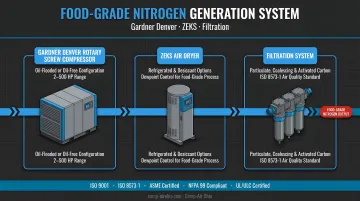
Comp-Air Ohio supplies Gardner Denver compressors paired with ZEKS dryers and filtration packages configured specifically for food-grade compressed air requirements — protecting CMS media in PSA systems and ensuring consistent nitrogen output for coffee production.
Frequently Asked Questions
Is nitrogen (N2) safe to use in coffee?
Yes. Nitrogen is an inert, tasteless, odorless gas that makes up 78% of the air we breathe. The FDA classifies it as GRAS for direct food use under 21 CFR 184.1540, and it's widely used across food and beverage production.
What is considered high-purity nitrogen for coffee?
High-purity nitrogen for coffee is generally 99.5%+ for dispensing and 99.9%+ for packaging applications. Purity refers to nitrogen concentration — residual oxygen is the primary contaminant to minimize, since even trace amounts accelerate oxidation.
Does nitrogen make coffee stronger?
No. Nitrogen affects texture and mouthfeel, not caffeine content or chemical composition. Any perceived strength difference comes from the brew method — cold brew ratios, grind size — not the nitrogen itself.
What is the difference between PSA and membrane nitrogen generators for coffee?
PSA generators achieve up to 99.999% purity and suit high-volume packaging and production operations. Membrane generators are simpler and lower-cost but top out around 99.5% purity, making them a practical choice for single- or multi-tap cold brew dispensing.
How long does it take for a nitrogen generator to pay for itself?
Most food and beverage operations recoup the investment in 12–14 months, though the timeline varies based on nitrogen spend, delivery costs, consumption volume, and electricity costs. Start by calculating your current monthly tank spend — that number drives the payback math.
Do I need a special air compressor to run a nitrogen generator?
You need a compressor sized for adequate feed air volume and pressure, and the compressed air must meet food-grade purity standards (ISO 8573-1). Compressor selection, dryer specification, and filtration are all integral parts of the system, not afterthoughts.